The pascal (Pa) is the SI unit of pressure and stress, defined as one newton per square meter. It quantifies how much force is distributed over a given area. In biomechanics, it is used to measure shear stress on arterial walls—the tangential force per unit area exerted by blood flow—which is critical for understanding cardiovascular health, as abnormal shear stress is linked to atherosclerosis and aneurysm formation.
History
The unit was named after Blaise Pascal, the 17th-century French mathematician and physicist, and was adopted as the SI unit in 1971.
How it works
Pressure or stress is calculated as force divided by area: p = F/A. One pascal is a relatively small amount—about the pressure exerted by a dollar bill resting flat on a table. In arteries, shear stress values typically range from 0.5 to 5 Pa, depending on vessel location and flow conditions. These values are derived from fluid dynamics equations (like the Navier–Stokes equations) applied to blood flow, often using computational models.
In practice
Used in cardiovascular research to assess arterial health, in engineering to design pressure vessels, and in meteorology (though hectopascals are more common for atmospheric pressure).
Fun fact
A typical blood pressure reading of 120/80 mmHg corresponds to about 16,000/10,700 Pa—far larger than the shear stresses that matter for arterial wall biology.
Systems:SIPressure or stress: one newton per square metre.
In a quiet room of a Budapest laboratory, a bracelet lies on the table, and instead of a strap, it has a thin conductive thread stretched in a zigzag. It doesn't heat up or glow, but when pressed against the wrist, it starts to listen. Each heartbeat sends a pressure wave through the radial artery, and the thread, deforming, changes its electrical resistance.
The brain self-cleans its waste: cerebrospinal fluid flows through narrow channels surrounding arteries. The channel walls are soft and ripple with each pulse, and the tissue is porous like a sponge. Every heartbeat turns arteries into tiny pumps, driving fluid through the pores.
The weak equivalence principle, silently tested since the time of Galileo and laid at the foundation of general relativity, states: all bodies fall equally, regardless of their internal composition.
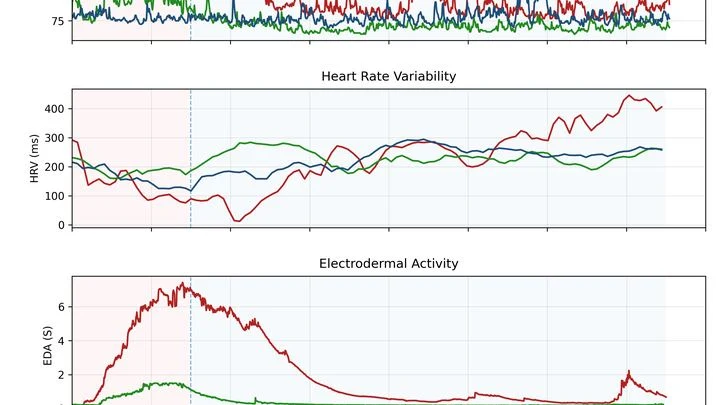
Six adults came to the lab on three consecutive days. On one day they simply rested, on another they pedaled a bike to exhaustion, and on the third they went through an ordeal that makes the heart race without a single movement: they had to give a speech and solve problems in front of a stern committee.
Inside the kidneys, liver, and other organs, fluid flows through channels that squeeze and release like a hose underfoot. The walls of these channels are not rigid: they are porous, elastic, and soaked with moisture.
Water deep within the Earth is compressed more than a thousandfold compared to the surface. Even there, it continues to flow, but its internal structure changes. Researchers measured how water resists flow and compression as pressure rises from zero to 1.6 gigapascals — equivalent to placing a 16-ton weight on every square centimeter.
Tearing apart an aluminum cube just a few nanometers wide is like trying to watch a droplet fall in slow motion when the camera itself is firing at machine-gun speed. Atoms inside the metal vibrate trillions of times per second, while real deformation in the lab takes minutes.
A laser pulse racing through plasma is like a runner carving a path through a crowd. It shoves electrons aside, leaving behind a rarefied channel, just as the crowd parts for a sprinter. In this channel, the crest of the light wave moves slightly faster than light in a vacuum, and it is this speed that determines how efficiently the pulse transfers energy to particles.
Diamond crystals harbor invisible cracks — dislocations. These are places where rows of atoms are shifted, like a sheet of paper pulled halfway out of a stack. Stress builds up around these spots, affecting how the material breaks, bends, or conducts electricity.
Inside a diamond anvil cell, a device where two diamonds squeeze a sample to hundreds of gigapascals, pressure is distributed unevenly. Some regions are compressed more, others less. This affects experimental results: the material may behave differently than under perfectly uniform compression.