quantity

stress

The internal force per unit area within a material that arises from external loads or defects.
9 related articles

Description

Stress is the internal force per unit area that develops within a material in response to external loads, temperature changes, or internal defects. It is a measure of how much force is transmitted through a material's cross-section, and it is crucial for understanding how materials deform, fracture, or flow. Stress is a tensor quantity, meaning it has both magnitude and direction, and it can be normal (perpendicular to a surface) or shear (parallel to a surface).

History

The concept of stress was formalized by Augustin-Louis Cauchy in the 1820s, who introduced the stress tensor and the equations of equilibrium. Earlier, Galileo Galilei had studied the strength of beams, but Cauchy's work laid the foundation for continuum mechanics.

How it works

When a force is applied to a material, the atoms or molecules shift slightly to resist the deformation, creating internal stresses. These stresses are balanced throughout the material, and their distribution determines whether the material will elastically return to its original shape, plastically deform, or break. The relationship between stress and strain (deformation) is described by Hooke's law for elastic materials, while more complex behaviors are modeled by plasticity and fracture mechanics.

In practice

Stress analysis is fundamental in civil engineering (designing buildings and bridges), mechanical engineering (ensuring machine parts don't fail), and materials science (developing stronger alloys and composites).

Fun fact

Diamond, the hardest natural material, can be made to emit light when subjected to stress, a phenomenon used to visualize stress patterns in transparent materials.
Concept graph →

Related articles · 9

HEP Phenomenology2026-07-111 minarXiv:2607.10272express
The Strong CP Problem: Much Ado About Nothing?
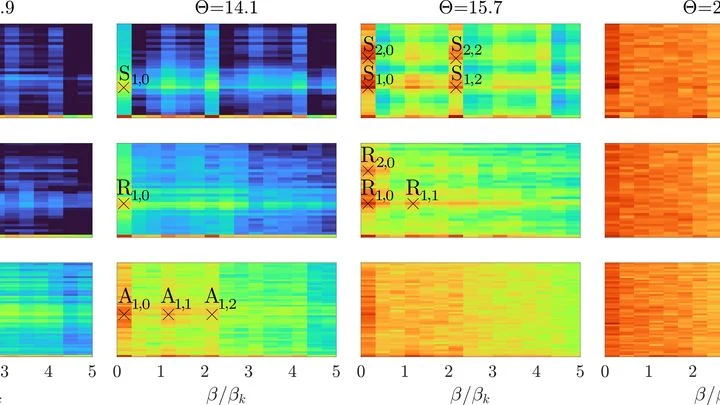
Quantum chromodynamics is the theory that describes how quarks and gluons assemble into protons and neutrons. In its equations, there is a strange angle, the parameter θ (theta).
Medical Physics2026-07-102 minarXiv:2607.09401express
When Vessel Walls Distort the Picture
In the brain's white matter, the signal travels along axons — long neuronal processes wrapped in an insulating myelin sheath. Water fills the space inside axons and outside, in the narrow gaps between fibers.
Tissue Turns to Stone
A living sheet of cells resembles a crowd on an escalator. In a calm state, everyone moves smoothly, but as soon as a crush occurs, movement comes to a halt. Similarly, cell layers under load can suddenly stiffen, turning from a pliable mass into an elastic scaffold.
q-bio.QM2026-04-142 minarXiv:2604.12671express
Stress Under the Skin: How the Body Betrays Anxiety
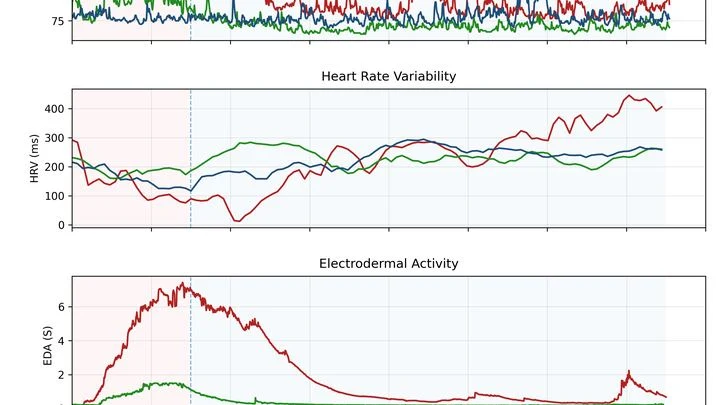
Six adults came to the lab on three consecutive days. On one day they simply rested, on another they pedaled a bike to exhaustion, and on the third they went through an ordeal that makes the heart race without a single movement: they had to give a speech and solve problems in front of a stern committee.
Water Under Pressure: Why It Flows Faster
Water deep within the Earth is compressed more than a thousandfold compared to the surface. Even there, it continues to flow, but its internal structure changes. Researchers measured how water resists flow and compression as pressure rises from zero to 1.6 gigapascals — equivalent to placing a 16-ton weight on every square centimeter.
The Glass That Breaks by a Single Law
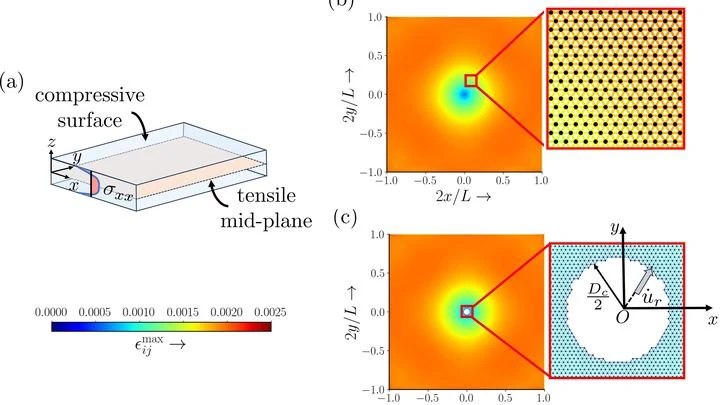
Glass is a material with attitude. It seems fragile, but powerful invisible forces can live inside it. In chemically strengthened glass, the surface is compressed like a stretched rubber band, while the interior is stretched. When a fast object hits such glass, that rubber band snaps in many places at once. Scientists fired projectiles at glass and watched how it shattered.
Materials2026-02-121 minarXiv:2602.12427express
Friction in Faults: How Sand Turns into an Earthquake
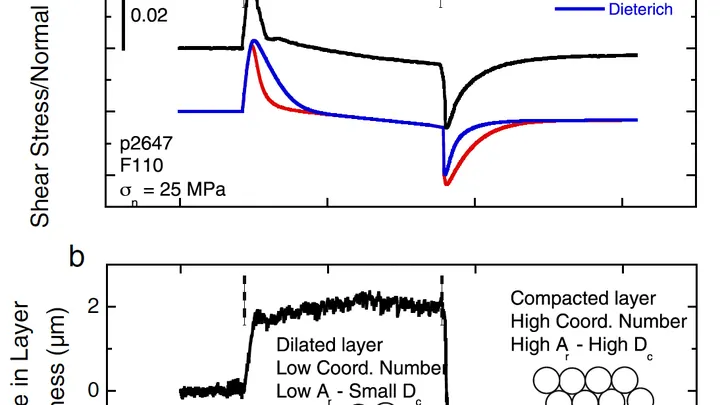
When two tectonic plates grind against each other, a layer of pulverized rock ends up between them, like sand between your palms. This layer, which geologists call fault gouge, behaves not like solid rock but like a thick paste: it can compact, dilate, and slide. Whether a fault ruptures in a devastating earthquake or creeps slowly and safely depends on its whims.
Fluid Dynamics2026-02-032 minarXiv:2602.03617express
Roughness That Decides a Flight's Fate
A blunt cylinder flying at six times the speed of sound isn't the most elegant object, but it's the star of a new simulation. The surface of such a vehicle is never perfectly smooth: during atmospheric entry, the heat shield ablates, leaving bumps and pits.
Materials2026-01-011 minarXiv:2601.00261express
Stress in Diamond Becomes Visible
Diamond crystals harbor invisible cracks — dislocations. These are places where rows of atoms are shifted, like a sheet of paper pulled halfway out of a stack. Stress builds up around these spots, affecting how the material breaks, bends, or conducts electricity.