Cosmic Filaments and the Birth of Stars express
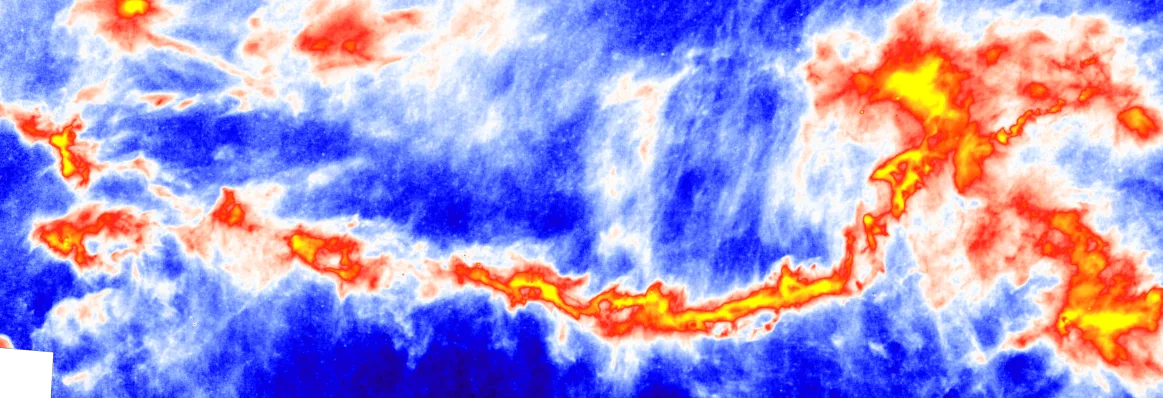
Hidden in cold interstellar gas clouds are long, thin filaments, like threads in a tangle. It is within these filaments, as they collapse, that new stars are born. Astronomers selected seven such clouds, located between 140 and 920 light-years away, and counted how many filaments of various thicknesses each contains.
Strikingly, in every cloud, regardless of its level of activity, the same rule applies: the thicker the filament, the rarer it is. Plotting the data yields nearly a straight line with a slope of 1.40. Remarkably, this slope almost matches the value 1.35—the same number that describes how many stars of different masses are born.
The matching slopes are no coincidence. It seems that the hierarchy of gas filaments, from thin to thick, directly determines which stars will emerge: light, intermediate, or heavy. This links the structure of cold gas to the long-standing puzzle of the stellar mass distribution, which has defied explanation since 1955.
The stellar mass distribution law was first derived by Edwin Salpeter in 1955. Since then, it has been observed in many corners of the universe, but why it takes this particular form has remained a mystery.