The interplanetary magnetic field (IMF) is the extension of the Sun's magnetic field carried outward by the solar wind, filling the entire solar system. It is not a static structure but a dynamic, spiral-shaped web of magnetic field lines that constantly changes in response to solar activity. The IMF plays a crucial role in governing space weather, as it interacts with planetary magnetic fields, cosmic rays, and charged particles throughout the heliosphere.
History
The concept was established in the 1950s by Eugene Parker, who predicted the spiral structure of the solar wind and its embedded magnetic field. The IMF was first directly measured by the Mariner 2 spacecraft in 1962.
How it works
The Sun's rotating magnetic field is dragged outward by the supersonic solar wind, a stream of charged particles. Because the Sun rotates, the field lines become twisted into a spiral pattern known as the Parker spiral. The IMF is not uniform; it is divided into sectors where the field points either toward or away from the Sun, and its strength and orientation fluctuate with solar activity, such as coronal mass ejections and solar flares.
In practice
The IMF is used to forecast space weather, particularly in predicting geomagnetic storms that can disrupt satellites, power grids, and communication systems on Earth.
Fun fact
The IMF is so weak at Earth's distance that a typical refrigerator magnet is thousands of times stronger, yet it still manages to deflect many cosmic rays and shape the heliosphere's boundary.
MOND function interpolating between Newtonian and deep-MOND regimes.
What is in the formula
g_N
variable
Newtonian gravitational acceleration — acceleration metre per second squared
ν
variable
MOND interpolation function
a_0
constant
Characteristic acceleration scale of Modified Newtonian Dynamics, below which deviations from Newtonian gravity appear. — mond acceleration scale = 1.2e-10metre per second squared
A spotlight with an adjustable beam width sweeps along the shore. Its light is the long ocean waves that are born in the surf zone and spread in both directions: toward the beach and out to the open sea. Previously, this spotlight was considered a point source, but the actual breaking zone, where short waves break, has a finite width, and it changes as the wave front advances and retreats.
Two galaxies (our Milky Way and its satellite, the Large Magellanic Cloud) slowly circle each other. Their gravitational pull stirs the distant outskirts of the Milky Way, like a pebble thrown into a pond makes the water ripple.
Light from a distant blazar, an active galactic nucleus whose jet points our way, travels for billions of years. Along the way, it triggers cascades of charged particles that the intergalactic magnetic field deflects sideways. This creates a blurred gamma-ray glow around the blazar: a secondary halo.
A sunspot cools, and above it a dark filament, a prominence, hangs for weeks. Inside it, like a compressed spring, hides the magnetic field. It can be laid out in neat arches, or it can be twisted into a tight rope.
The Sun is a boiling cauldron of hydrogen and helium, where scorching gas is caught in magnetic snares. When invisible ropes reconnect, energy comparable to billions of thermonuclear explosions is released. Where does it go?
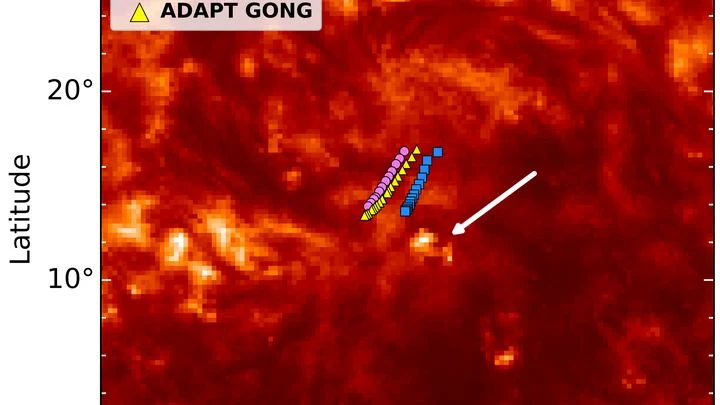
In December 2011, Comet Lovejoy boldly raced through the searing corona of the Sun. Right after — a flare. Scientists checked whether the comet could have caused it. The atmosphere of the Sun is threaded with taut magnetic loops, like a drawn bowstring.
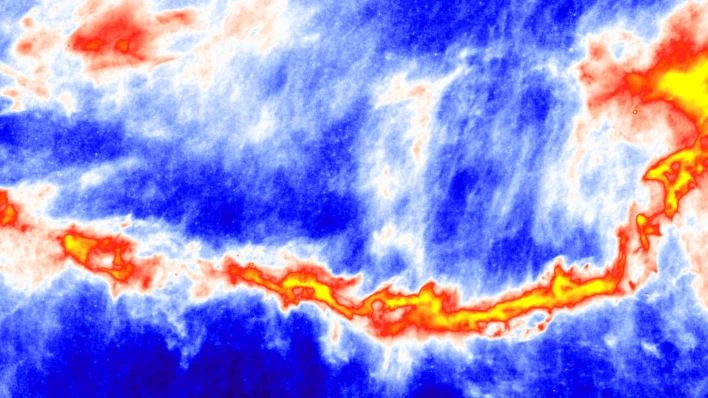
Hidden in cold interstellar gas clouds are long, thin filaments, like threads in a tangle. It is within these filaments, as they collapse, that new stars are born. Astronomers selected seven such clouds, located between 140 and 920 light-years away, and counted how many filaments of various thicknesses each contains.
The solar wind isn't a smooth flow: it's gusty. Inside it, protons and helium nuclei don't all travel at the same speed; they spread out like droplets in a hose stream. Usually, this spread is described by a simple bell-shaped curve.
Interstellar space is not empty: it is filled with tenuous gas, which is warm in some places and cold in others. The boundaries between such regions resemble the walls between soap bubbles.
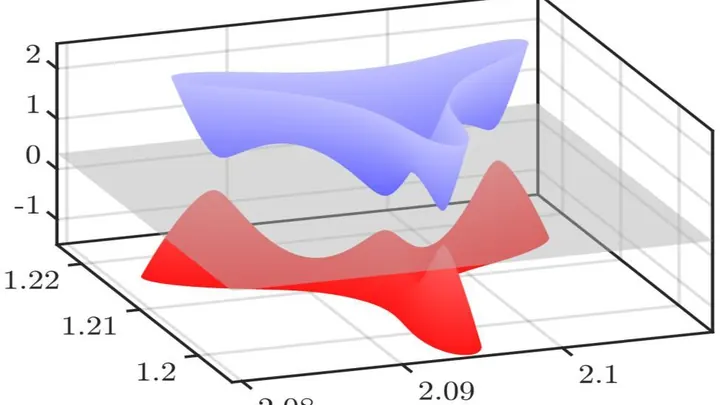
A sheet of graphene one atom thick is like a flexible metal mesh through which electrons zip almost unimpeded. Stack two such sheets with a slight twist, and the material's properties change dramatically: it can become an insulator that blocks current.
For a long time, the Universe was seen as a strict baker: it was thought that in every corner, stars were mixed from the same recipe — for each giant star, there were roughly the same number of dwarfs, no matter where they were born.
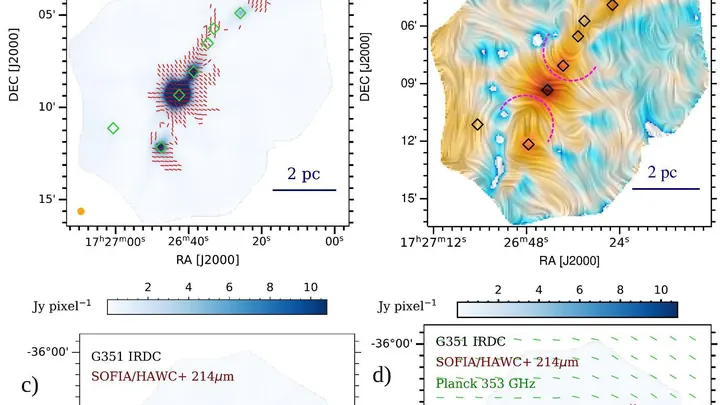
In the dark cloud G351, where new stars are about to emerge from gas and dust, the magnetic field has bent into an hourglass shape. Such a shape is a sign that the field is not just watching star birth from the sidelines but is actively taking part.
Scientists used the SOFIA telescope, mounted on an airplane, to see the dust in the cloud.
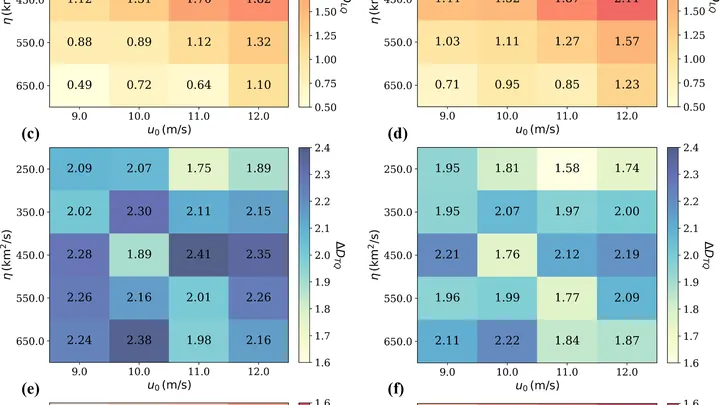
Sunspots are traces of magnetic fields that emerge on the surface. They live their own lives: spots closer to the equator tilt more, while those farther away tilt less. These two effects, like two knobs on an old radio, control how much magnetic field reaches the Sun's poles and accumulates there for the next cycle.
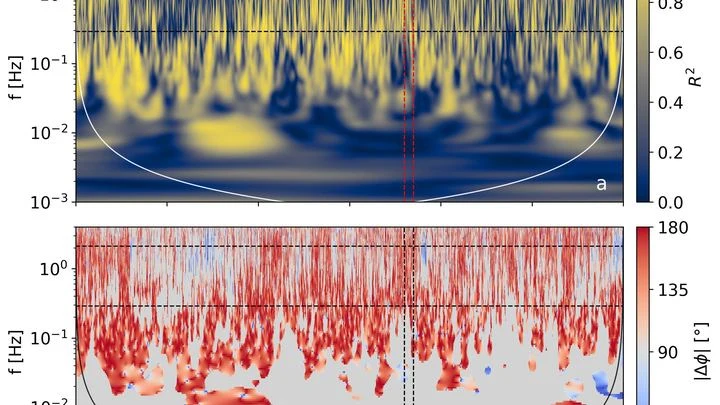
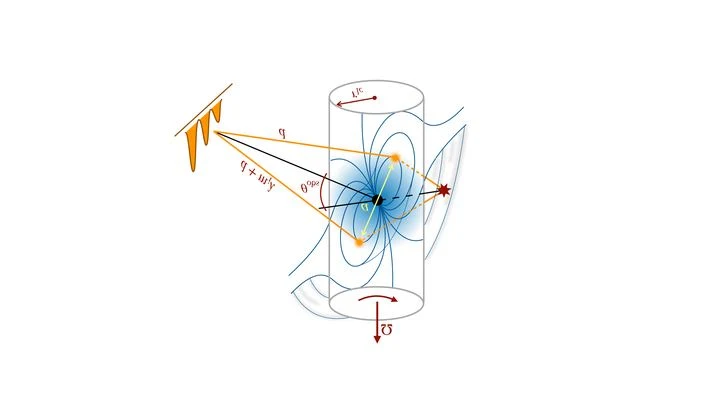
A radio telescope picks up a signal from the Crab Nebula, and instead of a smooth line, the screen shows bright and dark bands, like on a zebra's hide. This is the emission from the pulsar, a rapidly spinning neutron star left over from a supernova explosion.
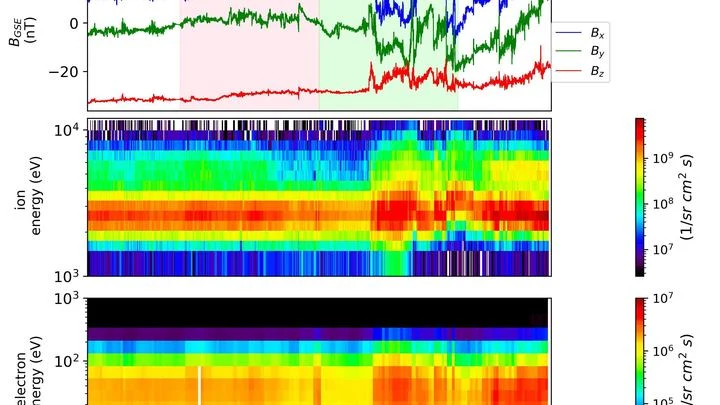
October 10, 2024. The Sun hurled a cloud of magnetized plasma toward Earth, and four spacecraft, stationed at a single point between the Sun and Earth, simultaneously recorded how that cloud churned. The distance between the outermost probes was just 80 Earth radii, about half a million kilometers.
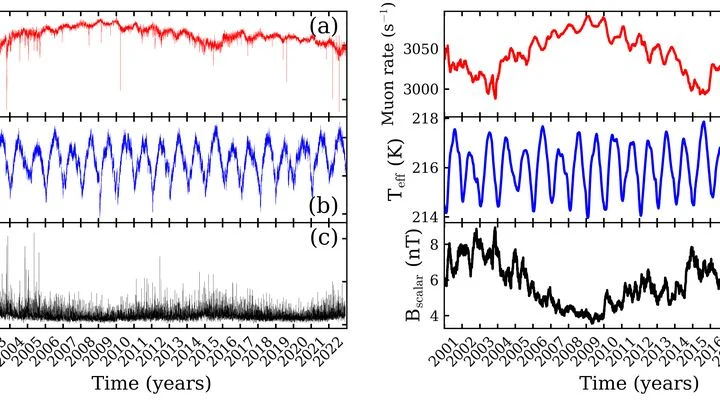
Every second, invisible particles from space, cosmic rays, strike Earth's atmosphere. Colliding with air molecules, they produce showers of secondary particles, among which muons are especially abundant. A muon is a heavy cousin of the electron that lives only a couple of microseconds but still manages to reach the ground.