Scientist

James Jeans

1877-1946 · Astrophysics, Theoretical Physics, Mathematics
British physicist, astronomer, and mathematician. Best known for his work on gravitational instability (Jeans instability), which explains the formation of stars from interstellar clouds. Also, in collaboration with Rayleigh, derived the Rayleigh–Jeans law for thermal radiation.

Biography

Born in Ormskirk, Lancashire. Studied at Trinity College, Cambridge. Taught at Cambridge and Princeton, then worked at the Royal Institution. Author of popular books 'The Universe Around Us' and 'The Mysterious Universe'. Awarded the Royal Medal and other distinctions.

Key discoveries

💡 Was a talented organist and often gave concerts.
"He said that the universe begins to look more like a great thought than a great machine."
Concepts
star formationinterstellar mediumgravity
Laws
Jeans instabilityRoche limit
Scientists
Robert HookeJacob BekensteinKarl SchwarzschildJoseph WeberHans BetheNancy Grace RomanTheodore LymanNicolaus Copernicus

Related articles

Nuclear Theory2026-01-061 minarXiv:2601.02980express
The Ultimate Stiffness Limit of Neutron Stars
Just as in a crowded room each new person sharply increases the pressure on the walls, in a neutron star increasing density leads to a rise in internal resistance. But even this resistance has an absolute ceiling.
Exoplanets2026-01-192 minarXiv:2601.13200express
Cosmic nurseries under fire
A young star is surrounded by a flat, rotating disk of gas and dust — the construction site for future planets. The disk lives its own life: gas flows toward the star, dust clumps together, and from outside, harsh ultraviolet light from neighboring hot stars presses down on it all, like wind blowing leaves off a path.
Galaxies2026-02-011 minarXiv:2602.01238express
Gas rivers feed a future star
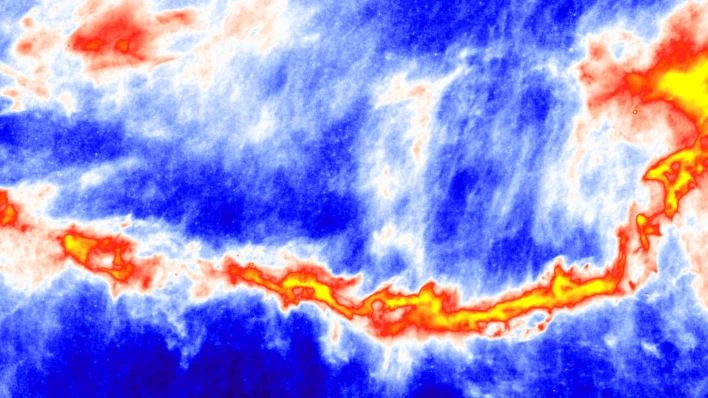
In the dark cloud G318.049+00.086, where no star has yet formed, dust and gas have arranged themselves into four long filaments. They converge into a dense central hub, like four rivers emptying into a lake. Gas flows along these filaments toward the center: the flow speed reaches 10–20 kilometers per second per parsec of length.
Galaxies2026-02-031 minarXiv:2602.03088express
How Galaxy Clusters Quench Star Formation
A galaxy cluster is like a busy intersection where galaxy-cars race through a headwind of hot gas. This wind, called ram pressure, strips galaxies of their cold gas — the fuel for star formation. Astronomers from the SAMI survey traced how this happens in hundreds of galaxies across eight nearby clusters.
Galaxies2026-02-031 minarXiv:2602.03836express
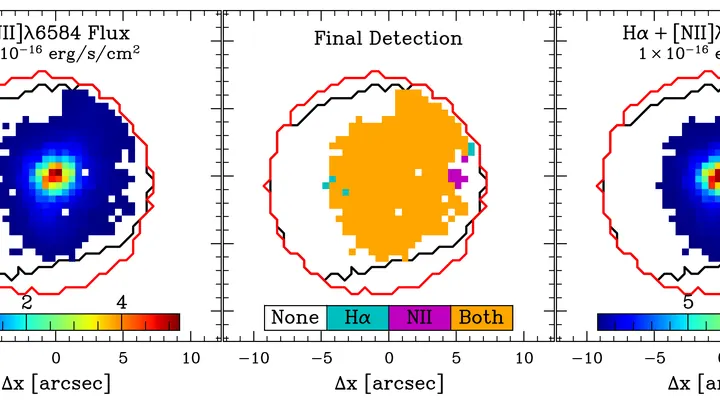
Galactic Winds: How Black Holes Quench Star Formation
At the heart of nearly every large galaxy lurks a supermassive black hole. As it devours gas, it blasts powerful outflows back into space, like a dragon that can't swallow all its prey and breathes fire. These 'winds' accelerate to thousands of kilometers per second and can sweep away the gas reservoirs from which stars are born.
Cosmology2026-02-182 minarXiv:2602.16295express
The Galaxy That Forgot How to Make Stars
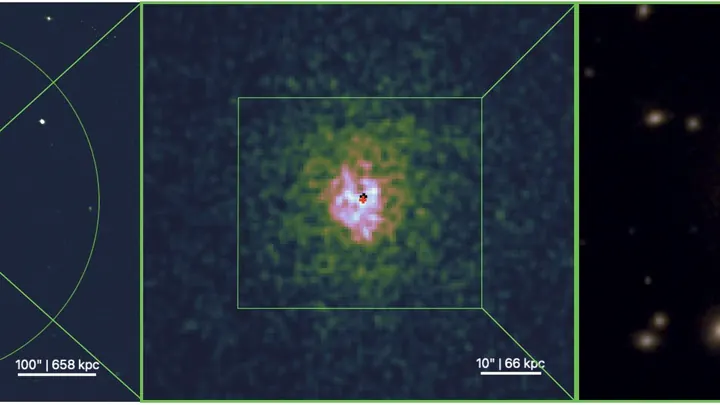
At the center of a vast city of galaxies hangs a thick cloud of gas. It has cooled to the point where, by all the rules, it should be collapsing into new stars, like steam turning to droplets on a cold window. But the window stays dry. Astronomers aimed the Chandra X-ray telescope at this cloud and watched it for nearly three straight days.
Galaxies2026-03-312 minarXiv:2603.30029express
The Cloud That Falls Into Itself
In a dark cloud where no star has yet ignited, gas begins to pull together toward a common center. This is how the most massive stars in the Galaxy are born: those tens of times heavier than the Sun. Astronomers pointed radio telescopes at the cloud SDC335.579-0.292 and saw gas molecules lining up into streams falling inward.
Stellar2026-04-031 minarXiv:2604.03010express
A Charge for Future Planets
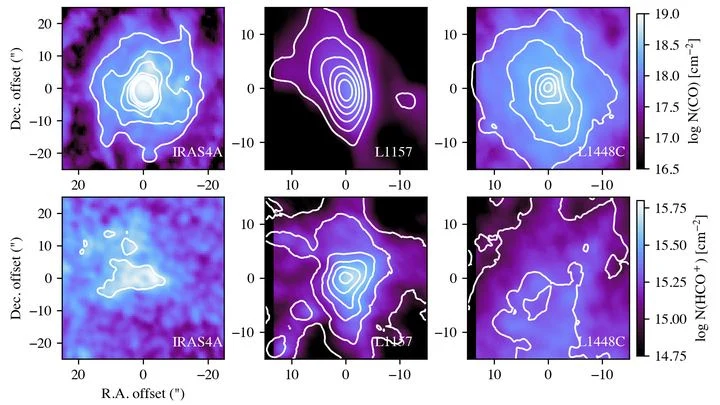
In the cold gas cloud where a star is born, chemistry sleeps. Molecules barely collide, reactions stall. But when a charged particle zips through the cloud, it knocks electrons off atoms — ionizing them. That's how active ions appear in a dormant cloud, ready to build new molecules.
Galaxies2026-04-062 minarXiv:2604.04501express
Chaos Reigns in the Thick of Stellar Filaments
In cold clouds of interstellar gas, long, dense filaments stretch out. Inside them, like overcrowded incubators, future stars are maturing. For a long time, it was thought that within such filaments, everything was governed by gravity: matter smoothly flows toward the centers, where density increases and eventually a star ignites.
Stellar2026-04-081 minarXiv:2604.06904express
Magnetic Brake for Binary Stars
Two stars orbit a common center, accreting gas from a surrounding cloud. Rotating disks of gas form around each star and around the pair as a whole. From these disks, jets shoot out like hoses. Inside the disks, gas is constantly churned — that's the magnetorotational instability at work.
Galaxies2026-04-151 minarXiv:2604.14093express
Cosmic Filaments and the Birth of Stars
Hidden in cold interstellar gas clouds are long, thin filaments, like threads in a tangle. It is within these filaments, as they collapse, that new stars are born. Astronomers selected seven such clouds, located between 140 and 920 light-years away, and counted how many filaments of various thicknesses each contains.
Plasma Physics2026-04-172 minarXiv:2604.16156express
How a Star's Magnetic Field Puts the Brakes on Outflows
A stream of scorching gas races away from a star, and suddenly stalls, as if it hit an invisible wall. That's exactly what researchers saw when they tried to reproduce a stellar eruption on a laboratory scale. They used a laser to create a plasma jet and shot it through a magnetic field — first weak, then strong, like that of many stars.
Galaxies2026-04-201 minarXiv:2604.17955express
Gas Jumps Over the Ring
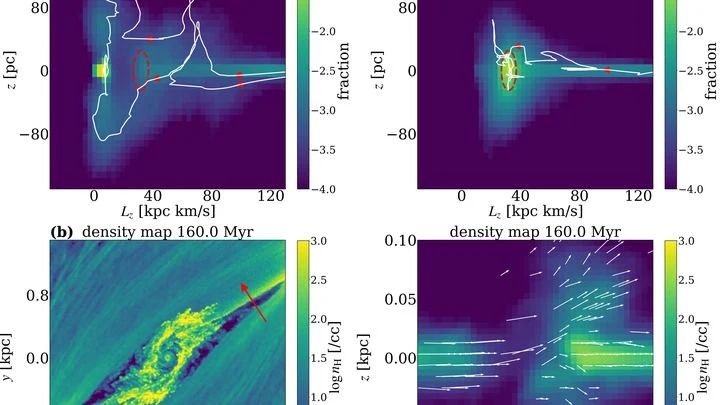
A river flows toward a whirlpool, but a dam with a notch blocks the way. Most water piles up before the dam, but some, gaining height, leaps over it and falls straight into the funnel. So it is with gas in a galaxy: it streams toward the center but hits a ring of stars and gas, like a dam. Usually, everything stops there, swirling into a dense vortex.
Galaxies2026-04-202 minarXiv:2604.18700express
Dust and Time: How Distant Galaxies Grow
In the distant universe, when it was just a couple of billion years old, many galaxies resembled boiling cauldrons: gas clumped so quickly that stars ignited one after another, and dust heated up and shone brightly in the submillimeter range.
High Energy2026-04-211 minarXiv:2604.19988express
A Stellar Cocoon for the Little Red Dots
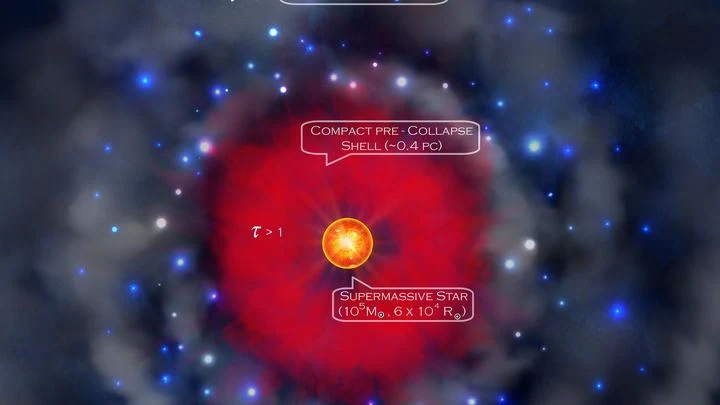
A star weighing a hundred thousand Suns lives bright and brief. Its finale is a rapid collapse into a black hole. But just before the end, it manages to wrap itself in a dense gas cocoon.
General Relativity2026-04-222 minarXiv:2604.20960express
What Holds a Star Together When It Has Two Pressures
A balloon in your hand springs back equally in all directions. But a bottle of soda behaves differently: along the neck it is stiff, while across it is easily squeezed. This is roughly how pressure works inside some stars: it can be unequal in different directions. Such stars are called anisotropic, and their behavior has so far been described by disparate methods.
HEP Phenomenology2026-04-282 minarXiv:2604.25687express
Neutrino Pairing Dance in a Dense Gas
In a packed hall where couples are spinning, a wave sometimes ripples through: some pairs break apart, others form, and the motion sweeps everyone along. A dense neutrino cloud behaves similarly: these are the tiniest particles that barely interact with matter.
HEP Phenomenology2026-05-042 minarXiv:2605.03003express
Cosmic Strings That Melt
When hot soup cools, clumps form on the surface — similarly, as the early universe cooled, it gave birth to threadlike clumps of energy: cosmic strings. Some of them are like a stretched rubber band: as long as it's intact, it's stable. But if you nick the band, it snaps.
Analysis PDEs2026-05-162 minarXiv:2605.17121express
Viscous honey and invisible air
A drop of honey spreads slowly across a table, while water spreads quickly. The resistance to flow, viscosity, differs from one fluid to another. But what if the viscosity changes on the fly, as the substance compresses or expands?
High Energy2026-05-272 minarXiv:2605.28944express
A Spiral at the Heart of a Star
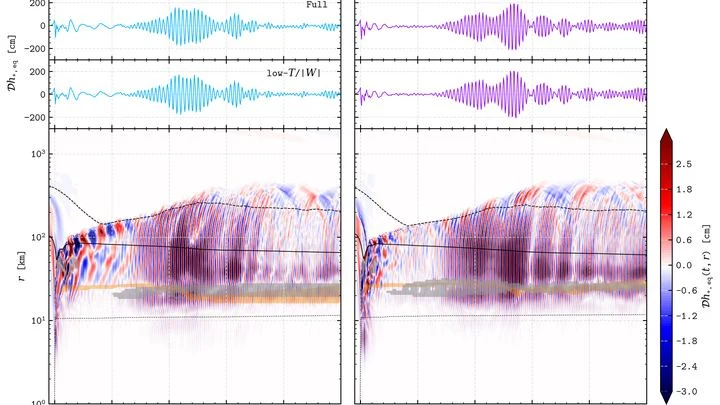
A figure skater pulls their arms in, and their spin suddenly accelerates. When a massive star exhausts its fuel and its core collapses, something similar happens, but on a cosmic scale. The core shrinks to a city-sized sphere, and if it is spinning rapidly, a peculiar instability can arise.
Cosmic Molasses: How Viscosity Changes the Rules of Primordial Black Hole Birth
In the search for the nature of dark matter, one of the most intriguing hypotheses traces back to the first moments after the Big Bang. Back then, quantum fluctuations of the inflation field gave rise to clumps of matter that could collapse into primordial black holes.
High Energy2026-07-221 minarXiv:2607.20314express
Why a Star Explosion Is Like a Tug of War
The collapse of a star's core is like compressing a spring: matter falls inward, and a neutron star is born at the center. But the fall is never perfectly smooth. In the boiling outer layers, random eddies transfer angular momentum to the infalling gas, and a disk swirls around the central object. This disk is no calm river. It pulses, strengthening and fading.
General Relativity2026-08-062 minarXiv:2608.06067express
A Star's Heartbeat: When a Boson Star Freezes
Every pulsating object has a moment when its rhythm falters. For boson stars, hypothetical clumps of ultralight particles, that moment turns out to be the point where mass stops growing. The authors calculated the lowest radial mode (the fundamental 'breathing' tone) for a whole family of such stars, including models with self-interaction.
Galaxies2026-08-102 minarXiv:2608.09813express
Teenage Galaxy Caught in the Act of Restructuring
In the first half-billion years after the Big Bang, galaxies grew like crazy. Gas fell in rapidly and collapsed into stars without any resistance. This period is called 'unimpeded star formation.' It's like frying pancakes on a scorching skillet without a lid: splatters fly, but nothing holds them back.
Immortal Stars with Black Holes Inside: How Gas Accelerates Mergers in Galactic Centers
At the center of a galaxy, where a supermassive black hole spins a disk of scorching gas around itself, giant stars sometimes form. They are unlike ordinary stars: the disk continuously feeds them with matter, and a star can grow to hundreds of solar masses, staying bright as long as the gas flow lasts.
Galaxies2026-09-062 minarXiv:2609.06679
Beads on Strings: How the Cosmic Web Molds Galaxies
A filament of the cosmic web stretches through the young universe, and strung along it like beads on a necklace are galaxies. In the core of the SSA22 protocluster, which in a few billion years will become the center of a massive cluster, these beads are still hot and dusty: stars are being born inside them, and cold gas serves as fuel.