The initial mass function (IMF) describes the relative number of stars that form at different masses in a given star-forming event. It is a fundamental statistical distribution in astrophysics, typically showing that low-mass stars are far more numerous than high-mass stars. The IMF is essential for understanding star formation, galaxy evolution, and the chemical enrichment of the universe, as it determines how many stars of each type contribute to light, heavy elements, and supernovae.
History
The IMF was first quantified by Edwin Salpeter in 1955, who derived a power-law distribution for field stars in the solar neighborhood. Later work by Miller and Scalo in 1979 and Chabrier in 2003 refined the IMF, especially at low masses, where it flattens.
How it works
The IMF is usually expressed as a power law, where the number of stars per unit mass interval decreases with increasing mass. A common parameterization is the Salpeter IMF, which has a slope of -2.35 for stars above about one solar mass. The origin of the IMF is still debated, but it likely arises from the interplay of turbulence, gravity, and feedback in molecular clouds during star formation.
In practice
The IMF is used to convert observed galaxy luminosities into star formation rates and stellar masses, and it is a critical input for models of galaxy evolution and chemical enrichment.
Fun fact
The IMF appears to be remarkably universal across different environments in the Milky Way, but some recent observations suggest it may be top-heavy (more massive stars) in extreme starburst regions, though this remains controversial.
A harbor lives by the tide schedule. Water rises and falls, and with it everything changes: the level at the dock, the composition of the sediment on the bottom, even the salinity in the far corners. A galaxy works similarly, except instead of water it has gas, and instead of the Moon, it has its own stars and neighboring clouds.
Forty light-years away lives a star that went unnoticed for a long time: TRAPPIST-1 emits two thousand times less light than the Sun. But it turned out to have seven Earth-sized planets, three of which orbit in the zone where water could remain liquid. Yet little was known about the star itself, about its chemical kitchen.
Around every galaxy lies an invisible corona of cold gas. It extends far beyond the stellar disk and serves both as a fuel depot for new stars and as a graveyard for ejected material.
A young star cluster resembles an orchestra before a concert: each instrument tunes up in its own way, and the overall hum seems like chaos. But if you listen closely, you can pick out individual notes.
After the Big Bang, the universe underwent a rapid expansion — inflation, smoothing out the cosmic microwave background and sowing the seeds of galaxies. But at the quantum level, chaotic fluctuations brewed in the inflaton field.
Light from a distant blazar, an active galactic nucleus whose jet points our way, travels for billions of years. Along the way, it triggers cascades of charged particles that the intergalactic magnetic field deflects sideways. This creates a blurred gamma-ray glow around the blazar: a secondary halo.
Imagine a person in an old photograph standing in a crowd while spinning — guessing their age would be nearly impossible. That's roughly how astronomers determine the ages and masses of distant stars, and they often get it wrong. For stars slightly heavier than the Sun (from 1.4 to 2.5 solar masses), standard methods like chemical-composition 'clocks' work poorly.
The Universe is singing. Not in the usual sense: its symphony is recorded in tiny density variations from which galaxies and ourselves grew. After the Big Bang, space was almost uniform, but quantum fluctuations during inflation left a faint pattern — slightly more matter here, slightly less there.
Images from the James Webb Space Telescope have revealed unexpectedly intense light from the first galaxies — colossal star systems that formed shortly after the Big Bang. Imagine a toaster browning a slice of bread in a minute, while an oven takes an hour to bake a loaf — the result is essentially the same.
In a city park, trees grow faster than in a deep forest — not because the soil is better, but because branches collide and seeds are exchanged more often. Galaxies in the Spiderweb protocluster behave much the same way. This vast clump of matter will become a mature cluster billions of years from now.
A spotlight shines through a dark hall. Between the lamp and the wall, an invisible lens drifts by, and the spot of light briefly brightens and shifts. That is exactly what the DECam telescope, aimed at the Large Magellanic Cloud, a satellite galaxy of our Milky Way, was watching for five consecutive nights.
Black holes come in lightweights, born from dying stars, and supermassive ones at galactic cores. The missing intermediate link had been hiding. Fast radio bursts, cosmic signals lasting milliseconds but carrying the energy of days of sunlight, helped crack the case. Think of these bursts as cries from the depths of the universe.
A vast, dark cloud of gas stretched across the young universe. Inside it, like invisible fingers, magnetic field lines left over from the very birth of the cosmos threaded through. These fields act on charged particles, pushing them together, like a gentle breeze gathering fallen leaves into piles.
Astronomers, like chefs, have long been preparing a description of the Universe using the same cumbersome recipes. These recipes — complex mathematical formulas — estimated how many galaxies of different luminosity and mass fill the cosmos, as well as how the invisible frameworks of dark matter are distributed. But the dishes lacked accuracy.
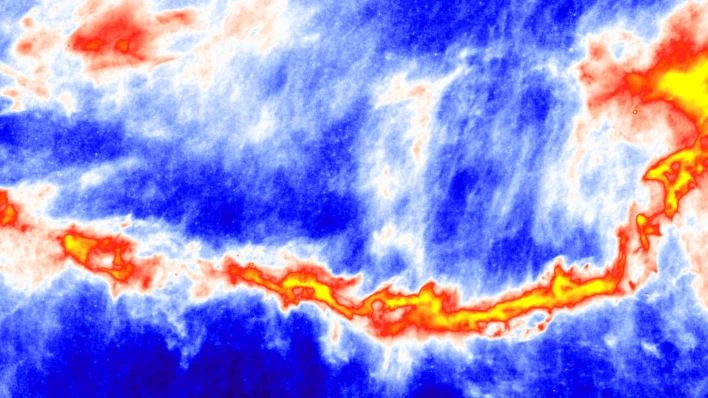
Hidden in cold interstellar gas clouds are long, thin filaments, like threads in a tangle. It is within these filaments, as they collapse, that new stars are born. Astronomers selected seven such clouds, located between 140 and 920 light-years away, and counted how many filaments of various thicknesses each contains.
Interstellar space is not empty: it is filled with tenuous gas, which is warm in some places and cold in others. The boundaries between such regions resemble the walls between soap bubbles.
Lithium is like a thermometer dipped into a star's interior. This light element is destroyed at temperatures around 2.5 million degrees, so its abundance on the surface tells us how deeply the star's material has been mixed.
Two very small, cool stars, similar to the famous TRAPPIST-1, reside in the young Upper Scorpius star cluster. They are only 5–10 million years old — by cosmic standards, mere infants. Each is surrounded by a disk of gas and dust from which planets may eventually assemble.
Ancient stars, nearly devoid of heavy elements, are like fossilized remnants of the first cosmic flashes. For a long time, the odd ratio of carbon, hydrogen, and helium in three such stars was thought to require a hypernova — an ultra-bright supernova with hundreds of times more energy than a regular one.
Every molecule is like a set of building blocks: the same pieces can be assembled in different ways. Two assemblies with the same atoms but different geometry are called isomers. If one can be turned into the other by a simple rotation around a bond, they are conformers, like a bent arm versus a straight one.
For a long time, the Universe was seen as a strict baker: it was thought that in every corner, stars were mixed from the same recipe — for each giant star, there were roughly the same number of dwarfs, no matter where they were born.
The kitchen where stars are baked works on a simple recipe: as much flour as you have, that's how many pies you get. For a long time, astronomers saw a strict relation between a galaxy's mass and how fast it forms stars, and they considered it a standalone rule. But a new study of 24,954 nearby galaxies shows that this relation is just a shadow of two more fundamental laws.
In the star cluster NGC 2158, which is over a billion years old, astronomers have counted how often stars live in pairs. The Hubble telescope stared at the cluster for a long time to catch even the faintest stars: those lighter than one-third of the Sun.
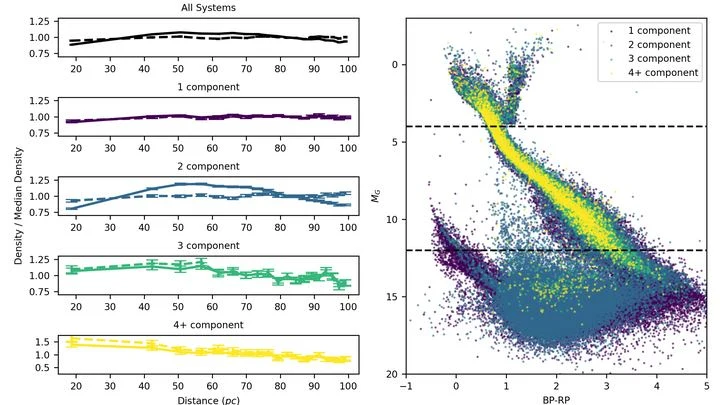
Two spotlights placed side by side: from a distance, their light blends into one patch, and it seems there's a single source. The same happens in space: about 10–20% of faint stars are actually close pairs of identical stars. Individually, they can't be resolved, but together they shine noticeably brighter than a single star with the same parameters.
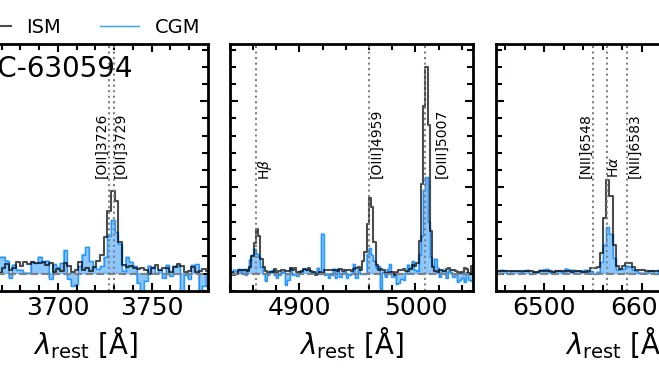
The kitchen of a distant galaxy isn't limited to its bright disk. Around every star system, there's an invisible cloud of gas, like steam above a pot of soup. Astronomers peeked into this steam around galaxies that appear as they were just one and a half billion years after the Big Bang.
The first stars ignited from clouds that contained nothing but hydrogen and helium. Heavy elements (carbon, oxygen, iron) came later, forged inside stars. But among those pioneers, there could have been lightweight stars, with masses just below that of the Sun.
Gas clouds in the Milky Way give birth to stars, and the heaviest among them are true giants. Previously, it was thought that such a star ignites almost instantly, like a light bulb. But new research shows that a star grows gradually, like a snowball rolling down a mountain: the longer it rolls, the bigger it gets.
The authors compared two catalogs: bright gas clouds around young stars and the stars themselves.
Take a child's spinning top and set it on the table. It spins steadily, with all its parts moving in the same direction. Now toss a handful of beads onto the floor and blow on them: each bead will fly its own way. That's roughly how astronomers distinguish two types of large galaxies: 'spinning tops' (fast rotators) and 'beads' (slow ones with chaotic stellar motion).
The galaxy's kitchen has a recipe for stellar soup. The main ingredient is hydrogen, but the flavor depends on a pinch of metals. Astronomers have now peered into the pots where that pinch is almost absent, and found that the smallest stars are missing.
In the Large Magellanic Cloud, a galaxy that orbits our Milky Way, astronomers have caught five stars that look like fossils from the very distant past. They contain almost no metals, only one-hundredth to one-thousandth of what the Sun has, but they have tens of times more carbon.
Astronomers pointed the James Webb at three galaxies whose light traveled 12 billion years. Early data pointed to incredibly fast growth — like an infant reaching adult height in just a year, clashing with the expansion of the Universe.
In cold clouds of interstellar gas, carbon hides inside carbon monoxide (CO) molecules, like sugar dissolved in tea. But near hot, massive stars, this 'tea' boils: harsh radiation tears the molecules apart, and carbon escapes as lone atoms or ions.
In the dark room of the early Universe, the first spark flickered. A few hundred million years after the Big Bang, when space was filled only with hydrogen and helium, Population III stars were born: metal-free giants whose light first tore through the primordial darkness.