Atomic Nuclei Measure Gravity ⚡ экспресс
Original: "Nuclear Heterodyne Interferometry for Gravitational Spectroscopy"
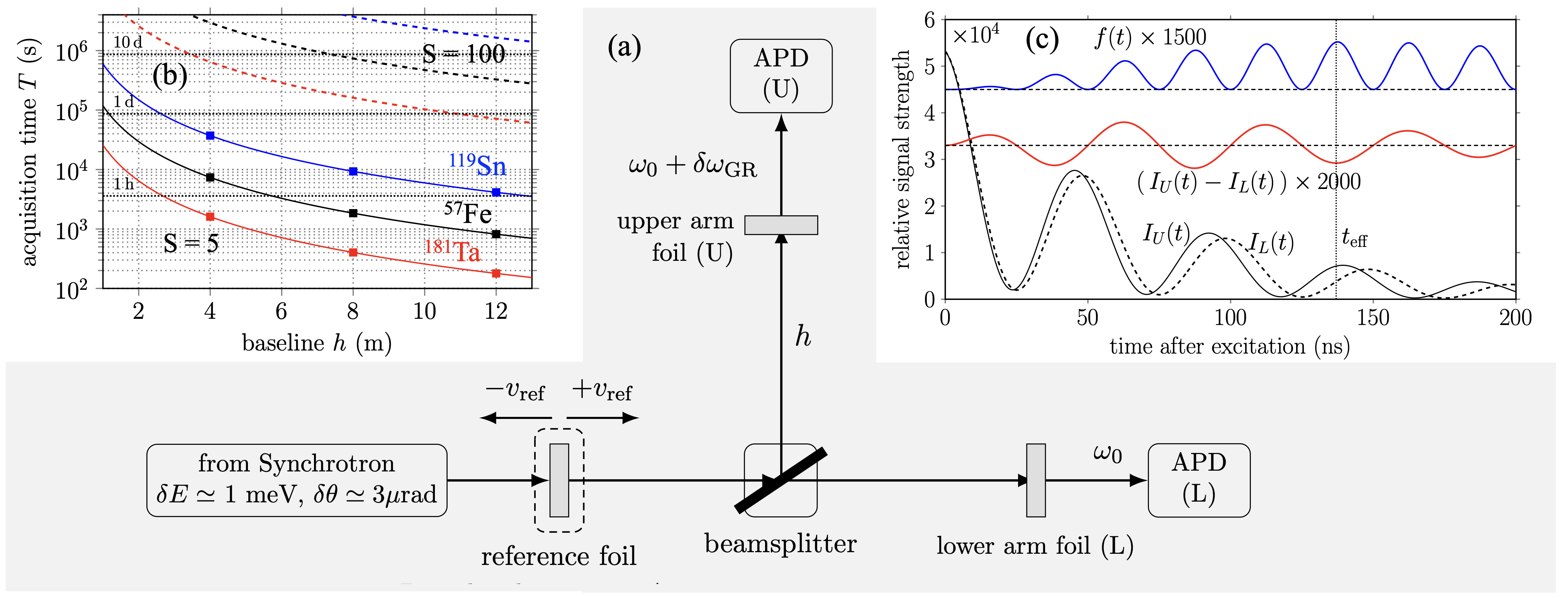
Physicists have found a way to spot how gravity slows time in atomic nuclei, using a height difference of just a couple of meters.
Links in the knowledge graph 1
Gravity slows time: a clock on the second floor runs fast compared to one in the basement. The new method catches this effect in atomic nuclei using synchrotron light. A tiny frequency shift builds up like a phase slip — and after a few hours at a height of three meters, it becomes noticeable. In this way, nuclei will help test Einstein's theory with record precision.
🎯 Iron-57 nuclei work at ordinary temperatures, needing no bulky cryostats — it's the only isotope that enables such ultra-precise measurements on a tabletop.
🎬 In 'Interstellar', the characters face a monstrous time differential near a black hole; the new method catches the same effect, only billions of times weaker, on a lab bench.
\frac{\Delta f}{f} = \frac{g \Delta h}{c^2}
The higher you go, the faster clocks tick: a one-meter lift speeds up their rate by a minuscule fraction — about 10^(-16) of the original frequency.