Gravity from Hundreds of Universes express
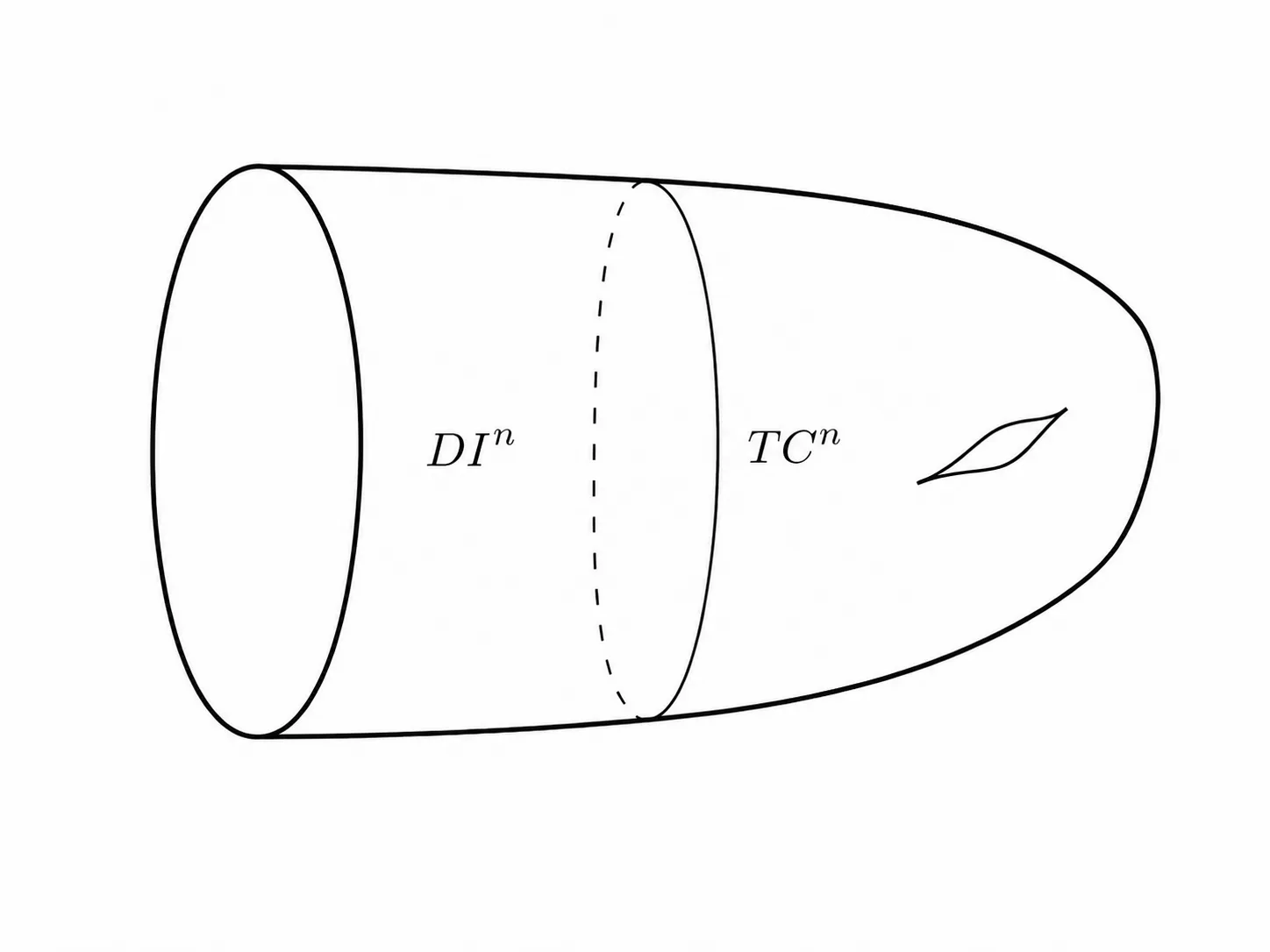
A patchwork quilt where each patch is a tiny quantum knot obeying strict mathematical rules. Physicists took many identical such knots and started sewing them together in all possible ways. The result was three-dimensional shapes — from simple spheres to intricate bagels with holes. That is what their model of quantum gravity looks like: not a single geometry, but a sum of all conceivable forms that space can take.
The big surprise came when physicists compared their patchwork quilt with what happens at its boundary. This whole jumble of three-dimensional shapes exactly corresponds to an ensemble of many two-dimensional worlds at the edge. The pattern on the quilt's surface perfectly describes its inner stuffing. Here the holographic principle comes into play: gravity in the bulk is equivalent to a quantum theory without gravity on the boundary.
When the number of patches became very large, the model simplified. Intricate patterns merged into a calm, nearly uniform structure. In this regime, familiar features of semiclassical gravity emerged. Negative probabilities, which had plagued calculations in early stages, disappeared: they were "cured" by taking into account all possible shapes. The model also showed a phase transition reminiscent of black hole evaporation. The amplitude of wormholes, tunnels in spacetime, turned out to be exponentially suppressed. They occur rarely, as theory predicts.
Original abstract
as written by the authors arXiv:2605.12590
We consider a model of 3d quantum gravity defined by $$n$$ copies of a rational Virasoro TQFT with central charge $$1/2$$, summed over all 3d topologies. This theory is holographically dual to an ensemble of all 2d CFTs with central charge $$c=n/2$$ and chiral algebra that includes $$Vir_{1/2}^n$$. We perform the sum over topologies and evaluate the partition function of the bulk theory. We then confirm the holographic duality by matching it to the boundary ensemble for small $$n$$. We proceed to consider the limit of a large central charge, in which the bulk theory simplifies and condenses to an Abelian phase. In this regime, the model manifests many features expected in semiclassical 3d quantum gravity. In particular, inclusion of all 3d topologies in the bulk sum cures the negativity of the density of states evaluated by the torus partition function. The model also exhibits a Hawking-Page transition, an exponentially suppressed wormhole amplitude, and provides a toy example of the holographic code. We discuss these aspects in detail and conclude with lessons for semiclassical quantum gravity.
In this model, space can take the shape of a bagel with several holes, and each hole contributes to gravity, like an extra universe sewn onto ours.
The idea of a sum over topologies echoes Borges's "Garden of Forking Paths": reality is the totality of all possible branching paths.