Semiclassical gravity is a theoretical framework that treats matter and fields quantum mechanically while keeping spacetime itself classical, described by Einstein's general relativity. It is the standard approach for studying phenomena where quantum effects are significant but the gravitational field is not yet quantized, such as black hole evaporation, the early universe, and the behavior of quantum fields in curved spacetime. The theory predicts that quantum fields can influence the geometry of spacetime through their energy-momentum tensor, leading to effects like Hawking radiation.
History
The framework was developed in the 1970s, notably by Bryce DeWitt and others, as a stepping stone toward a full theory of quantum gravity. It gained prominence with Stephen Hawking's 1974 calculation of black hole radiation, which used semiclassical methods.
How it works
In semiclassical gravity, the Einstein field equations are modified to include the expectation value of the quantum energy-momentum tensor as the source of curvature. This means that the quantum state of matter determines the classical spacetime metric, and the metric in turn defines the background on which the quantum fields evolve. The back-reaction of quantum fields on the geometry is computed self-consistently, often using approximations like the large-N expansion or perturbation theory.
In practice
It is used in theoretical studies of black hole thermodynamics, cosmological inflation, and the information loss paradox, as well as in quantum field theory in curved spacetime.
Fun fact
Semiclassical gravity predicts that black holes emit thermal radiation and eventually evaporate, but the final stage of evaporation remains unresolved because quantum gravity effects become dominant.
A superconductor pushes out a magnetic field like a sponge squeezing out water. This Meissner effect has been known for nearly a century, but it's usually calculated in a flat world — without gravity. In the strong field of a black hole or at enormous speeds, the picture changes.
A boiling kettle on the stove eventually boils dry — and so, according to the classical picture, a black hole should gradually vanish in a hiss of radiation. But what if you add a special ingredient to the kettle?
A black hole is not an eternal vacuum cleaner. It slowly loses mass by emitting particles, much like a heated stone cooling as it radiates heat. This process, discovered by Stephen Hawking, is barely noticeable for large holes, but for tiny ones, with masses comparable to a mountain, it becomes a violent evaporation.
In the far reaches of space, there exists a hypothetical object: an ultracold black hole. It is charged and resides in an expanding universe (de Sitter space). Its temperature hovers just above absolute zero — about one trillionth of a degree above it.
A black hole that swallows matter might not just evaporate over billions of years: it could pop like a soap bubble and turn into its opposite: a white hole. This scenario emerged from numerical experiments in semiclassical gravity.
Hot tea cools down, a pendulum comes to rest — nature loves equilibrium. But a charged black hole can reach a special, extreme state: the mass becomes minimal, and the temperature drops to zero.
In a two-dimensional universe, a black hole looks like a funnel in spacetime. But the authors of the new work went further: they proposed that the space where particle momenta 'live' is also curved, like a saddle.
An eardrum at the very edge of a waterfall. Sound behaves strangely here: echoes don't multiply: they fade. That's exactly what gravitational waves look like at the horizon of a black hole — the boundary beyond which even light disappears.
The agony of a solitary black hole lasts forever. But in its final moments, as its mass evaporates according to the law discovered by Hawking, it manages to send a radio farewell signal. Not a quantum whisper, but a classical hum — if only there's a magnetic field nearby.
Photographing hummingbird wings with an ordinary camera gives a blurry smudge. For a sharp picture, you take many rapid shots from different angles and piece them together: that's how a quantum 'snapshot' is made. In the lab, scientists 'feel' the vibrations of a tiny mirror with a laser beam.
Two light rays meet at a point and then diverge. Their paths form two intersecting surfaces in spacetime — null hypersurfaces (boundaries along which light propagates). It is on such a pair of surfaces that physicists can set initial data for Einstein's equations. This is called the characteristic Cauchy problem.
The black hole paradox has haunted physicists for decades. If a hole evaporates, where does its contents go? Discoveries by Stephen Hawking and Jacob Bekenstein showed that saving the laws of nature requires an unconventional move.
Imagine the universe as a woven blanket of invisible threads.
Strike a tuning fork with a mallet — it vibrates, and the sound gradually fades. A black hole behaves much the same way when disturbed: it emits gravitational waves — ripples in spacetime itself — and then settles down.
At the center of attention is a black hole with two points of no return: the outer and inner horizons. Beyond the outer horizon, space and time swap roles, but the journey is not over. Further in, at the inner horizon, gravity has another surprise in store.
Gravity seems simple: it keeps us on the ground and makes planets orbit. But if it were classical (described by Einstein's equations as the curvature of spacetime, while all matter follows the quantum laws of the Standard Model) then an ordinary quantum bit (qubit) falling freely…
A flashlight beam travels straight into the dark: that's how we usually think of light. But near a massive body, like a star or a black hole, space is curved, and the beam bends smoothly, as if guided by an invisible hand. The authors of a new study have worked out exactly how gravity alters the familiar laws of electricity and magnetism.
An orchestra plays out of tune, and the sound seems like chaos. But if you record all the notes and analyze them mathematically, you can reconstruct the shape of the concert hall — where the walls are, how high the ceiling is. Roughly in this way, physicists propose to derive gravity from quantum theory.
In everyday life, space and time are the stage on which events unfold.
Quantum noise, like the hiss of an untuned radio, filled the infant Universe. Alan Guth showed that superfast expansion (inflation) caused this ripple to freeze, giving rise to clumps of matter — the seeds of galaxies.
A new method extends this picture to any theory of gravity.
For almost a century, cosmologists have been grappling with the mystery: what makes the Universe expand ever faster? The standard answer — dark energy — creates a monstrous discrepancy between the theoretical vacuum density and observations. But there's another path, one that turns causality on its head.
A light ray skims along the horizon of a black hole: that invisible boundary from which nothing can escape. The closer the ray gets to the horizon, the slower its own 'time' stretches — a special measure of path called the affine parameter.
When a massive star runs out of fuel, its core collapses under its own weight. A black hole forms — a region where gravity is so strong that even light can't escape. For a long time, it was thought that a point of infinite density, a singularity, lurks at the very center.
For nearly a century, astronomers have watched galaxies spin as if held together by invisible mass. Fritz Zwicky first noticed it, and Vera Rubin precisely measured the speeds of stars at the edges.
Drop an ice cube into boiling water, and it will melt away until nothing is left. A black hole in space behaves much the same way — except the 'boiling water' is space itself, which continuously siphons energy out of the hole.
The deepest equations of physics, like the Wheeler–DeWitt equation, contain no time. Past and future are scrambled within them, like frames on a film reel with no arrow indicating which way to play it. This symmetry is not a flaw but a feature.
Sound travels through a medium at a certain speed. If the medium moves faster, the sound gets swept along by the flow — like a wood chip pulled into a whirlpool. In superfluid helium — a frictionless liquid — rapid rotation spawns vortex funnels. Inside them, an acoustic black hole forms: a region from which sound cannot return.
When a balloon with a painted pattern deflates, the pattern ripples and distorts. Something similar happens to a black hole that slowly evaporates, losing energy through the radiation discovered by Stephen Hawking.
Drop a pebble into a well, and the sound tells you its depth. That's roughly how astrophysicists listen to black holes: after a merger or other disturbance, the hole vibrates, emitting gravitational waves. The frequency and damping of this 'ring' depend on what's inside the hole.
Holography is the idea that everything happening inside a volume can be encoded on its boundary, like an image on a hologram. In physics, this helps connect gravity to the quantum world. But sometimes, the holographic rules fail to assemble familiar spacetime, and scientists are looking for where exactly the mechanism breaks down.
In 1965, Penrose unleashed a mathematical thunderbolt on physics: any sufficiently massive star, shrinking under its own weight, inevitably collapses into a singularity — a region where spacetime curvature becomes infinite and the laws of physics break down.
In one model, spacetime is a smooth lake, and quantum particles are fish swimming in it. Their motion inevitably creates ripples. The math insists that the water trembles — otherwise the theory collapses. This trembling is strictly ordered and comes in two types.
Water boils in a pot, and bubbles rise from the bottom. They grow, float up, and pop, and the water remains water. Something similar, physicists have found, can happen to space itself — if it contains dark energy (the mysterious force accelerating the expansion of the universe).
In such an eternally inflating universe, black holes are sometimes born.
The standard picture of black hole evaporation, painted by Hawking, long seemed reassuring: quantum fluctuations near the horizon produce thermal radiation, the hole slowly melts away, and the spacetime behind it remains smooth.
In a strong magnetic field, electrons in a thin metal film move along circular orbits. When the film thickness is comparable to the size of such an orbit, the resistance starts to oscillate: these are Sondheimer oscillations, known since the mid-20th century as a purely geometric effect.
According to ordinary mechanics, an electron in an atom should spiral into the nucleus and crash into it, like a surfer losing speed and falling off the board. But atoms live for billions of years. Because space isn’t empty. Even in absolute vacuum, an invisible electromagnetic sea ripples — the zero-point field. Its waves continuously nudge the electron.
A spring compressed to the limit breaks. Likewise, classical gravity theory leads to a singularity — a point where all laws break down. Quantum mechanics turns this end into an elastic bounce.
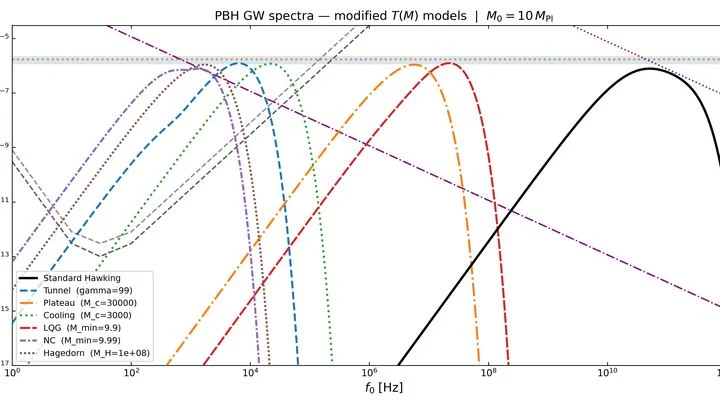
Primordial black holes behave like boiling kettles: as they evaporate, they whistle gravitational waves. The character of the whistle, its spectrum, depends on how the hole's temperature relates to its mass.
IBM's Heron R3 quantum computer handled a task that made a classical method back down. The challenge was finding the ground state, the lowest energy level, of a system of 49 quantum bits.
Light trapped in a tiny cavity is like a pendulum that gets pushed harder and harder. At first, it swings smoothly and predictably, like an ordinary clock. But if you push it hard enough, the motion becomes strange: the pendulum seems to be in two extreme positions at once.