Scientist

Juan Maldacena

1968 – present · string theory, quantum gravity, quantum field theory
Argentine theoretical physicist, who proposed the AdS/CFT correspondence (Maldacena conjecture), which links string theory in anti-de Sitter space with conformal field theory on its boundary. This revolutionary discovery made it possible to study strongly interacting quantum systems through gravity and vice versa.

Biography

Received his PhD from Princeton University in 1996. Worked at Harvard, and since 2001 has been a professor at the Institute for Advanced Study in Princeton. Recipient of numerous awards, including the Lorentz Medal, the Gruber Prize in Cosmology, and the Fundamental Physics Prize.
Key discoveries

💡 Maldacena is one of the most cited physicists of today; his 1998 paper on AdS/CFT has accumulated tens of thousands of citations.
"He viewed the universe as arranged in such a way that the apparent complexity of a black hole can be described by a simple theory on the boundary."
Concepts
string theoryblack holegravity
Laws
AdS/CFT correspondence
Scientists
Robert HookeFritz ZwickyJacob BekensteinSubrahmanyan ChandrasekharRainer WeissStephen HawkingKarl SchwarzschildJoseph Weber

Related articles

A Black Hole as a Bridge: Beyond the Singularity Lies a World of Antigravity
A century ago, Einstein's equations predicted black holes, but inside them physics broke down: particle trajectories ended at the singularity, a point of infinite curvature. It was a dead end, the end of spacetime. Now physicist Itzhak Bars proposes a radical twist: the singularity is not a wall but a door.
General Relativity2025-11-271 minarXiv:2511.22671express
Echo in a Wormhole
A wormhole is a tunnel that pierces through curved space and connects distant regions of the Universe. Recently, Juan Maldacena and his colleagues proposed a working model of such a hole based on a special combination of spatial curvature and quantum particles.
Quantum Physics2025-12-011 minarXiv:2512.02156express
Hidden Wormholes in the Hydrogen Atom
Two water droplets tremble in sync — because they're connected by a straw. So it is with entangled particles: their unity may be held together by a microscopic wormhole.
High Energy2026-01-051 minarXiv:2601.02487express
Why Magnetic Fields Make Black Holes Quiet
At the centers of many galaxies lurk supermassive black holes, surrounded by disks of gas, cosmic dust, and stars. Their collisions can spawn gravitational waves — ripples in spacetime.
Quantum Physics2026-01-221 minarXiv:2601.16275express
Quantum Strings Resonate in a Rydberg Chain
Physicists built a chain of Rydberg atoms — atoms with electrons in enormous orbits, comparable to planetary paths. These giant atoms feel their neighbors intensely, turning the chain into a quantum analog of a string.
General Relativity2026-02-141 minarXiv:2602.13609express
A black hole can turn into a wormhole
An ordinary black hole is a bottomless pit from which not even light can escape. However, physicists have found a way to turn this pit into a through-tunnel — a wormhole.
General Relativity2026-02-151 minarXiv:2602.14182express
Wormhole Shadow: Sharp Angles When Rotating
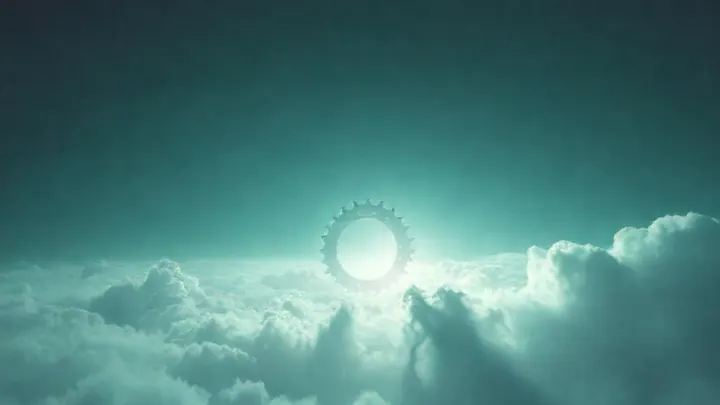
A wormhole is a tunnel through space, connecting distant regions of the Universe. Its shadow against a bright gas background was long thought to be as round as that of a black hole. But for a rotating wormhole (one you could actually traverse), the shape of the shadow might be surprising: the edge becomes jagged, like a gear.
Hidden Pathways Across an Ocean Desert
Thousands of kilometers of open ocean separate the reefs of the central Pacific from the sparse coral outposts to the east. This stretch of water, known as the Eastern Pacific Barrier, has long been considered nearly impassable for tiny coral larvae. The currents here mostly carry water westward, away from the eastern islands.
HEP Theory2026-04-111 minarXiv:2604.10090express
Wormhole on a quantum chip
Physicists found out: to open a wormhole, you have to shake it hard. Not literally — but on a quantum chip, they simulated a system of 8 particles, so chaotic and entangled that it turned into a vibrating hologram of a black hole.
HEP Phenomenology2026-04-163 minarXiv:2604.15445express
Quantum Whispers in Scale-Free Silence
A stone drops into a pond. Ripples spread, fade, and soon the surface is smooth again. But what if the pond has no shores, no bottom, and no characteristic ripple size? That is the world, a scale-free world, where quantum systems live when surrounded by an environment that picks out no particular length or energy.
General Relativity2026-04-171 minarXiv:2604.15965express
Dancing Black Holes Put the Universe's Geometry to the Test
The merger of two black holes is like a dance that ends in a powerful burst — a gravitational wave. This wave carries the imprint of how spacetime is curved around the objects. If the geometry differed from what we're used to, as if a ball rolled not on a flat floor but on wavy linoleum, the signal would be different.
General Relativity2026-04-252 minarXiv:2604.23163express
The Quantum Whisper of Black Holes
At the center of a vast funnel sucking everything in, a small ball spirals inward. As it orbits, a low hum arises: it's spacetime itself trembling, and we call that trembling gravitational waves. The frequency rises, the pitch climbs, just like the sound of a siren from a passing ambulance.
General Relativity2026-04-292 minarXiv:2604.27185express
Gravitational Waves See No Split in Black Holes
The trembling of space sounds like an orchestra. Gravitational waves caught by the LIGO and Virgo detectors tell of black hole collisions. Sometimes the music carries off-key notes — tiny deviations from Einstein's score. They might whisper of new physics or simply of dust on the bows.
General Relativity2026-04-302 minarXiv:2604.27880express
Black Hole with a Fluffy Core
A pencil dropped on the floor hits with its entire surface at once. But if the floor were quantum, made of countless vibrating grains of sand, the pencil would never touch a single point.
Gravitational Duet: How Entangled Masses Listen to the Whisper of Other Dimensions
The universe, according to the Standard Model, seems to be a three-dimensional canvas upon which familiar physics unfolds. Yet deep down, beyond the threshold of the everyday, there may be curled-up, invisible dimensions — six or seven tightly wound loops, as predicted by string theory.
HEP Theory2026-05-022 minarXiv:2605.01453express
Hidden Symmetry: How Particles Negotiate Their Own Rules
In particle physics, it has long been taken for granted that the forces of nature (electromagnetism, the weak and strong interactions) obey a strict symmetry called gauge symmetry. It's like a set of rules by which particles exchange force carriers. But where do the rules themselves come from?
General Relativity2026-05-021 minarXiv:2605.01602express
Five-Dimensional Wormholes
You can poke a pencil through a folded sheet of paper, and the path between two points becomes shorter. That's roughly how the idea of a wormhole works: a tunnel in space connecting distant regions.
General Relativity2026-05-042 minarXiv:2605.02453express
How to Hear a Crack in the Fabric of the Universe
The symphony plays, but a barely perceptible wrong note has crept into the score. This is roughly how physicists search for deviations from general relativity in the 'sounds' of the universe — gravitational waves from merging black holes.
Strongly Correlated2026-05-052 minarXiv:2605.03700express
Quantum Pendulum on a Sphere and a Torus
A pendulum swings not in a single plane but in five dimensions at once. Its motion is described by a complex mathematical model, and the pendulum itself is an electron in a graphene sheet interacting with five different "flavors" of its environment.
HEP Theory2026-05-051 minarXiv:2605.04032express
How Gravity Dictates Patterns in the Quantum World
A stone thrown into a pond leaves ripples spreading across the water. In quantum physics, the role of such ripples is played by equations that relate the properties of particles. Recently, mathematicians proposed a set of such equations for a world without gravity but with a large number of 'degrees of freedom'—roughly like the complex ripples on water.
Gravitational Shooting Gallery: Sighting in on Black Holes
When black holes approach and then fly apart — without merging, just grazing each other's gravitational fields — they become ideal projectiles for testing the laws of gravity. In extreme fields, where time dilation reaches monstrous magnitudes, any crack in the theory would flash dazzlingly bright.
Gravitational Shadows: How Mass Splits Reality
A massive nanodiamond inside a quantum interferometer splits in two, pulling itself into two realities. Its gravity — tiny, almost imperceptible — stirs the quantum field of the vacuum, giving rise to coherent clouds of gravitons. These are the gravitational shadows cast by each position of the mass.
HEP Theory2026-05-062 minarXiv:2605.05178express
How Supersymmetry Hides Charges in Black Holes
A stone falls into a pond — ripples spread across the water. In physics, a similar conservation law works for energy and momentum: what goes in comes out. But in curved spacetime, where gravity rules, conserved quantities are harder to define.
HEP Theory2026-05-062 minarXiv:2605.05336express
Wormholes Set Limits on Imagination
Spacetime sometimes resembles a sheet of paper in which you can punch a hole and connect the edges with a short tube: you get a wormhole. In the simplest mathematical models of such wormholes, massless scalar fields appear — something like an invisible fog filling everything around.
General Relativity2026-05-082 minarXiv:2605.07187express
Black Hole Without a Singularity: Particles Dancing to Quantum Music
A stone falls into a well, and a second later, a splash. A star falls into a black hole, and disappears beyond the horizon, leaving only a ripple in space. But what if the bottom of the well is not a dead end but a passage? In the usual picture, matter compresses into a point of infinite density — a singularity.
HEP Theory2026-05-082 minarXiv:2605.08058express
Cosmic Doughnuts with a Gravity Filling
A mathematical doughnut, a torus, sits on the boundary of a three-dimensional world where gravity acts. You can crumple and stretch it, and physicists decided to see how it behaves. Inside this world, space can be flat like a table, expanding like a soap bubble, or curved like a saddle. The doughnut boundary refused to stay smooth.
Cosmic Instrument: Resonant Songs of Rotating Wormholes
Einstein and Rosen imagined a bridge connecting two sheets of reality. Wheeler gave it a name — wormhole, and Thorne with Morris proved: the tunnel is traversable if you fill it with exotic matter.
HEP Theory2026-05-121 minarXiv:2605.12590express
Gravity from Hundreds of Universes
A patchwork quilt where each patch is a tiny quantum knot obeying strict mathematical rules. Physicists took many identical such knots and started sewing them together in all possible ways. The result was three-dimensional shapes — from simple spheres to intricate bagels with holes.
Geometry's Verdict: Why Wormholes Are Doomed to Exoticity
Since time immemorial, physicists have dreamed of tunnels piercing the cosmos — wormholes, capable of connecting far-flung corners of the Universe in an instant.
HEP Theory2026-05-151 minarXiv:2605.15776express
The Perfect Mirror: Quantum Fields on a Donut and the Geometry Within
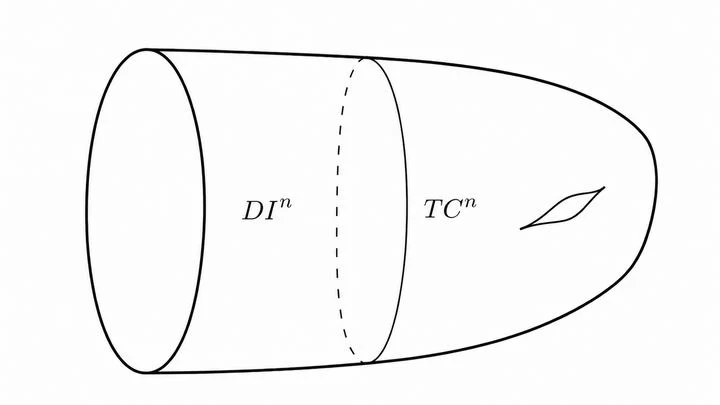
On a donut-shaped ring, the theory lives on the surface, while inside hides a curved space — like a saddle widening toward the edge. According to the holographic principle of Juan Maldacena, everything happening inside can be described by data on the boundary.
General Relativity2026-05-181 minarXiv:2605.18376express
Wormholes Without Exotic Matter
A wormhole is a tunnel through the fabric of spacetime, an idea expanded by John Wheeler and Kip Thorne. Just as a mountain passage tends to cave in, the throat of a wormhole wants to snap shut.
General Relativity2026-05-192 minarXiv:2605.20493express
Electricity and Magnetism Swap Roles — Black Holes Don't Notice the Switch
Two electrically charged spheres attract each other with a certain force. If you replace their charges with magnetic poles, a spring scale shows exactly the same force. Black holes, it turns out, behave the same way — except instead of springs, the fabric of spacetime itself does the work.
General Relativity2026-05-231 minarXiv:2605.28871express
Black Hole Shadows Put Quantum Gravity to the Test
The shadow of a black hole is not just a silhouette. It's the edge of the abyss, where space and time are twisted so tightly that even light is forced to swirl like a wood chip in a whirlpool. This 'cosmic whirlpool' arises from the monstrous mass warping spacetime.
General Relativity2026-05-312 minarXiv:2606.01141express
A Rotating Wormhole Without Exotic Matter
A wormhole is a hypothetical tunnel in curved spacetime connecting two distant regions of the universe and potentially shortening the journey between them.
HEP Theory2026-05-312 minarXiv:2606.01167express
How Logarithmic Divergence Hides in Higher-Dimensional Spaces
An infinitely long tube with a tiny sphere attached to each point: that's what the space the authors worked with looks like. One part of it resembles a saddle (this is anti-de Sitter space, or AdS), the other a sphere.
HEP Theory2026-05-312 minarXiv:2606.01296express
Wormholes Between Theories: How to Compare Quantum Worlds
Every quantum system (whether an atom, a crystal, or the entire Universe) has its own set of allowed energies, like the steps of a ladder. The hotter the system, the more readily particles climb to higher rungs.
Phantom Glow: A Wormhole's Shadow Shines Brighter Than a Black Hole's
In 2019, the image of the M87* shadow was a sensation: for the first time, humanity saw the outlines of a black hole, predicted by Schwarzschild and shrouded in myth. But what if that glowing crescent isn't a portrait of an absolute abyss, but of a cosmic portal?
Echoes of Black Holes: How Gravitational Sirens Reveal the Curvature of the Universe
It was Edwin Hubble who discovered that galaxies are rushing apart, and Georges Lemaître linked this to the expansion of space. Today, the ΛCDM model, relying on dark energy and dark matter, asserts that the Universe is flat as a perfectly stretched canvas.