Popular

David Deutsch

1953- · quantum physics, quantum computing, philosophy of science
British theoretical physicist who laid the foundations of quantum computing. He formulated the concept of a universal quantum computer and showed how quantum parallelism can solve problems inaccessible to classical machines. A strong advocate of the many-worlds interpretation of quantum mechanics, Deutsch argues that quantum computers draw their power precisely from parallel universes. His work blurs the line between physics, computer science, and philosophy.

Biography

Born in Haifa, Israel. Studied physics at Cambridge, received his doctorate from Wolfson College, Oxford. Began thinking about quantum computing in the 1970s, and in 1985 published the revolutionary paper 'Quantum Theory, the Church–Turing Principle and the Universal Quantum Computer'. He is a visiting professor at Oxford University and one of the founders of the Centre for Quantum Computation. Author of popular books 'The Fabric of Reality' and 'The Beginning of Infinity', in which he expounds his vision of science and progress.

Key discoveries

💡 Deutsch considers the quantum computer a literal window into parallel worlds: in his view, computation is distributed across the multiverse. His book 'The Beginning of Infinity' asserts that knowledge has no limits and that with sufficient scientific advancement, any problems are solvable.
Quote: "The most important thing to understand about quantum mechanics is that parallel universes are not just a mathematical abstraction, but reality."
Links in the knowledge graph 1
Related tags
quantum algorithmquantum computerquantum entanglementquantum informationsuperposition
Related laws
superposition principle
Related scientists
Alain AspectErwin SchrödingerLouis de BroglieJohn Stewart BellNiels BohrSerge HarocheDavid BohmCharles Bennett

Related articles

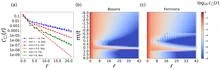
The Skyrmion Dance: How a Magnetic Vortex Conducts the Quantum Orchestra

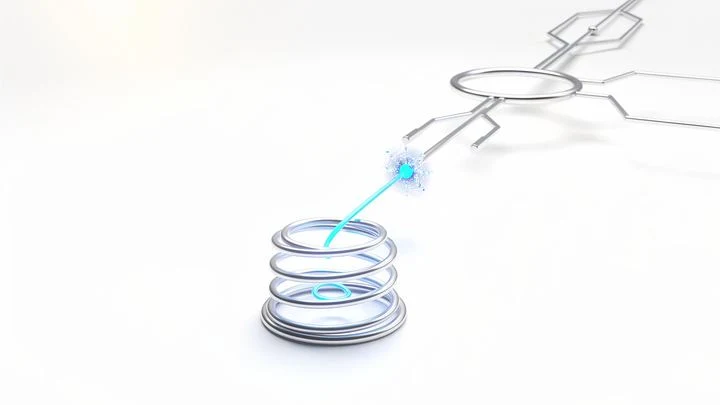
A hybrid quantum system has been proposed, combining long-lived spin memory, a fast superconducting processor, and a topologically protected mediator — a magnetic skyrmion. Its oscillations bridge the atomic world of defects with macroscopic circuits, overcoming the scale chasm. Calculations promise
arXiv:2505.00266v1 · 2025-05-01

Quantum Boomerang: Fugue in a Detuned Orchestra

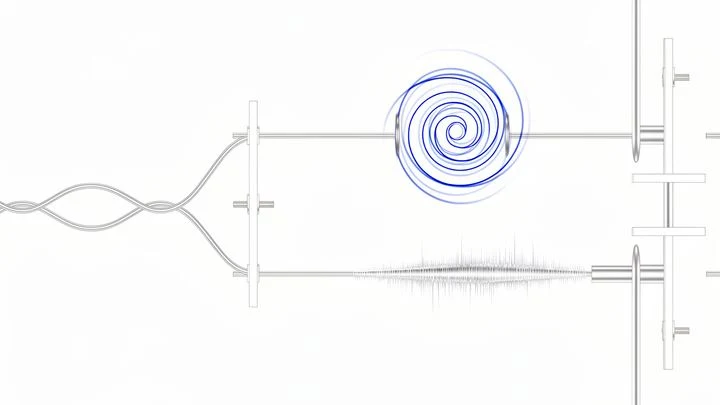
Disordered quantum systems usually stifle any transport, but new simulations have revealed a quantum boomerang: in a discrete walk, the wave packet returns, only not to the starting point, but to the opposite end. The internal state of the coin particle creates an asymmetry without external force—li
arXiv:2505.01532v1 · 2025-05-02

A Glass Loom for Light: 99.7% Fidelity Across 24 Quantum Threads

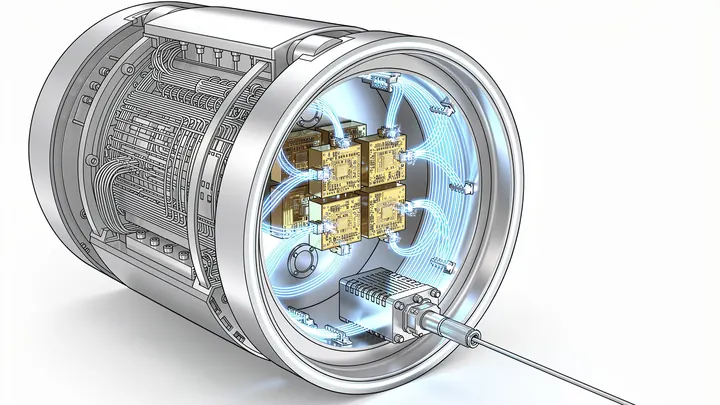
Researchers from Ephos and the Polytechnic University of Milan inscribed a 24-mode universal photonic processor into glass, using femtosecond lasers like a sewing machine needle. Operating at 925 nm—ideal for quantum-dot single-photon sources—the device is controlled by microheaters and uses less po
arXiv:2505.01609v2 · 2025-05-02

When Quantum Meets Gravity, Weirdness Fades

Mixing quantum theory and gravity often requires bending the rules into nonlinear forms. A fresh study uncovers a stunning side effect: this bending kills contextuality—the hallmark of quantum strangeness where a particle’s properties depend on how you look. If real, these models would make the worl
arXiv:2506.04298v1 · 2025-06-04

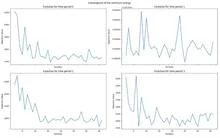
How Noise Turns Order into Chaos on a Quantum Chip

Physicists ran two programs on a superconducting chip: an orderly one and a chaotic one. By measuring the distances between energy levels, they found that in chaos, these levels keep a respectful distance, like people in a crowded room forming a circle. On a graph, this looks like a 'donut'—an empty
arXiv:2506.04325v1 · 2025-06-04

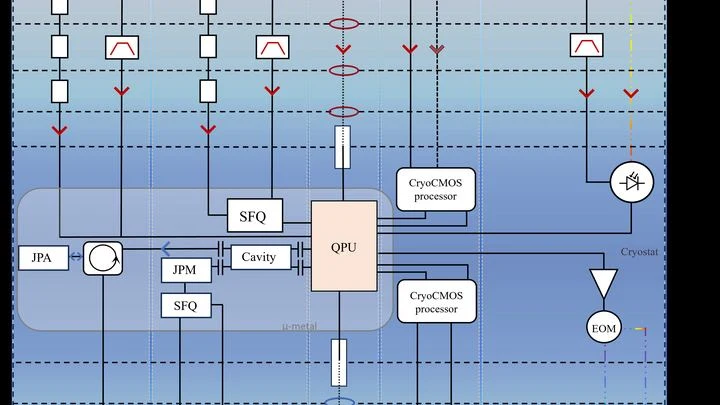
Precise tuning of quantum gates without compromising readout

A new tuning technique made it possible to combine ultra-precise single-qubit and two-qubit operations with high-quality readout. Previously, one harmed the other, but now a balance has been found. This is an important step toward computers that can correct their own errors.
arXiv:2508.16437 · 2025-08-22

How to Swap Your Reality Without Knowing

A new idea called reality steering lets you switch between parallel branches of reality by erasing your memory of an event. The catch: the switch is invisible from the inside, so you can never be sure it happened. This turns philosophical 'what if' questions into a precise physics puzzle.
arXiv:2512.14377 · 2025-12-16

Magnetic Walls — The Key to Quantum Computers

The boundaries between magnetized regions can be moved like a wave through a row of dominoes. These mobile walls are perfect candidates for quantum bits: they carry information while dodging interference and could lead to compact devices that don't need ultra-low temperatures.
arXiv:2604.19304 · 2026-04-21

A Trap for 11,000 Atoms: A Step Towards a Quantum Computer

Using a flat metasurface the size of a coin, replacing bulky lenses, scientists trapped 11,000 atoms for the first time. This breakthrough paves the way to quantum computers with tens of thousands of qubits, capable of solving problems beyond the reach of ordinary machines.
arXiv:2606.02715 · 2026-06-01

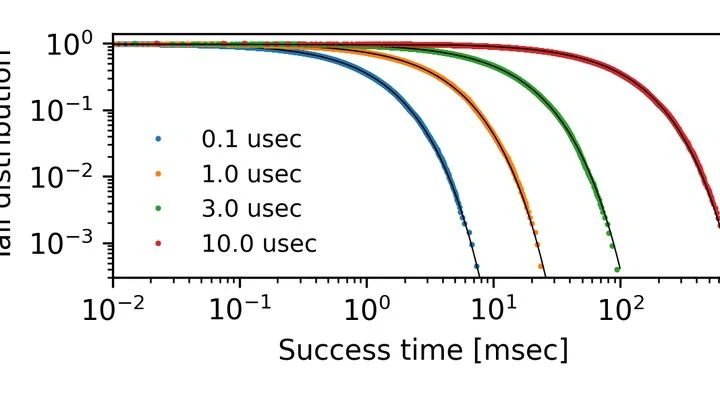
Quantum sieve catches one-in-a-million glitches

Predicting rare disasters—market crashes, AI glitches—is nearly impossible. Classical computers demand oceans of data or predefined checklists. A new quantum algorithm flips this: it uses the blurry nature of qubits to amplify the faintest warning signs, offering a safety net for banks, power grids,
arXiv:2606.06316 · 2026-06-04

Quantum Computer Learns to Play Without a False Note

Automatic tuning of quantum gates, like a musical instrument, reduced failures to 0.007%. The method remains stable for hours without human intervention — an important step toward reliable quantum computers.
arXiv:2607.01422 · 2026-07-01