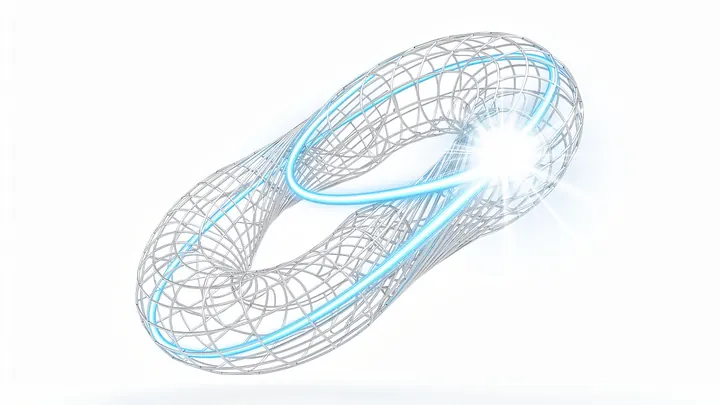
The torus universe quantum gravity model is a theoretical framework in which the universe is assumed to have the topology of a torus (a doughnut shape) rather than the standard flat or spherical geometry. This model is used to study quantum gravity and quantum field theory because the compact, periodic nature of a torus simplifies certain mathematical calculations, such as the quantization of fields and the behavior of particles in a finite space. It allows physicists to explore how the large-scale structure of the universe might affect fundamental interactions and the nature of spacetime itself.
History
The idea of a torus universe has been explored since the early 20th century, but it gained prominence in the 1980s and 1990s with the development of quantum cosmology and string theory. Physicists like Alexander Vilenkin and others have considered toroidal topologies as possible models for the universe, particularly in the context of the 'small universe' hypothesis.
How it works
In a torus universe, space is finite but unbounded, meaning that traveling in a straight line eventually brings you back to your starting point. This compactness introduces periodic boundary conditions, which alter the allowed wavelengths of quantum fields and can lead to phenomena like the Casimir effect. In quantum gravity, the torus topology provides a manageable setting for testing theories like loop quantum gravity or string theory, where the geometry of spacetime is quantized. By studying how gravity behaves on a torus, researchers can gain insights into how quantum effects might modify the fabric of the universe on the smallest scales.
In practice
The torus universe model is used in theoretical research to study the effects of topology on quantum fields, the early universe's structure, and the possible signatures of extra dimensions in cosmic microwave background radiation.
Fun fact
In a torus universe, if you looked far enough in any direction, you would see the back of your own head, because light would have traveled all the way around the universe and returned to you.
Electrons in a solid usually either run freely (metal) or are locked in place (insulator). But sometimes strong mutual repulsion locks them into a halfway state: charges stand still, while spins, tiny magnetic arrows, continue to live their own life. This is called a Mott insulator.
In the standard picture, black holes are the undisputed density champions: all their matter is squeezed into a single point. Imagine the entire mass of Mount Everest packed into a grain of salt. But physicists have found a theoretical trick.
At the center of almost every large galaxy lurks something supermassive and dark. Most often, that something is thought to be a black hole — a region where gravity is so strong that even light cannot escape. But what if it's not a black hole, but a dense ball of ultralight particles — a boson star?
A patchwork quilt where each patch is a tiny quantum knot obeying strict mathematical rules. Physicists took many identical such knots and started sewing them together in all possible ways. The result was three-dimensional shapes — from simple spheres to intricate bagels with holes.
The quantum birth of the Universe is like a game of dice, where the chance of rolling a six is catastrophically small. The formalism of Hawking and Hartle, an elegant recipe for a world born from timelessness, has spent decades predicting that a universe like ours is fantastically improbable.
An invisible film, a quantum field, is stretched over a rubber bagel. While the bagel is small, the film stays taut and doesn't sag anywhere: the vacuum remains empty. But once you stretch the bagel to a certain size, a dent spontaneously appears in the film — the field starts to be felt at every point.
This dent is not random.
The law discovered by Wolfgang Pauli forbids identical particles from occupying the same spot. Hence, in cold matter, a Fermi sea is born: particles, like water, fill energy levels from bottom to top. The shape of the sea's surface — including 'islands' of emptiness — dictates the properties of the whole system.