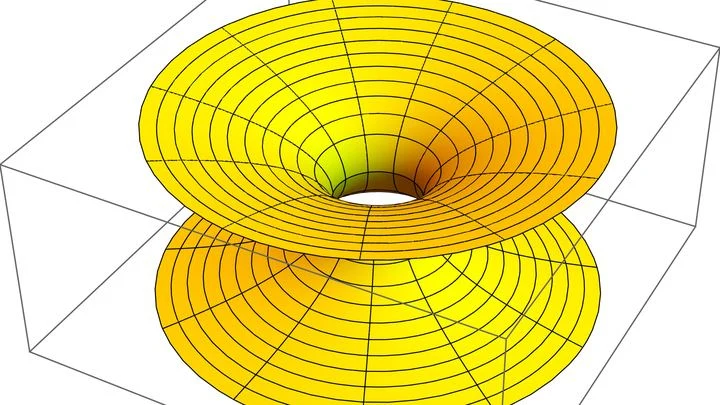
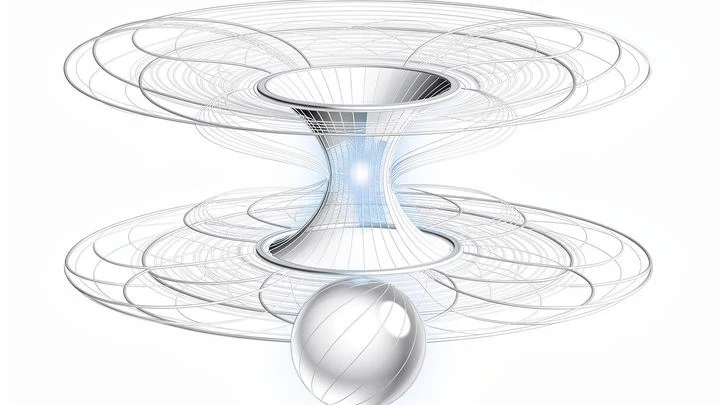
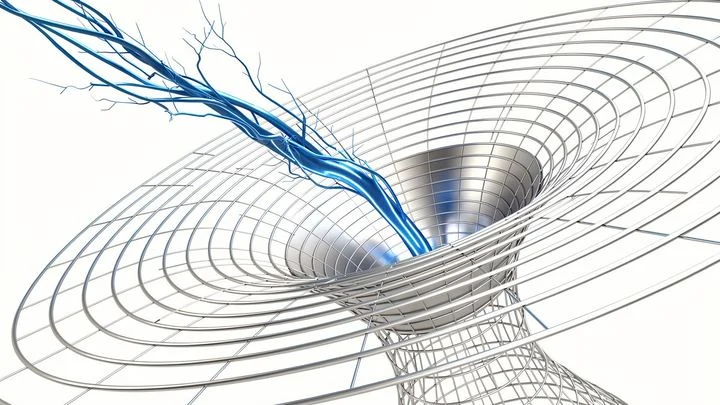
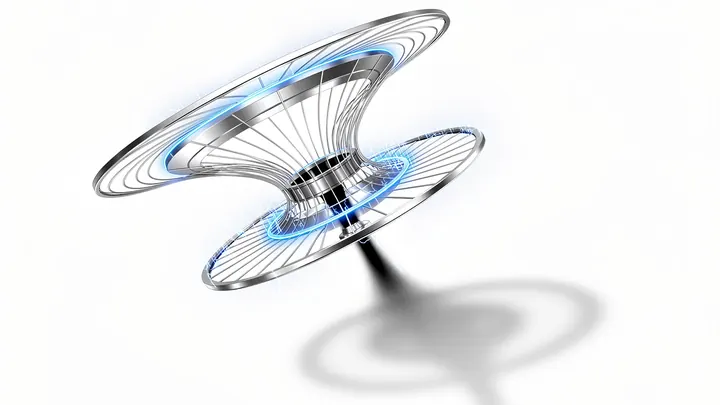
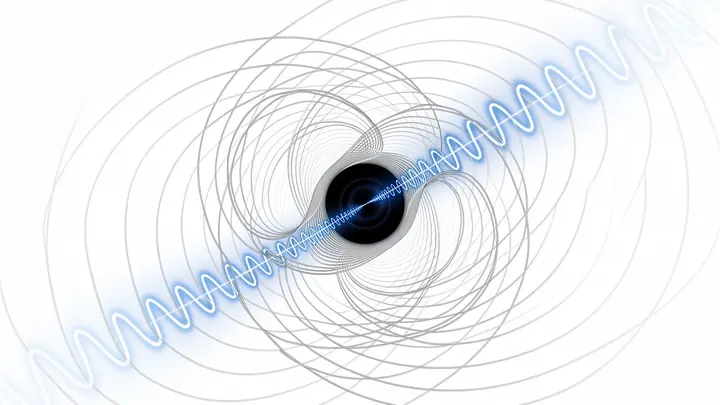
A wormhole is a hypothetical structure allowed by general relativity that connects two points in spacetime like a handle. It could link distant regions of the same universe or different universes. To keep the hole open for passage, exotic matter with negative pressure is needed, violating the usual energy conditions.
History
In 1916, Ludwig Flamm, interpreting the Schwarzschild solution, proposed the idea of a 'wormhole'. Einstein and Rosen in 1935 described the bridge as a geometrized model of an elementary particle. The term 'wormhole' was introduced by John Archibald Wheeler in 1957 in the context of quantum foam. Modern interest revived after the paper by Morris and Thorne, which showed the possibility of travel provided exotic matter exists.
How it works
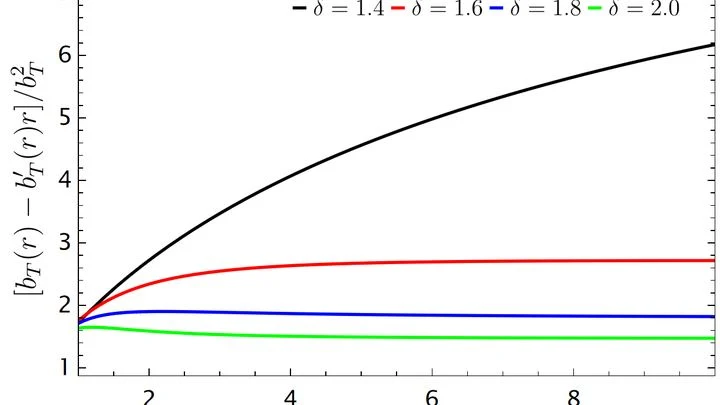
Einstein's equations link geometry (the Einstein tensor Gμν) to matter (the energy-momentum tensor Tμν). For a wormhole, the metric is given as ds² = -e^{2Φ(r)}c² dt² + dr²/(1 - b(r)/r) + r² dΩ². The absence of a horizon requires Φ(r) to be finite everywhere. Traversability imposes conditions on b(r) and Φ(r), and also requires violation of the null energy condition (negative energy). Quantum effects, such as the Casimir effect, provide such a possibility.
In practice
So far pure theory, but wormhole research advances quantum gravity and may one day underlie superluminal communications or travel.
Fun fact
If you looked through a wormhole, you could see a distorted, lens-like but recognizable image of the other end — perhaps a star or galaxy that would otherwise take millions of years to reach.
A river drawn on a map is always a single line. But stand on the bank, and you will see that within the channel there are faster currents, eddies, and branches that merge and split. The cosmic web is like that river, but made of dark matter, and until recently astronomers drew it as a single line.
A vortex in a magnetic material is like a whirlpool, but instead of water, the directions of magnetization twist. An electron flying through such a vortex feels not just a magnetic field, but a curvature of space: its path bends as if it were rolling down a funnel with a narrow neck.
The idea was elegant: take a BTZ black hole (the three-dimensional analog of a regular black hole) and smooth its horizon with a special function. The hope was that inside, the spacetime signature might change — time becoming space, and space becoming time. But the calculations showed otherwise.
The universe isn't just a place; it's a schedule of events: what happened earlier and what happened later. In Einstein's geometry of spacetime, this schedule sometimes breaks off. For instance, inside a black hole, particle paths run into a singularity — an edge beyond which the equations stop.
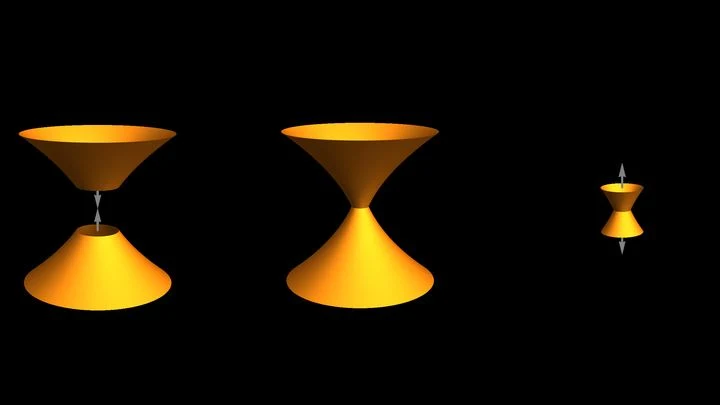
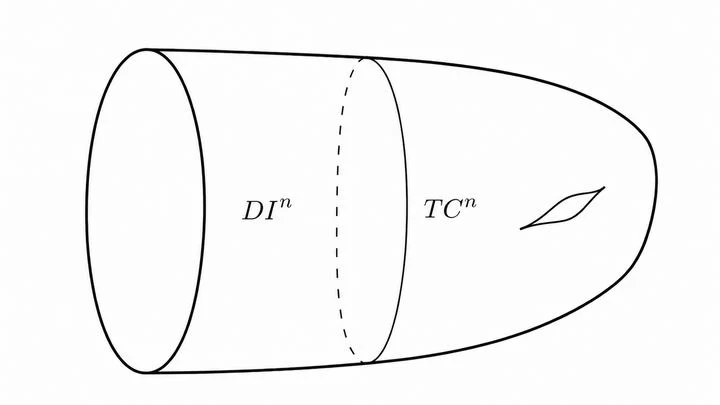
The neck of an hourglass is the narrowest point where grains of sand change sides. In quantum gravity, there is a similar object: an instanton (an instantaneous solution connecting two states of space). It acts like a tunnel through which the geometry of the universe flows from one form to another.
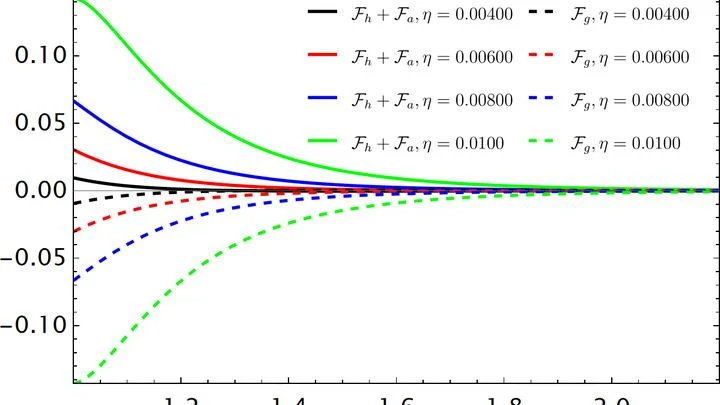
A black hole is not an eternal vacuum cleaner. Surround it with a non-ideal fluid (matter with internal friction), and the geometry starts to lead a life of its own. The authors of the paper showed that a special geometric flow, the almost η-Ricci–Yamabe soliton, acts like an invisible sculptor.
Two metal plates in a vacuum attract each other without any magnets or charges. This is the Casimir effect: the void is not empty; particles constantly pop in and out of existence, and there are fewer of them between the plates than outside. The pressure difference pushes the plates together.
A stone falls into still water, and smooth rings spread across the surface. If the stone doesn't just fall but also spins, tiny whirlpools, vortices, appear on the surface. Light can do the same, only instead of water, it's space and time themselves.
A black hole usually hides its singularity behind an event horizon — an invisible boundary from which not even light can escape. But sometimes this 'cloak' is absent, and the singularity, a point where familiar physics breaks down, is exposed to an outside observer.
It all starts with a tiny scar — a thin tunnel connecting two universes. In quantum cosmology, there has long been discussion that our closed universe could have been born from "nothing" via tunneling (a process where a system overcomes a barrier that is insurmountable by ordinary standards).
In the microscopic world, noise, random fluctuations, usually destroys fragile quantum states, much like ripples on water break the reflection in a puddle. However, in some systems, collective, coordinated noise from many particles produces the opposite effect: a stable unidirectional flow emerges.
A wormhole is a tunnel connecting two distant regions of the universe. If such a wormhole existed and were traversable, a particle inside it would feel not only gravity but also a force from its own electric field. This force depends on how spacetime is curved around it.
The black hole paradox has haunted physicists for decades. If a hole evaporates, where does its contents go? Discoveries by Stephen Hawking and Jacob Bekenstein showed that saving the laws of nature requires an unconventional move.
Imagine the universe as a woven blanket of invisible threads.
Wormholes — tunnels through curved spacetime, allowed by general relativity. To be stable, they need repulsive energy — the kind that pushes apart rather than attracts.
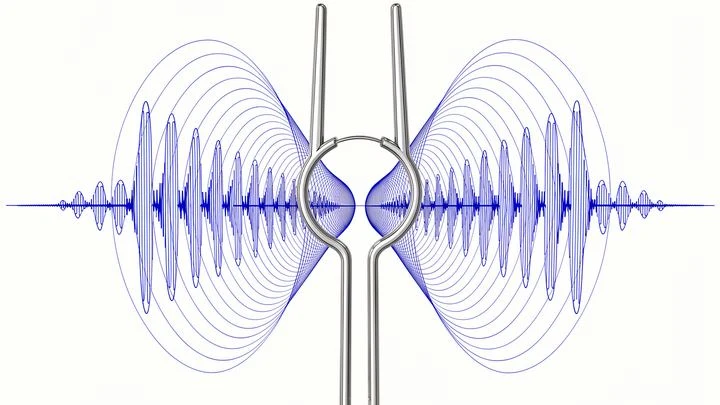
A wormhole is like a tunnel with a very narrow throat. If you send a sound signal into such a tunnel, part of the echo returns, while part gets stuck in the middle, and will leak out very slowly.
Usually, a wormhole is imagined as a tunnel in space, whose walls are held open by something unusual — matter with negative energy. Like the supports in a mine that keep the ceiling from collapsing. But in this work, the physicists did without supports.
A black hole is like a pot that slowly boils away. Its surface emits particles, a process known as Hawking radiation. The hotter the pot, the faster it empties. But what if the pot is not ordinary, but has a double bottom — capable of turning into a passage to another place?
In 2019, the image of the M87* shadow was a sensation: for the first time, humanity saw the outlines of a black hole, predicted by Schwarzschild and shrouded in myth. But what if that glowing crescent isn't a portrait of an absolute abyss, but of a cosmic portal?
A wormhole is a hypothetical tunnel in curved spacetime connecting two distant regions of the universe and potentially shortening the journey between them.
Every quantum system (whether an atom, a crystal, or the entire Universe) has its own set of allowed energies, like the steps of a ladder. The hotter the system, the more readily particles climb to higher rungs.
Spacetime is like a giant sheet of paper. Fold it, and distant corners come together. Poke a pencil through, and you get a wormhole, a short tunnel through the folds. But the paper wants to spring back flat, snapping the passage shut. To keep it open, you need a rare “gasket”—matter with negative energy.
Some solutions to Einstein's equations allow closed timelike curves — loops that let you travel to the past. Two well-known designs, the Ori geometry and the Ahmed geometry, do without exotic matter, catching physicists' eyes.
Black holes come in lightweights, born from dying stars, and supermassive ones at galactic cores. The missing intermediate link had been hiding. Fast radio bursts, cosmic signals lasting milliseconds but carrying the energy of days of sunlight, helped crack the case. Think of these bursts as cries from the depths of the universe.
A wormhole is a tunnel through the fabric of spacetime, an idea expanded by John Wheeler and Kip Thorne. Just as a mountain passage tends to cave in, the throat of a wormhole wants to snap shut.
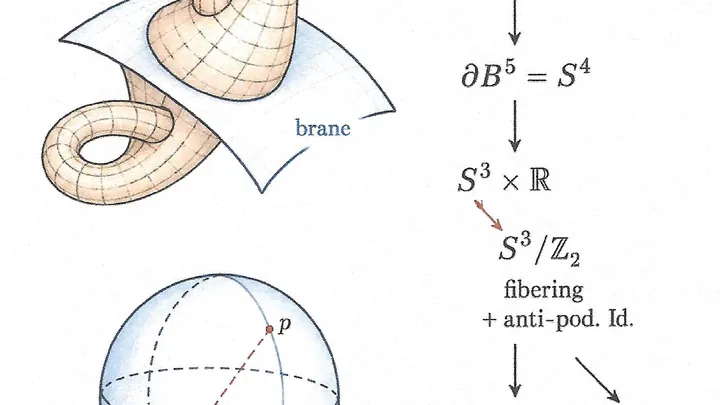
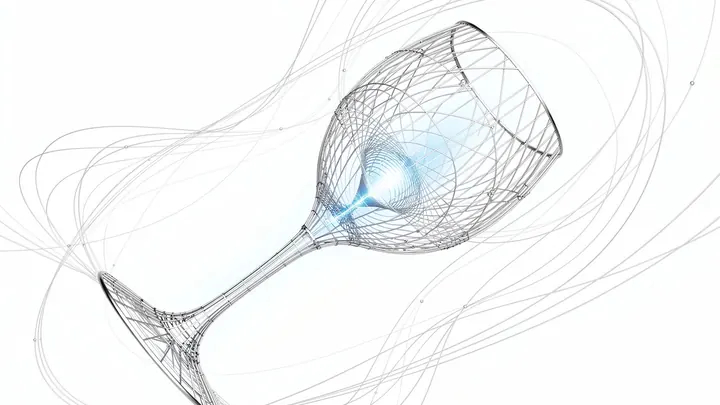
First thing that comes to mind when thinking about the birth of the Universe is an explosion. But modern cosmology paints a more refined picture: birth through the neck of a wine glass. This geometry is not a sommelier's fantasy, but a rigorous form of Euclidean wormhole that connects two anti-de Sitter worlds.
First thing that comes to mind when thinking about the birth of the Universe is an explosion. But modern cosmology paints a more refined picture: birth through the neck of a wine glass. This geometry is not a sommelier's fantasy, but a rigorous form of Euclidean wormhole that connects two anti-de Sitter worlds.
Since time immemorial, physicists have dreamed of tunnels piercing the cosmos — wormholes, capable of connecting far-flung corners of the Universe in an instant.
A patchwork quilt where each patch is a tiny quantum knot obeying strict mathematical rules. Physicists took many identical such knots and started sewing them together in all possible ways. The result was three-dimensional shapes — from simple spheres to intricate bagels with holes.
Cosmology has long sought a loophole behind the Big Bang. Inflation, proposed by Alan Guth, stretches and smooths out primordial inhomogeneities, but what lit the fuse itself?
Cosmology has long sought a loophole behind the Big Bang. Inflation, proposed by Alan Guth, stretches and smooths out primordial inhomogeneities, but what lit the fuse itself?
Einstein and Rosen imagined a bridge connecting two sheets of reality. Wheeler gave it a name — wormhole, and Thorne with Morris proved: the tunnel is traversable if you fill it with exotic matter.
The shadows of supermassive objects at the centers of galaxies, M87 and the Milky Way, have become icons of modern astrophysics. But what if these shadows are not from absorption, but passage? The equations of Einstein allow for traversable wormholes — tunnels in the fabric of spacetime.
Spacetime sometimes resembles a sheet of paper in which you can punch a hole and connect the edges with a short tube: you get a wormhole. In the simplest mathematical models of such wormholes, massless scalar fields appear — something like an invisible fog filling everything around.
The shadows of supermassive objects at the centers of galaxies, M87 and the Milky Way, have become icons of modern astrophysics. But what if these shadows are not from absorption, but passage? The equations of Einstein allow for traversable wormholes — tunnels in the fabric of spacetime.
You can poke a pencil through a folded sheet of paper, and the path between two points becomes shorter. That's roughly how the idea of a wormhole works: a tunnel in space connecting distant regions.
The term 'wormhole'—coined for physics by John Archibald Wheeler in 1957—still teases the imagination. It's a hypothetical tunnel through curved spacetime, connecting distant regions of the Universe or even different universes.
A drop of cream falls into a cup of coffee, and within a minute, the entire drink turns beige. This mixing process can be quantified: how much "stirring" is needed to transform one distribution of particles into another? In mathematics, this approach is called optimal transport, and the measure of effort is the Wasserstein distance.
The authors applied this idea to quantum systems.