Are you one of the authors of this paper? Email us from your institutional or work email address mentioning this article's arXiv ID and we'll verify you and give you edit access to this page.
Are you an author who sees something we missed or got wrong? Write to us — the subject line already carries the paper id. We read every note and correct the write-up.
A new analysis of data from the upcoming Euclid telescope will help peer into the first moments after the Big Bang.
📄 Showing the "Simple" version — "Advanced" is not ready yet. Add it to favorites to help prioritize it.
The Universe was born in the Big Bang and immediately underwent an ultrafast expansion — inflation. Quantum jitters imprinted themselves on the fabric of space like ripples on water from a tossed stone. These ripples became the seeds of galaxies. Usually the waves are random, but if inflation was complex, some crests are slightly higher — the shape isn't a perfect circle. Catching such a skew means reading the story of the first moments.
The European Euclidtelescope will be able to check this. In their model, scientists combined two approaches: one measures the overall height of the ripples, the other catches triangular patterns from neighboring crests. Together they reduce noise and double the accuracy. The cleanest signal comes from distant galaxies half the age of the Universe. To avoid being fooled, the galaxy data is correlated with a dark matter map — the invisible scaffolding of the cosmos. This way, we can tell whether inflation was simple or multi-field, much like figuring out if one stone or several made the ripples.
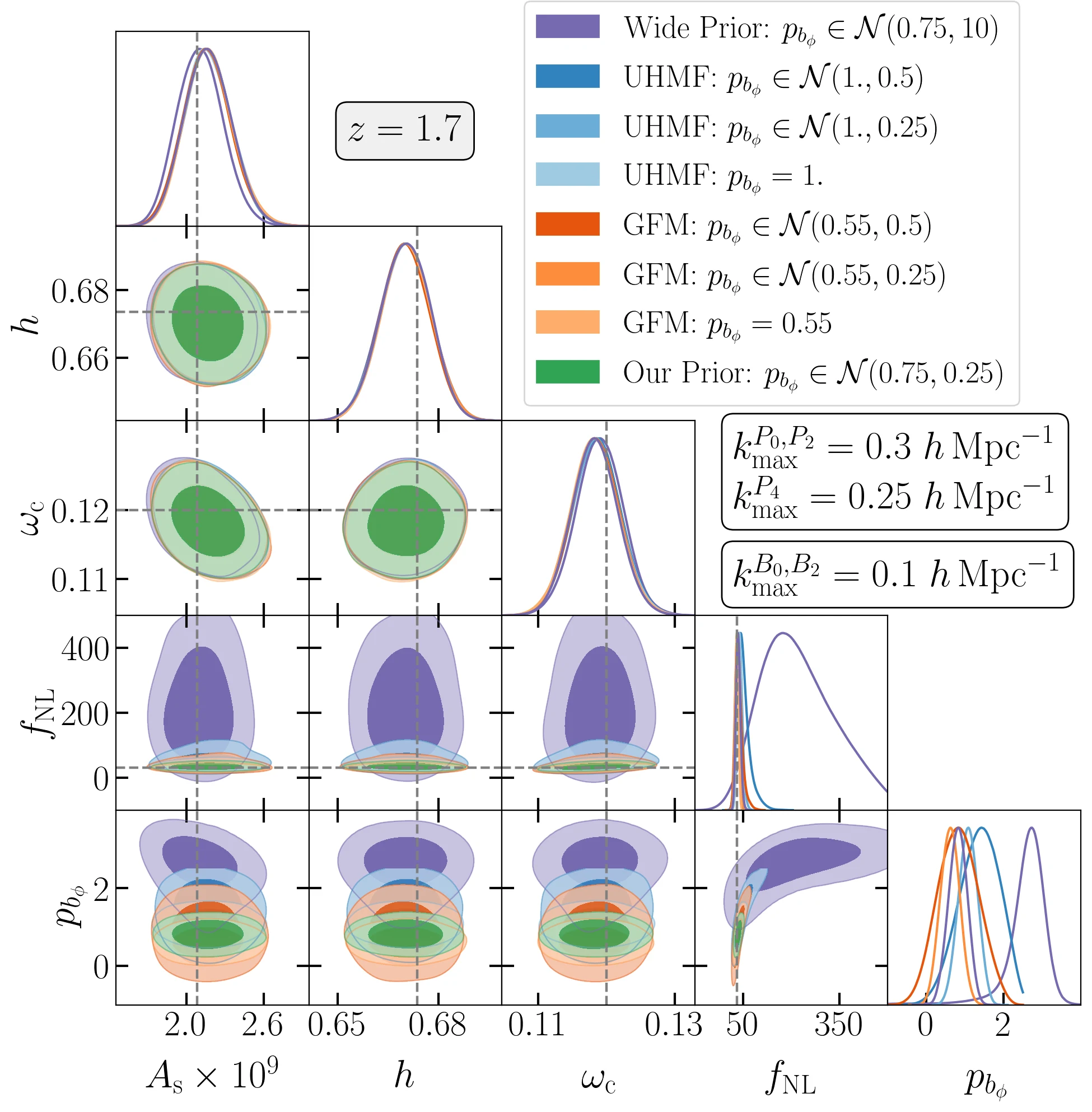
Primordial non-Gaussianity (PNG) is a powerful probe of the origin of cosmic structure. Stage-IV surveys like \Euclid will measure galaxy $$2$$- and $$3$$-point clustering at high signal-to-noise, whose exploitation requires robust joint analysis. We prepare for Euclid's spectroscopic sample by validating a redshift-space power-spectrum and bispectrum pipeline (one-loop $$P_\ell$$, tree-level $$B_\ell$$) on Euclid-like mocks from Abacus-PNG $$N$$-body simulations with Gaussian and local-PNG initial conditions, using a halo occupation distribution (HOD) tuned to Euclid Flagship 2. We stress-test analysis choices -- PNG-bias parametrisation, priors, and scale cuts -- and perform null tests without PNG. In a `prior-agnostic setup', detection of the dominant PNG term $$\propto f_{\rm NL} \, b_\phi$$ in single redshift bins is difficult; nevertheless, the bispectrum provides constraints on other PNG combinations that partially lift degeneracies. We propose a physically motivated prior on $$b_\phi$$ that yields unbiased $$f_{\rm NL}$$ while accounting for theory uncertainty, and determine scale cuts that give unbiased $$\Lambda$$CDM and $$f_{\rm NL}$$. With $$V_{\rm eff}=16\,h^{-3}\,{\rm Gpc}^3$$ across four snapshots ($$0.8\le z\le1.7$$), our likelihood analyses recover $$<1\sigma$$ bias in $$f_{\rm NL}$$ and $$\Lambda$$CDM. At fixed cuts, $$B_\ell$$ alone reduces $$\sigma({f_{\rm NL}})$$ by $$\sim29$$--$$46\%$$ relative to $$P_\ell$$, and joint power spectrum-bispectrum analysis tightens a further $$\sim8$$--$$13\%$$; the cumulative gain from $$z=0.8$$ to $$1.7$$ is $$\sim2.3$$ for the joint case. The bispectrum quadrupole is key. Our strongest results are at $$z=1.7$$: $$1.9\sigma$$ for $$f_{\rm NL} \, b_\phi$$ (prior-agnostic) and $$2.35\sigma$$ for $$f_{\rm NL}$$ (prior-based). Joint analyses thus offer strong prospects for testing multi-field inflation, pending end-to-end validation in the full Euclid geometry with observational systematics.
If the cosmic ripples were perfectly symmetric, the Universe would have remained featureless, like white noise in headphones, and complex structures would never have formed.
In Carl Sagan's 'Contact,' a message hides in the noise of the cosmic microwave background. Astrophysicists with Euclid are also searching for a hidden signal in the cosmic ripples, but its author is not an extraterrestrial intelligence, but the quantum laws of the early Universe.