G. Testera

4 articles · 30 co-authors · latest: 2026-05-20
14,127 citations · h-index 61 · 578 papersData: Semantic Scholar

We have retold 4 papers by this author. most often about: dark matter, neutrino, hadron. 30 co-authors across our retellings.

Links in the knowledge graph
HEP Experiment2026-02-102 minarXiv:2602.09421express
Heavy Dark Matter: Traces in Liquid Argon
A bullet that doesn't just pierce one target but leaves marks in several layers of armor. That's roughly how superheavy dark matter behaves, and it's what the DarkSide-50 detector was built to catch for the first time. The usual suspects for dark matter (weakly interacting massive particles, or WIMPs) pass through matter almost unnoticed, occasionally bumping into a nucleus.
HEP Experiment2026-02-161 minarXiv:2602.14538express
Argon catches dark matter
In the dark chamber of the detector, argon waits. When an invisible particle (say, a dark matter candidate) flies through, it gives the argon nucleus a gentle shove. The nucleus is knocked out of place, and charges are born around it. Exactly how many charges is no trivial question: physicists use that number to tell what kind of visitor dropped by.
Nuclear Experiment2026-04-102 minarXiv:2604.08950express
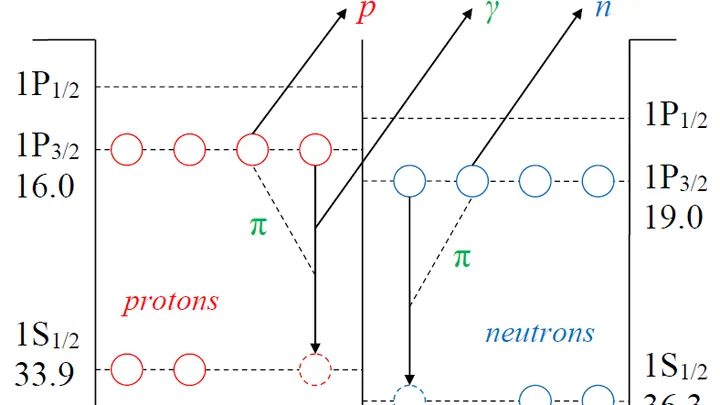
How Physicists Tested the Pauli Exclusion Principle Using Carbon
In a carbon atom's nucleus, particles occupy their own 'apartments'—like residents who cannot share the same room. Physicists call this rule the Pauli exclusion principle: two identical inhabitants of a nucleus cannot be in the same state. But what if the rule is sometimes broken?
Cosmology2026-05-202 minarXiv:2605.21436express