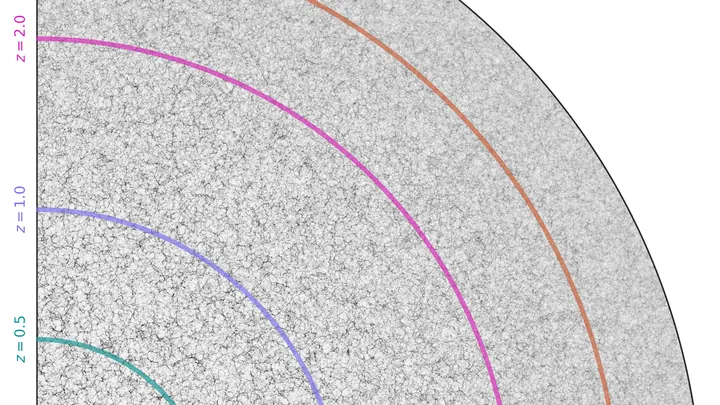
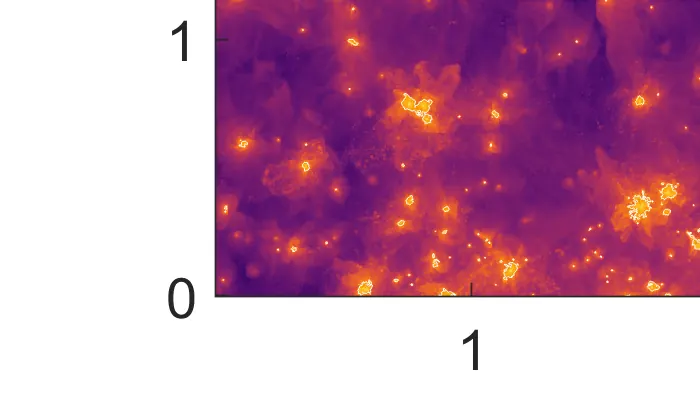
IllustrisTNG is a suite of state-of-the-art cosmological simulations that model the formation and evolution of galaxies from the Big Bang to the present day. It is one of the most comprehensive simulations of its kind, incorporating dark matter, gas, stars, black holes, and magnetic fields. The simulations aim to reproduce the observed properties of galaxies, such as their sizes, masses, and star formation rates, while also predicting new phenomena.
History
IllustrisTNG is the successor to the original Illustris simulation, which was completed in 2014. The TNG project, led by a team including Volker Springel and Mark Vogelsberger, released its first results in 2018.
How it works
The simulation works by dividing a large volume of the universe into a grid of cells and tracking the gravitational interactions and hydrodynamic processes of matter within them. It uses a moving-mesh code called Arepo, which allows it to accurately follow the flow of gas and the formation of stars. The simulation includes sub-grid models for processes that occur below the resolution limit, such as star formation, supernova feedback, and black hole growth, which are calibrated to match observations.
In practice
IllustrisTNG is used by astronomers to interpret observations from telescopes like Hubble and ALMA, to test theories of galaxy formation, and to predict what future instruments like the James Webb Space Telescope might see.
Fun fact
The IllustrisTNG simulation used over 16,000 CPU cores and generated more than 1 petabyte of data, making it one of the largest computational projects in astrophysics.
A filament of the cosmic web stretches through the young universe, and strung along it like beads on a necklace are galaxies. In the core of the SSA22 protocluster, which in a few billion years will become the center of a massive cluster, these beads are still hot and dusty: stars are being born inside them, and cold gas serves as fuel.
A census by body shape: that's one way to describe what astronomers did with 6348 massive galaxies. Instead of height and weight, they measured how concentrated the light is toward the center, how flattened the galaxy is, and how asymmetric its shape is. Then they ran the same measurements on galaxies from three computer models of the universe and compared the results.
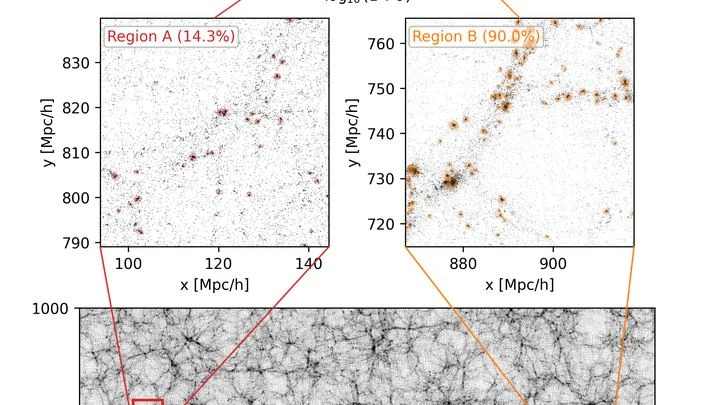
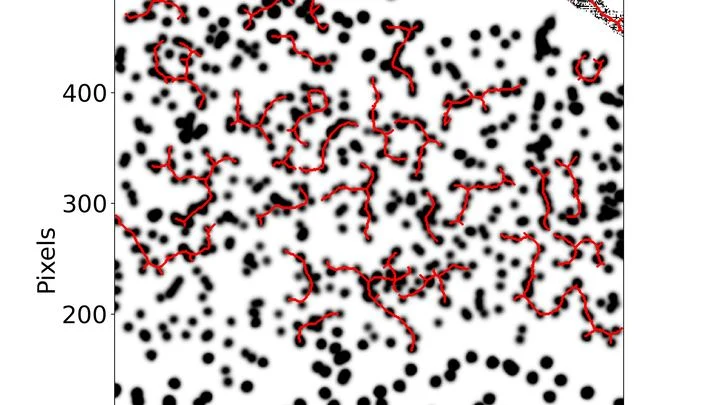
In a dark room, music plays. Powder is scattered on the floor — fine, almost invisible. Low frequencies make it gather into intricate patterns: filaments, clumps, voids. In much the same way, gravity over billions of years weaves galaxies into the cosmic web — except here, attraction does the work instead of sound waves.
A galaxy collision is like a slow dance in which two partners gradually draw closer. Hidden at the center of each is a supermassive black hole — an invisible flywheel with a mass of millions or billions of suns.
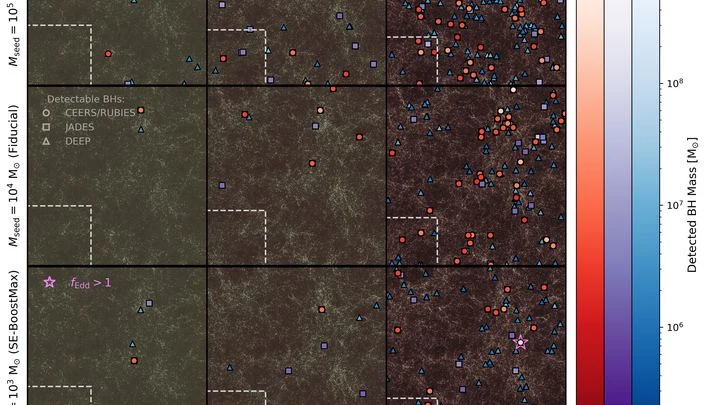
A marathon lasting 13 billion years started with different weights. A hundred solar masses — lighter than some gas clouds. A hundred thousand — gravitational dominance, comparable to an elephant among kittens. That's what black hole seeds looked like, ones that by our time should have turned into supermassive giants.
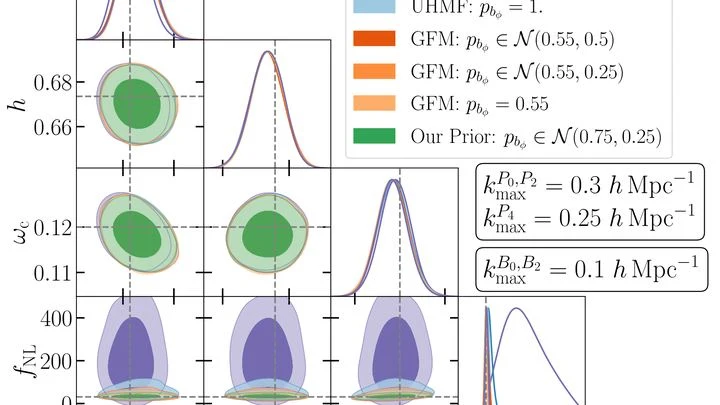
The cosmos resembles silk fabric with threads of the dark web showing through. We only glimpse tiny swatches of the real tapestry — through telescopes, in actual galaxy catalogs. To separate the fundamental signal from astrophysical noise in the cosmic pattern, statistical analysis demands thousands of plausible sketches — synthetic sky maps.
The first three minutes after the birth of the world are a cosmic kitchen where nature cooked the lightest atomic nuclei. The recipe is set by gravity: it controls the cooling rate of the hot 'broth' of particles. If gravity worked differently than we are used to, the dish would have turned out different — with different amounts of helium and deuterium.
In 1981, Alan Guth proposed a scenario of cosmological inflation — a lightning-fast expansion of space that stretched quantum fluctuations to the scale of entire galaxies. Since then, cosmologists, like archaeologists, have been excavating this event from the structures of the Universe.
Galaxy clusters are the greatest gravitational ensembles in the Universe. In X-ray glow from hot plasma, the story of cosmic expansion, hidden dark matter, and enigmatic dark energy is encoded.
The first two billion years after the Big Bang were an era when the universe resembled a boiling construction pit. Dark matter clumped the gas together, igniting the first stars. It seemed there simply wasn't enough time to assemble massive elliptical galaxies—'dormant' stellar metropolises — from this raw material.
The Universe was born in the Big Bang and almost instantly passed through a phase of inflation — an ultra-fast expansion that blew up microscopic regions to cosmological scales.
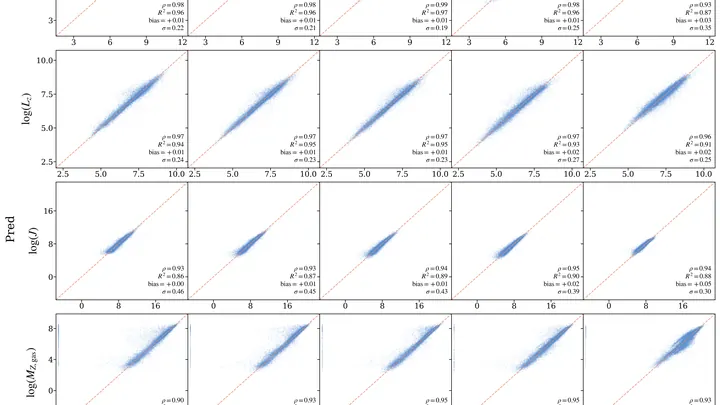
Studying the birth of galaxies requires simulating billions of years of dark matter growth and star formation — even supercomputers handle this slowly.
The Universe is vast, and figuring out how galaxies and dark matter are distributed within it is no easy task. Usually, scientists run computer simulations that "play out" the evolution of entire regions of space billions of light-years across. But such calculations demand colossal resources and time.
The night sky sometimes throws up riddles that take your breath away. One of them is a ring of galaxies stretching across a third of the horizon. Astronomers have named it the “Giant Ring on the Sky”: a cluster of galaxies stretched into a thin filament and closed into a circle about 400 megaparsecs in diameter.
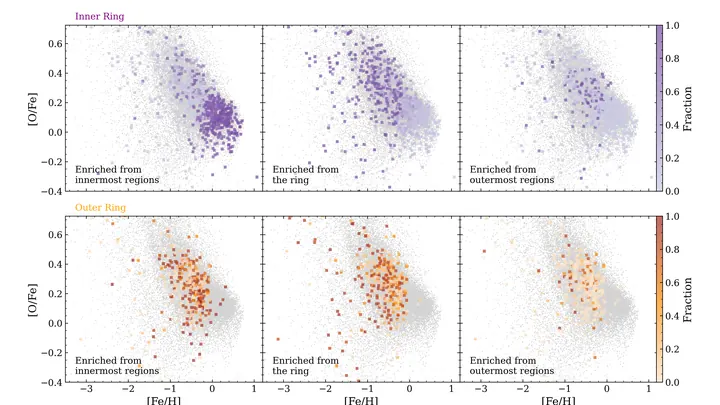
A star inherits the chemical makeup of its parent gas cloud, just like a child inherits genes from its parents. Astronomers turned this into a method: by measuring the fraction of carbon and other elements with spectroscopy (splitting light into colors), they construct family trees for the stars in a galaxy.
Every galaxy floats in an invisible cloud of gas, like fruit in syrup. This gas is the leftover building material from which stars were assembled, and it is constantly replenished by fresh supplies from intergalactic space. Seeing it directly is nearly impossible: it is too tenuous and too cold.
In the first few hundred million years after the Big Bang, the cosmos was like a noisy teen club: galaxies flared up, collided, and churned out stars by the hundreds.
A programmer writes code, runs it, sees an error, and fixes it. Now this process can be handed over to the program itself. Machine learning can already improve algorithms, but it usually requires lots of data and ready-made examples.
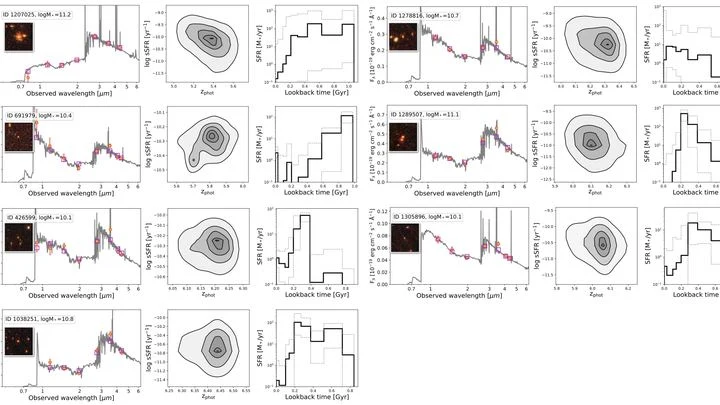
A galaxy is like a city where no new houses are being built. Stars are no longer born there, and the old buildings tell you when construction was bustling. Astronomers peered into 14 such 'ghost towns' on the edge of the visible universe: their light has been traveling to us for 11–12 billion years.
Take a child's spinning top and set it on the table. It spins steadily, with all its parts moving in the same direction. Now toss a handful of beads onto the floor and blow on them: each bead will fly its own way. That's roughly how astronomers distinguish two types of large galaxies: 'spinning tops' (fast rotators) and 'beads' (slow ones with chaotic stellar motion).
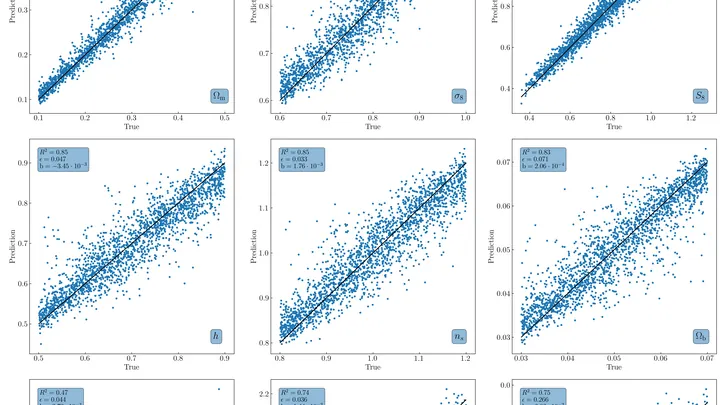
Thousands of universes were born in a computer, all to tell us about our own. Each one has its own galaxy clusters, arranged by the laws of gravity like peas in a jar shaken with varying force. From how the peas settle, you can tell what kind of hand shook the jar.