Are you one of the authors of this paper? Email us from your institutional or work email address mentioning this article's arXiv ID and we'll verify you and give you edit access to this page.
Are you an author who sees something we missed or got wrong? Write to us — the subject line already carries the paper id. We read every note and correct the write-up.
A new analysis of data from the future Euclid telescope will help peer into the first moments after the Big Bang.
The Universe was born in the Big Bang and almost instantly passed through a phase of inflation — an ultra-fast expansion that blew up microscopic regions to cosmological scales. Quantum fluctuations, inevitable in the microcosm, left their imprint on the fabric of spacetime, much like a stone thrown into water creates spreading ripples. These primordial inhomogeneities became gravitational seeds around which galaxies later formed. In the simplest models of inflation, such ripples are statistically isotropic: their crests are distributed randomly, with no preferred directions. However, if inflation was multi-field, driven not by one but by several interacting fields, then randomness is broken: crests may be slightly higher in some regions, and their shape deviates from a perfect circle. Detecting such non-Gaussianity, a skew in the distribution, would allow us to read the history of the first moments and distinguish whether one 'stone' or several created the ripples, that is, whether inflation was simple or complex.
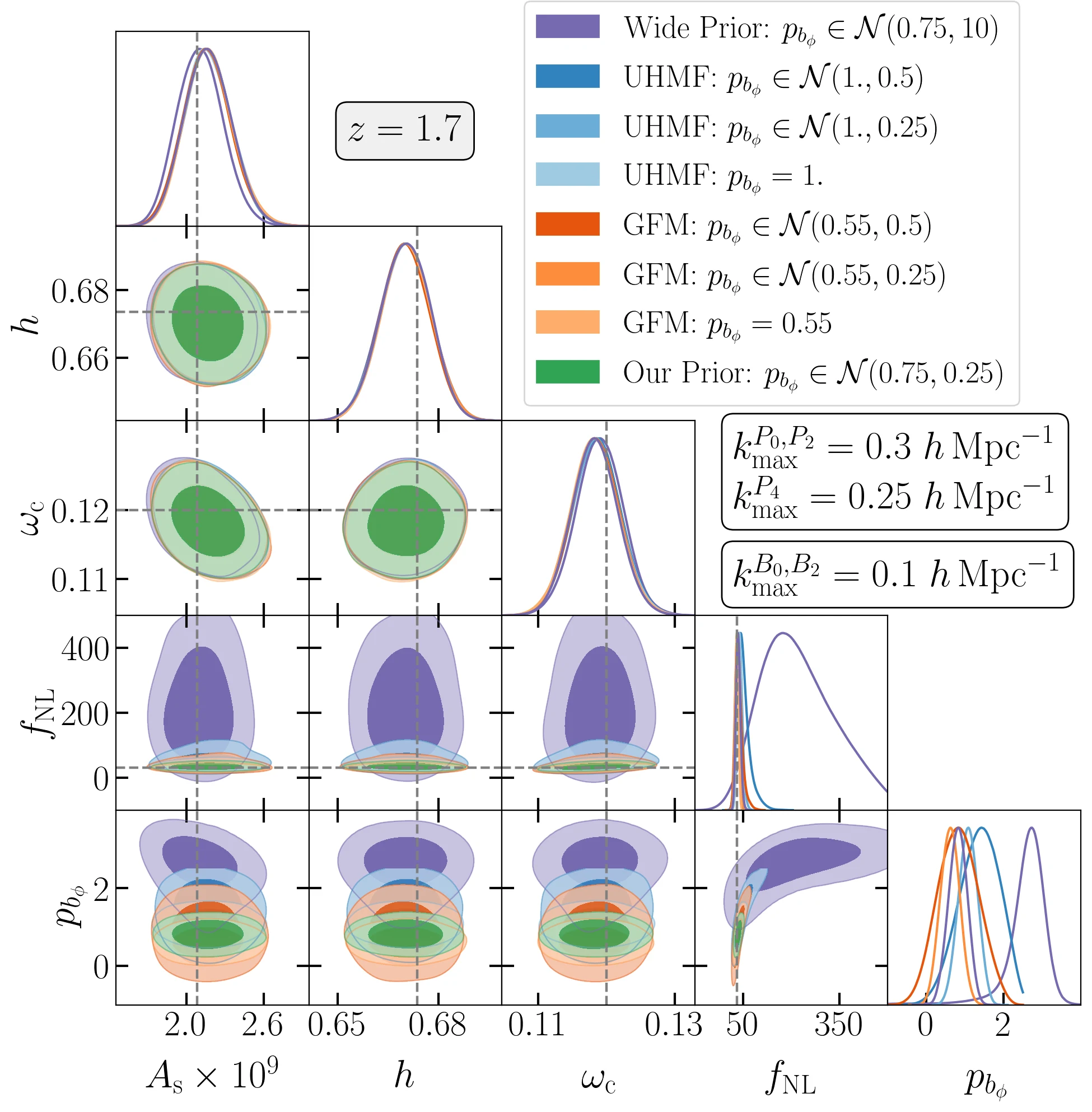
The European space telescopeEuclid can test this. The researchers built a model that combines two independent observational approaches. The first measures the overall amplitude of the ripple, that is, the typical height of the crests, through the statistics of the large-scale structure. The second catches triangular patterns — correlations between three neighboring crests, which are sensitive precisely to deviations from Gaussianity. A joint analysis allows a radical reduction of instrumental noise and doubles the precision of measurements. The cleanest signal is expected from distant galaxies, whose age is about half the age of the Universe: their distribution still preserves the imprint of the primordial ripple, not too distorted by later evolution. To rule out false interpretations, data on visible galaxies were correlated with a map of dark matter — the invisible gravitational scaffold that forms the basis of the cosmic web and directly reflects primordial density fluctuations. This cross-check will help confidently distinguish simple inflation from multi-field inflation, almost as if, looking at the ripples, we could tell whether one stone or several were thrown.
If the cosmic ripple were perfectly symmetric, the Universe would have remained as monotonous as white noise in headphones, and complex structures would never have arisen.
In Carl Sagan's 'Contact', a message is hidden in the noise of the cosmic microwave background. Astrophysicists with Euclid are also searching for a hidden signal in the cosmic ripple, but its author is not an extraterrestrial intelligence but the quantum laws of the early Universe.