Euclid is a European Space Agency space telescope launched in 2023 with a single, ambitious goal: to map the geometry of the dark universe. It does this by observing billions of galaxies across more than a third of the sky, measuring their shapes and positions with unprecedented precision. The mission is designed to answer two of the biggest questions in cosmology: what is dark matter, and what is dark energy?
History
The mission was proposed in 2007 and selected by the European Space Agency in 2011, with launch occurring on July 1, 2023. It is named after the ancient Greek mathematician Euclid, the father of geometry.
How it works
Euclid carries two instruments: a visible-light imager and a near-infrared spectrometer. The imager measures the shapes of distant galaxies, which are subtly distorted by the gravitational pull of intervening dark matter — an effect called weak lensing. The spectrometer measures the redshift of galaxies, allowing astronomers to map their three-dimensional distribution and trace how cosmic structure has grown over time. By combining these measurements, Euclid can infer the properties of dark energy and test theories of modified gravity.
In practice
Euclid's data will produce the largest and most precise 3D map of the universe, used to constrain cosmological parameters and test fundamental physics.
Fun fact
In its first observation run, Euclid unexpectedly discovered 164 supernovae, a bonus yield beyond its primary dark universe mission.
From 1987 to 1991, astronomers last measured how Jupiter's icy moons reflect radio waves. Then came a long pause. In 2011–2024, researchers aimed a radar beam at Europa again: this time using the 70-meter antenna at Goldstone and the Green Bank Telescope.
Ice is nearly transparent to radio waves, like clear window glass is to light.
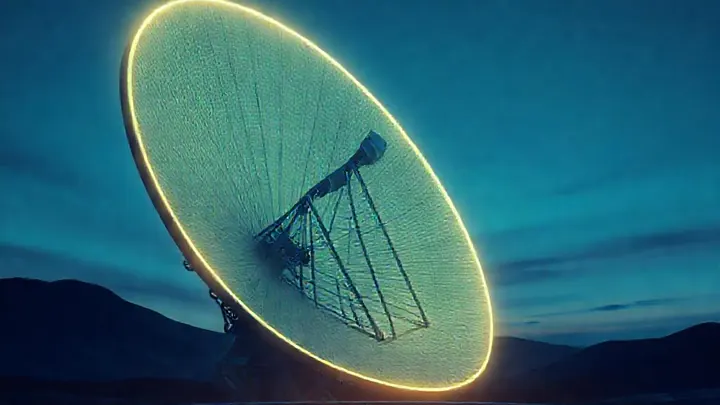
The five-hundred-meter FAST radio telescope picked up a signal at the 21-centimeter wavelength — the telltale glow of cold hydrogen. The signal came from a cloud named Cloud-9. It hangs in space near the galaxy M94, but it contains not a single star.
Buried in Antarctic ice, there's a detector the size of a cubic kilometer. It doesn't catch light but ghostly particles — neutrinos. Yet sometimes, a different beast might flash through: a pair of muons born together and flying apart in a wide fan. No known particle of ordinary matter can paint that pattern.
The night sky is like an ocean: the longer you stare, the more faint lights you notice in the depths. That's how astronomers, peering into the outskirts of the Milky Way, found Aquarius IV — a tiny stellar system that had been hiding in the dark until now.
The system was spotted in images from an early survey by the future Vera Rubin Observatory.
In 1929, Edwin Hubble pointed his telescope at distant galaxies and discovered they were receding. Ninety years later, two measurements of this recession rate, from ancient light and from nearby stars, stubbornly disagree. A 9% discrepancy cannot be chalked up to error. It is as if the Universe in its youth and in its maturity runs on different clocks.
In 2019, the world saw the first image of a black hole's shadow — an orange doughnut on a black background, becoming a symbol of scientific progress. But this image wasn't captured by a camera: it was born from mathematical alchemy, where data from eight radio telescopes, which gathered only crumbs of signal, merged into a single picture.
The Universe grows like a metropolis: galaxies skyscrapers are erected on an invisible scaffold of dark matter: its gravity pulling in construction material. Meanwhile, dark energy makes the city itself continuously expand.
Dark matter is an invisible substance that reveals itself only through gravitational effects: it bends the light of distant galaxies, much like an unseen window that alters the path of light rays.
The Universe was born in the Big Bang and almost instantly passed through a phase of inflation — an ultra-fast expansion that blew up microscopic regions to cosmological scales.
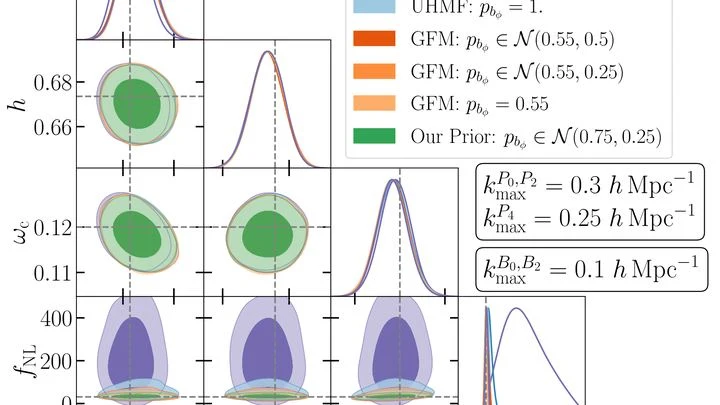
Dark matter has eluded direct observation so far, even though its gravity holds galaxies together. One hypothesis: it’s made of axions — ultra-light particles predicted by theory.
Deep in the Mediterranean Sea, where water presses down with the force of hundreds of atmospheres, a network of light-sensitive spheres waited for a rare guest. And it came — a neutrino that carried through the bulk of the Earth an energy comparable to the impact of a flying brick.
The universe is permeated by an invisible substance, dark matter, whose gravitational influence is obvious, but whose composition remains a mystery. One hypothesis suggests it consists of ultralight particles so light that they exhibit wave-like behavior, forming a kind of cosmic ripple.
Neutrinos — elementary particles rightly dubbed “ghosts”—barely interact with matter, making their detection a formidable challenge. The existence of neutrinos was predicted by Wolfgang Pauli, and the name was coined by Enrico Fermi.
The night sky is no longer as quiet as it used to be. Thousands of satellites are whizzing overhead, and each one can accidentally emit radio waves, interfering with astronomers trying to listen to distant galaxies. To make sense of this noise, scientists pointed the 21CMA radio telescope in China at Starlink satellite passes.
Light from a star travels for millions of years, yet in a telescope it still appears as a point: it's just too far away. To see a star's surface, you need an instrument the size of a city. In Chile, such a giant is already under construction: ELT with a 39-meter mirror made of 798 hexagonal segments.
A bullet that doesn't just pierce one target but leaves marks in several layers of armor. That's roughly how superheavy dark matter behaves, and it's what the DarkSide-50 detector was built to catch for the first time. The usual suspects for dark matter (weakly interacting massive particles, or WIMPs) pass through matter almost unnoticed, occasionally bumping into a nucleus.
Galaxies are flying apart, but the expansion rate measured from the afterglow of the Big Bang and from supernova explosions doesn't match: this problem has been called the Hubble tension. It's like two dancers losing their rhythm because they can't feel each other.
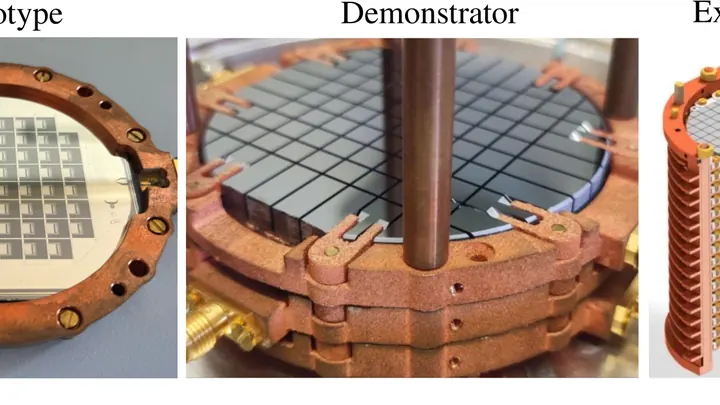
Dark matter is the invisible substance that holds galaxies together, yet it has so far escaped direct detection. The BULLKID-DM detector is designed to catch candidate particles with a mass around 1 GeV (roughly that of a proton) and an extremely weak interaction with ordinary matter — a…
In a dark corner of the Milky Way, a natural metronome is at work. Every 8196 seconds, about 2 hours and 16 minutes, X-ray light flares on the surface of a neutron star. The star EP J171159.4-333253 pulls gas from a neighboring star, and this gas, falling inward, accumulates on its surface.
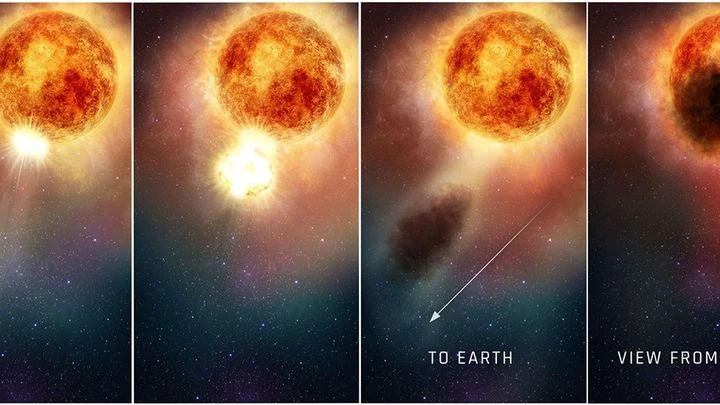
In 2019, Betelgeuse suddenly dimmed, sparking rumors of an imminent explosion. But clouds of cosmic dust turned out to be the culprit. Now, the Gemini North telescope has discerned a minuscule companion star in its dazzling glare, just as calculations had predicted.
Inside a giant spectrometer in Karlsruhe, shaped like a huge metal barrel, scientists are catching particles that are nearly impossible to catch. Neutrinos are the ghosts of the microcosm: every second, trillions of these particles fly through your body, and you don't even notice. But they do have mass, and scientists want to measure it.
Dark matter is an invisible ocean that, as shown by observations by Vera Rubin, keeps stars in galaxies from flying apart. Physicists suspect that if dark matter consists of ultralight particles, in the cosmic cold it turns into a frictionless fluid — a so-called condensate.
The Comet Interceptor mission launches without a target. The spacecraft freezes at a point of space equilibrium, like a fighter jet on combat standby: engine warmed up, but takeoff only on alert.
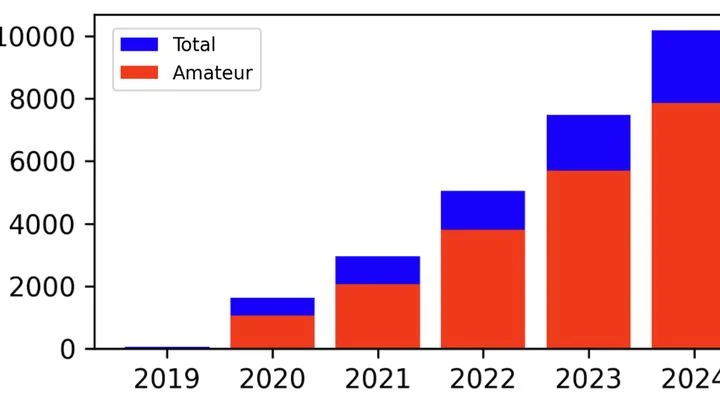
A bus schedule drifts: if you don't check it, you'll miss your ride. Planets around other stars have the same problem – their crossings of the star's disk gradually shift. The ExoClock project pooled 30,000 observations from Earth and space to refine the schedule for 620 distant worlds. For 45% of the planets, transits were found to be off by hours.
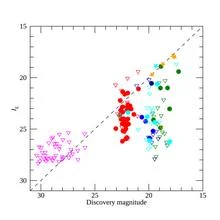
In Euclid's deep fields, stars flare up that were not in any catalog. A telescope built to map dark matter has worked like a camera trap: one frame, and a cosmic explosion is already on record.
At Jefferson Lab, electrons are accelerated to 12 GeV and smash into protons to pry out their secrets. But existing detectors are like cameras with a narrow field of view: you either see a lot but dimly, or brightly but only a tiny patch. Electron scattering is the main tool, but statistics are insufficient for subtle effects.