Is Dark Energy Changing? A Fresh Look express
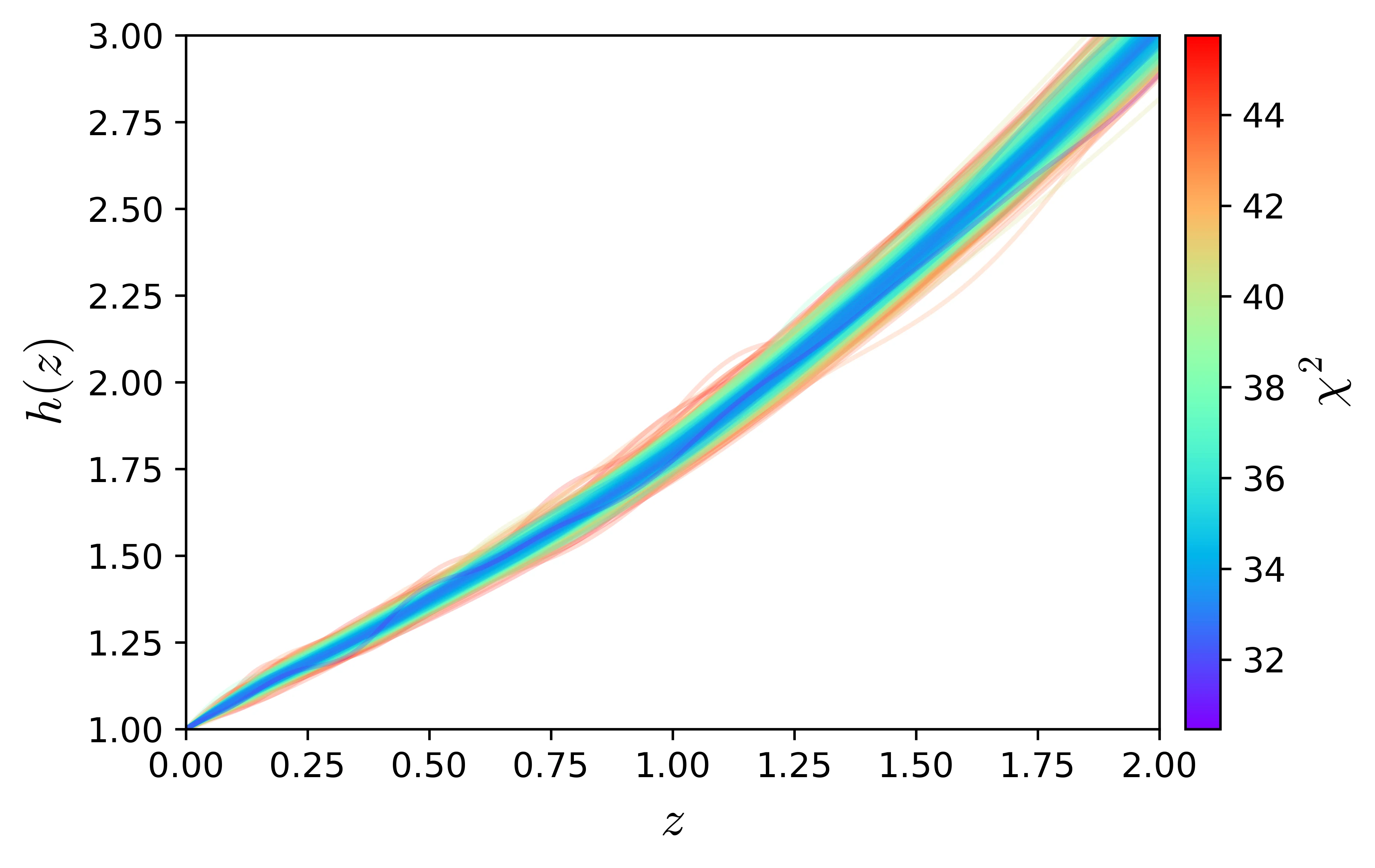
The Universe is expanding faster and faster thanks to mysterious dark energy, discovered in the late 1990s by Adam Riess, Saul Perlmutter, and Brian Schmidt using supernovae. For a long time, scientists thought this force was constant, like a gas pedal floored forever. But a new approach — a direct look at that pedal — says otherwise. Without complex calculations, just by linking the expansion rates of different eras, the method reveals: dark energy is now weaker than expected. Its parameter w₀ (think of it as the pedal pressure) is –0.62, not the –1 predicted by the standard model. This rejects conventional cosmology with 95% confidence. If dark energy continues to fade, the Universe's expansion could not only slow down but reverse into a contraction — meaning the cosmos might be headed not for a cold, lonely death, but a fiery rebirth in a new cosmic cycle.
Original abstract
as written by the authors arXiv:2605.27230
Recent DESI data suggest that dark energy may be evolving and motivate the use of model-independent diagnostics such as $$Om(z)$$ and probes of the equation of state (EoS) of dark energy, $$w(z)$$. Traditional reconstructions of $$w(z)$$ rely on differentiating the expansion history, $$h(z)=H(z)/H_0$$, which amplifies noise and systematic uncertainties. In this work, we introduce a new diagnostic, the $$w_0$$-probe, which is constructed from $$Om(z)$$, and which enables a direct determination of the current EoS from $$h(z)$$ without any additional differentiation. While retaining the null-test capability of $$Om(z)$$ for $$\Lambda$$CDM, the $$w_0$$-probe also provides a direct estimate of $$w_0$$ -- the current EoS of dark energy. We demonstrate that this reconstruction of $$w_0$$ is robust for any smooth underlying $$w(z)$$. We apply this method to Gaussian-process (GP) reconstructions of $$h(z)$$ using current SNe Ia+BAO+CMB data. Both $$Om(z)$$ and the $$w_0$$-probe exclude $$\Lambda$$CDM at the $$95\%$$ confidence level (C.L.), with the latter favouring $$w_0\simeq-0.62 \pm 0.03$$ at $$95\%$$ C.L. To mitigate potential over-constraining from GP priors, we additionally analyze $$\chi^2$$-limited reconstructions with likelihoods exceeding the $$95\%$$ CPL threshold. The $$w_0$$-probe obtained from these high-likelihood samples again predominantly excludes $$\Lambda$$CDM and yields $$w_0\in(-0.8,-0.5)$$ at $$z\to 0$$, demonstrating the robustness of our results. The $$w_0$$-probe therefore provides a simple, model-independent, and robust diagnostic of the current EoS of dark energy.
Although dark energy fills 70% of the cosmos, its nature remains a total mystery: invisible and intangible.
The idea of changing dark energy echoes the science fiction concept of 'quintessence' — a field that can weaken or strengthen, shaping the destiny of the Universe.