Dark energy is a mysterious force that pushes galaxies in the Universe apart faster and faster, like wind blowing balloons apart. We don't see it, but we know it exists because the Universe is expanding at an accelerating rate.
History
In 1917, Albert Einstein introduced the cosmological constant for a static Universe, but abandoned it after Edwin Hubble's discovery of expansion in 1929. Georges Lemaître also linked the cosmological constant with vacuum energy. In 1998, the Supernova Cosmology Project and High-Z Supernova Search Team discovered accelerated expansion, independently confirming the need for dark energy. Subsequent experiments, such as WMAP and Planck, refined its parameters.
How it works
In the framework of GR, dark energy manifests as a source in Einstein's equations, creating a repulsive gravitational effect under negative pressure. The Friedmann equation describing the evolution of the scale factor a(t) contains a term with the cosmological constant: (ȧ/a)² = (8πG/3)ρ - k/a² + Λ/3. Under the dominance of Λ, the scale factor grows exponentially. Hubble's law v = H₀ d is modified: the Hubble parameter changes with time, and data from distant supernovae show deviation from linearity, indicating acceleration.
Fun fact
Dark energy makes up about 68% of all energy in the Universe — it's as if in a huge pie, almost three-quarters were made of invisible, intangible jelly!
A light ray passing near a massive body bends around it, like a runner rounding the corner of a stadium. For a neutron star, this deflection angle is usually assumed to be the same as for a point mass. But if the star is wrapped in an invisible halo of dark matter, the picture changes: light passing through the halo is deflected less than the total mass would predict.
The night sky looks calm, but in reality, invisible particles, cosmic rays, are constantly flying through us. Among them are electrons and their antimatter counterparts, positrons. When they collide with detectors on satellites or balloons, the instruments record their energy.
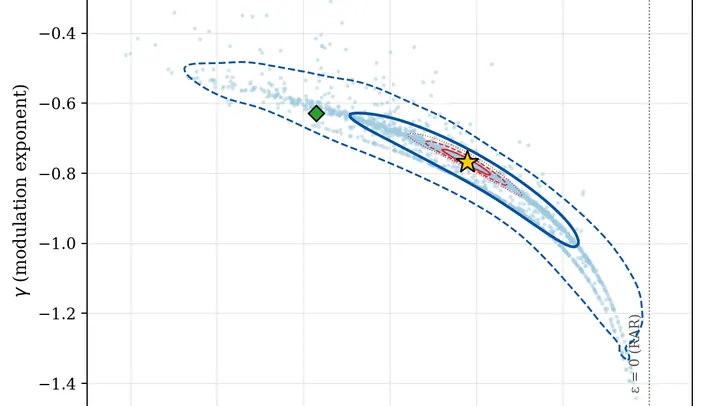
The universe is like dough rising in an oven. Galaxies are flying apart, and the rate of this expansion is accelerating. To explain the accelerating expansion, cosmologists came up with dark energy — a mysterious force that pushes space apart from within. The standard recipe, called Lambda-CDM, works pretty well, but it has its inconsistencies.
In the first moments after the Big Bang, matter and antimatter should have been created in equal amounts. But today, everything around us is ordinary matter, and antimatter is almost nowhere to be found. Where did it all go? The standard answer: a tiny imbalance in favor of matter wiped out almost all antimatter.
A galaxy is like a city: bright lights and dense buildings at the center, sparse lights and emptiness toward the outskirts. But if you watch how gas rotates in a galaxy's disk, you see that its speed barely drops at the edges. As if invisible neighborhoods keep the motion going. Astronomers have found a way to map this invisible city.
A sheet of paper stretches rapidly in all directions. On it are drawn tiny arrow-particles, and the stretching makes them move and interact differently than they would on a stationary table. That's roughly how space behaves in an expanding universe, where curvature isn't just an abstraction but a real factor influencing the very foundations of matter.
In the first moments after the Big Bang, the universe resembled a boiling cauldron. According to one hypothesis, dark matter, the invisible substance that holds galaxies together, could have been born there.
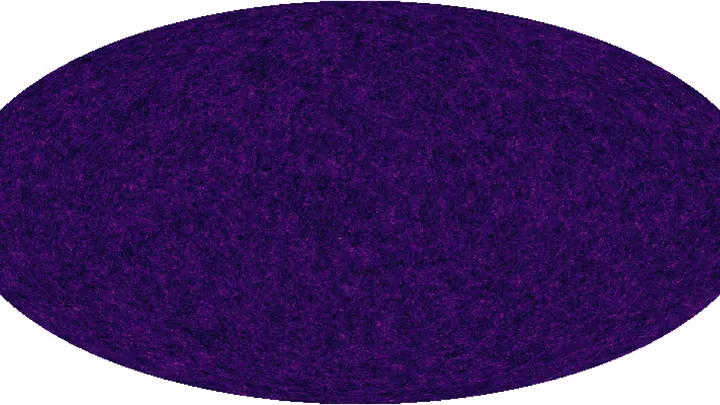
Light from the hottest stage of the universe has been traveling toward us for nearly 14 billion years. This is the cosmic microwave background — a faint glow filling the entire sky.
An invisible scaffold holds galaxies together, keeping them from flying apart. This is dark matter — matter that doesn't shine and barely interacts with ordinary stuff. Astrophysicists have long debated what it's made of.
The cosmological standard model is like a recipe for a cake where everything is strictly measured: dark matter is like flour without a single lump (zero pressure), and dark energy is like the perfect leavening agent (equation of state exactly minus one). But what if the flour is a bit damp and the leavening agent has lost its oomph?
It all started with stretching. In the first fractions of a second, the universe ballooned — physicists call this inflation. Then the rapid expansion gave way to a phase where the field's energy converted into ordinary particles.
Light from the hottest stage of the universe has been traveling toward us for nearly 14 billion years. This is the cosmic microwave background — a faint glow filling the entire sky.
A gravitational wave from a black hole merger is like a bell tolling in the night. The loudness tells you how far away the source is. But to learn how fast the night itself, the cosmos, is expanding, you usually need a second signal: a flash of light or a catalog of galaxies. Both are rare to catch.
Dark matter is the invisible scaffolding of the universe. It's there, we know from the motion of stars and galaxies, but what this scaffolding is made of remains unknown. One guess is ultra-light particles similar to axions. They barely interact with ordinary matter, yet occasionally they do get involved.
In the first fraction of a second after the Big Bang, the universe expanded at an unimaginable rate. The engine behind this expansion could have been a field that behaves like a slowly rolling ball — the axion. What makes the axion special is that, like a conductor, it can drive electromagnetic waves, creating them literally out of nothing.
A black hole is not an empty funnel. Invisible matter can accumulate around it, and then the familiar boundaries shift.
A group of theorists found a simple condition: if the mass of this surrounding material grows smoothly and satisfies the inequality 1 − 2m' − rm'' > 0, then the event horizon remains well-defined and the hole stays stable.
In the first moments after the Big Bang, the universe underwent a rapid expansion — inflation. Space stretched faster than light, and quantum jitters of the vacuum turned into real particles. This is how dark matter, the invisible substance that holds galaxies together, could have been born.
In the first moments after the Big Bang, the universe was a searing 'soup' of particles. As it cooled, phase transitions occurred — much like water turning to ice. At one such moment, magnetic monopoles of dark matter could have been born: tiny clumps of field with a single magnetic pole.
In the first moments after the Big Bang, the universe expanded at an incredible rate — a phase known as inflation. Even the vacuum was restless back then: quantum jitters shook the fields like wind rustling through a wheat field.
Two houses with identical facades. Windows, doors, wall color — everything matches. But inside, one is empty, while the other buzzes with life. How can you tell without stepping inside? In space, there's a similar puzzle: a black hole and a gravastar look the same from the outside, but they are built differently.
Cosmologists are like cartographers — only instead of mountains and rivers, they map invisible forces. Dark energy, which drives the accelerating expansion of the universe, remains a mystery. One idea is the 'kinetic gravity braiding' (KGB) model. In it, dark energy interlocks with gravity. The celestial map's paper becomes elastic. It alters the path of light rays.
In 1929, Edwin Hubble pointed his telescope at distant galaxies and discovered they were receding. Ninety years later, two measurements of this recession rate, from ancient light and from nearby stars, stubbornly disagree. A 9% discrepancy cannot be chalked up to error. It is as if the Universe in its youth and in its maturity runs on different clocks.
The universe is like a vast invisible scaffold. We don't see it directly, but we know it's there: galaxies and clusters hold together thanks to it. This scaffold is dark matter. The most popular version says it is "cold," made of heavy, slow-moving particles.
The universe is a vast, dark ocean. We see only the glowing foam on its surface — stars and galaxies. But hidden in the depths are two invisible forces: dark matter, which with its gravity keeps galaxies from flying apart, and dark energy, which, on the contrary, pushes space itself apart, making the universe expand faster and faster.
At the center of a galaxy sits a supermassive black hole, surrounded by a vast, tenuous cloud of dark matter. It doesn't shine or heat, but its gravity warps space and changes the rules of the game for everything orbiting nearby.
In 1998, physicists caught neutrinos doing something astonishing: the particle changes its type on the fly. That is only possible if it has mass. This became the only laboratory proof of physics beyond the Standard Model. But exactly how much a neutrino weighs remains a mystery.
The galaxy is not a smooth lake but a pond with ripples. These ripples are created by ultralight dark matter (particles billions of billions of times lighter than an electron).
A climber on a ridge notices something strange: the horizon around them seems to freeze. No forward, no backward — only emptiness and silence. This is roughly the picture painted by new calculations for our Universe. At some point in its expansion, the invisible boundary, the future event horizon, stopped growing.
37 pairs of galaxies of different ages served as clocks. Their hands, the difference in stellar ages, told how fast the Universe expanded at different epochs. Based on these readings, cosmologists built a lie detector for dark energy.
Two balls dropped from different heights fall to the ground with different accelerations. In space, things are more complicated: even emptiness makes bodies move differently.
Gravity is a remarkably weak force. A small magnet holds a paperclip against the pull of an entire planet. Physicists have long sought the reason for this weakness, and one guess leads us into hidden dimensions. Perhaps gravity 'leaks' into them, losing strength in our three-dimensional world.
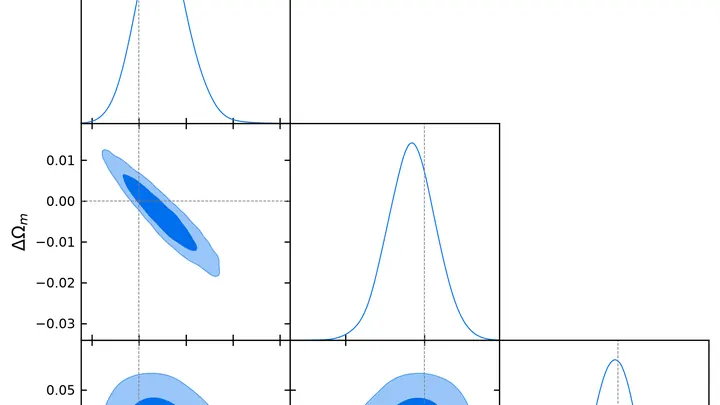
Cosmology has landed in an interesting pickle. The two main ways to look back into the universe's past, via the early glow (the cosmic microwave background) and via later objects like supernovae, yield different numbers for the expansion rate (the Hubble constant) and for how clumpy matter is distributed.
Usually, a black hole is described as a frozen frame: there's mass, there's charge, and it's all static. But real objects live in time. They radiate, lose energy, and change.
380 thousand years after the Big Bang, the universe cooled enough for light to decouple from plasma. That cosmic microwave background still pervades space, like the first chord of a symphony, the echo of a fiery beginning.
At the center of a distant galaxy, where a supermassive black hole weighing a hundred million suns spins, space is threaded with magnetic fields. They coil into tight vortices, like a drain in a sink, but instead of water, there's plasma whipped up to near-light speeds.
Cosmic ripples begin with tiny clumps. 380,000 years after the Big Bang, the universe was nearly homogeneous — density fluctuations were only one part in 100,000. But gravity turned these weak ripples into galaxies, clusters, and giant voids.
A cold, black mirror — that's what the sea of dark energy, the invisible substance driving the expansion of the universe, looked like for billions of years. But the DESI spectrograph has caught a faint ripple.
At the centers of many galaxies, not only supermassive black holes lurk, but also vast clouds of invisible matter. If this matter consists of ultralight particles, it can gather into dense clumps — a kind of 'star' made of dark matter.
A neutron star is a city the size of Manhattan that weighs as much as half a million Earths. A teaspoon of its material would outweigh Mount Everest. Now, into this superdense sphere, something invisible and elusive has been mixed — dark matter particles.
That's exactly what physicists did in a new study.