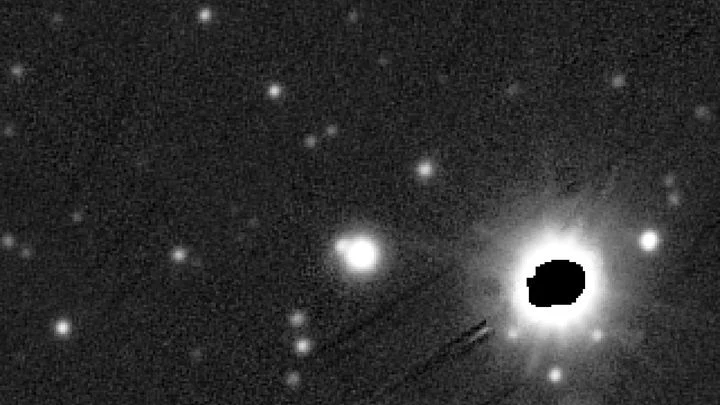
A supernova is a grand fireworks display, when a star explodes and momentarily shines brighter than an entire galaxy. It's like a balloon that's been inflated for millions of years until it pops.
History
The term 'supernova' was coined by Fritz Zwicky and Walter Baade in 1934, suggesting that core collapse leads to the formation of a neutron star. Previously observed 'guest stars', such as in 1054 (the Crab Nebula), were interpreted as novae. A type classification was developed by Rudolph Minkowski in 1941 based on spectra. In 1987, supernova 1987A in the Large Magellanic Cloud provided an opportunity to test theories and record a neutrino burst from the collapse.
How it works
For core-collapse supernovae (Type II): when the core exhausts its nuclear fuel by fusing iron, degenerate electron pressure can no longer withstand gravity. The core collapses at up to 70,000 km/s, reaching nuclear density. Neutronization occurs: p + e- → n + ν_e. A neutron star is born, and the shock wave powered by neutrino heating tears apart the outer layers. For Type Ia: a white dwarf accretes matter, reaches the Chandrasekhar limit (~1.4 M☉), triggering runaway carbon fusion that completely destroys the dwarf.
Fun fact
The most powerful supernova explosion was seen back in 1006 – and it was as bright as day at night!
In the cosmic forge, stars do not melt iron but atomic nuclei. An ordinary furnace can do that, but sometimes the heat becomes so intense that the furnace blows itself apart. That seems to be exactly what happened with supernova SN 2024afyu. Its spectrum shows sulfur and silicon lines that leave no doubt: several solar masses of these elements were forged inside.
In the cosmic forge, stars do not melt iron but atomic nuclei. An ordinary furnace can do that, but sometimes the heat becomes so intense that the furnace blows itself apart. That seems to be exactly what happened with supernova SN 2024afyu. Its spectrum shows sulfur and silicon lines that leave no doubt: several solar masses of these elements were forged inside.
In a pot on the stove, water starts to churn from the bottom long before the whole thing boils. Bubbles of steam rise from the base even though the burner itself hasn't heated up yet.
In a quiet back alley of a galaxy, where stars are rare and old, a light suddenly flares up, brighter than an entire galaxy. This is a Type Ia supernova: a thermonuclear explosion of a white dwarf that astronomers use as a standard candle to measure cosmic distances.
Twenty thousand years ago, the star that would become supernova 1987A put on a ring. Not one — three. The two outer ones, like lampshades, tilted relative to the equatorial ring, and the star's light, struggling through them, barely reached an observer who happened to be in the plane of the equatorial ring.
Twenty thousand years ago, the star that would become supernova 1987A put on a ring. Not one — three. The two outer ones, like lampshades, tilted relative to the equatorial ring, and the star's light, struggling through them, barely reached an observer who happened to be in the plane of the equatorial ring.
The night sky in neutrino light resembles a canvas worked on by two hands. One holds a broad, soft brush: these are supernova remnants, the shells left behind after stellar explosions. The other grips a fine, hard pen — microquasars, binary systems where a black hole twists matter into narrow jets.
In the dense galaxy cluster Abell 2744, where gravity bends light like a lens, the James Webb Space Telescope spotted a new point of light. It appeared in images from 2023 and then began to change brightness. It was a supernova, the explosion of a dying star, but not just any kind: a Type IIP.
A neutron star is what remains after a massive star explodes. Its matter is compressed so tightly that a teaspoonful would weigh billions of tons. Under such conditions, protons and neutrons can rearrange, and new particles (hyperons, similar to neutrons but containing a 'strange' quark) can appear.
When a star explodes, its material flies into space. In the supernova remnant SNR 0509-67.5, this material did not spread into a smooth cloud but gathered into separate clumps, like lumps in batter that is quickly stirred. The MUSE telescope in Chile saw these clumps in the faint glow of forbidden iron and calcium lines.
When a massive star explodes as a supernova, heavy nuclei are forged in its interior within seconds. Among them is titanium-44, a radioactive isotope that later glows in gamma rays for years. How much of it remains depends on a single nuclear reaction: a proton is captured by a vanadium-45 nucleus, turning it into chromium-46.
Cosmic rays are particles that race across our Galaxy at enormous speeds. Their energies can be millions of times higher than those of particles in the most powerful accelerator on Earth. But the higher the energy, the fewer such particles there are: the plot of their numbers shows a noticeable kink, which is called the knee.
A bridge where pedestrians and cyclists flow together without getting in each other's way. That's roughly how hybrid systems of superconductors and semiconductors work: the former carry current without loss, the latter control that current.
After a supernova explosion, a dense ball the size of a city remains at the center — a newborn neutron star. It is hot, compressed, and rings like a bell after being struck. These tremors, the star's oscillations, emit gravitational ripples that sensitive detectors on Earth can catch.
The explosion of a massive star is not just a flash: it's a blow to the surrounding gas. But until now, no one had looked at how the gas itself moves at the sites of such explosions. Now astronomers have gathered data on 33 nearby supernovae and for the first time measured the turbulence of the cold molecular gas around them.
A balloon that lets out air in bursts zips around the room — the jet blasts first one way, then another. A dying star behaves the same way as it sheds its bloated shell. Only instead of air, it's superheated gas, and instead of a balloon, it's a future white dwarf (the dense stellar remnant about the size of Earth).
A neutron star is the ultra-dense remnant of a supernova: the mass of the Sun packed into a sphere the size of a city. For billions of years, it travels through space, gathering around itself invisible matter, dark matter, which emits no light but pulls with gravity.
At the heart of a dying star, as its core collapses into a neutron sphere, an invisible storm is born. Trillions of neutrinos, particles that barely interact with matter, race through the scorching plasma. There are so many of them that they begin to influence each other, changing their 'flavors' (electron, muon, tau) like chameleons.
The cosmic detective story began with a quiet flash in the optical band. AT2019wzc slowly brightened and faded like a smoldering ember. But hidden inside was something more energetic — repeating soft X-ray bursts that astronomers call quasi-periodic eruptions.
These eruptions last minutes to hours and repeat every few hours or days.
A superconducting qubit is like a finicky musical instrument: until you tune it, you won't get a clean note. But even after tuning, the pitch drifts. The culprits are tiny defects in the material that physicists call two-level systems. They're like invisible cracks that appear and disappear, throwing off the processor's rhythm.
When a star many times heavier than the Sun dies, it collapses and explodes as a supernova. This is not just a flash of light — the entire process, from core collapse to the ejection of the outer layers, makes space itself tremble. These ripples are called gravitational waves.
Hidden within thin layers of tantalum selenide (TaSe₂) is a property that defies conventional physics. When guest atoms were added between the layers of this material, the structure lost its center of symmetry, and inside, superconductivity with armor emerged.
An empty resonator isn't truly empty. Even in an absolute vacuum, where not a single photon exists, quantum fluctuations persist. They resemble ripples on water in a dead calm: the surface appears smooth, but molecules keep jittering. Physicists have learned to turn this jitter into real waves.
The most massive stars are like overinflated balloons: their envelope stops stretching and instead begins to furiously vent material. At a certain stage, the mass loss becomes so intense that the star stops growing in size. Astronomers see this moment as a kink in the diagram where stars are sorted by luminosity and temperature.
A cloud of cold atoms is trapped between two mirrors. Light is shone through it, and the atoms start to emit collectively: this effect is called superradiance. But the atoms don't just 'glow': their spins (internal magnetic arrows) interact with light in two distinct ways.
On March 26, 2026, the Chinese-European Einstein Probe observatory caught an X-ray flash that lasted a little over a quarter of an hour. A thousand seconds. The onboard WXT telescope registered a sharp rise in radiation, then a smooth decline, as if someone had screamed into silence, and the echo slowly faded.
In superconductors, electrons pair up and flow without resistance. Usually, these pairs are distributed uniformly, like water in a calm lake. But sometimes ripples appear in the material — pairs bunch up and thin out with a certain period. This state is called superconductivity with pair-density waves.
17 supernovae from the ZTF DR2 sample lit up ahead of schedule. In the first hours and days after the explosion, they emitted more light than standard models predict. Astronomers compare this to a Bickford fuse: before the blinding flash tears across the sky, a precursor spark runs through the outer layers.
1799 kilometers per second — that's the speed at which star S5-HVS1 is permanently leaving the galaxy. 4.8 million years ago, it was ejected from the center of the Milky Way during a close encounter with the supermassive black hole Sgr A*.
On August 6, 1181, Chinese astronomers spotted a new star in the constellation Cassiopeia. It shone for 185 days, slowly fading, and then vanished, leaving only a record in the chronicles. Today, at its location, there is a hot white dwarf — a compressed stellar core with no nuclear reactions, heated to tens of thousands of degrees.
The collapse of a star's core is like compressing a spring: matter falls inward, and a neutron star is born at the center. But the fall is never perfectly smooth. In the boiling outer layers, random eddies transfer angular momentum to the infalling gas, and a disk swirls around the central object.
This disk is no calm river. It pulses, strengthening and fading.
The hunter of ancient light, the James Webb Telescope, aimed its mirrors at a tiny patch of sky and caught a strange beacon. The object, with the working name beacon_1420-$$5253_{4770}$$, flashed and faded. At first, it was logged as a candidate for the most distant galaxy, as if we were seeing it just 300 million years after the big bang.
In June 2024, the CHIME radio telescope recorded over 700 radio bursts per hour from source FRB 20240114A. Such a hyperactive repeater releases in one hour nearly all the magnetic energy of a typical magnetar (a neutron star with an ultra-strong field).
A heaping teaspoon, and the scale reads a billion tons. That's roughly what a teaspoon of neutron star matter would weigh if you could scoop it up and put it on a scale. Such objects are born after a supernova explosion: the star's core collapses into a sphere the size of a city, and the density exceeds that of an atomic nucleus.
A piece of metal is cooled to minus two hundred degrees, and electric current begins to flow through it without the slightest friction, like water in a pipe flowing without touching the walls. This behavior is called superconductivity.
When a star ventures too close to a supermassive black hole, a cosmic requiem plays out — a tidal disruption event. Thanks to photometry and spectroscopy, astronomers discern every instrument in this orchestra.
Erwin Schrödinger pondered how life maintains order despite the second law of thermodynamics. He could never have imagined that part of the answer lies hidden in the instability of giant stars.
An old factory where instead of machines there are atomic nuclei, and neutrino radiation seethes all around. When a massive star exhausts its fuel, its core compresses a hundredfold, and the temperature skyrockets to billions of degrees.
In the quiet of cold molecular clouds, where interstellar gas under gravity condenses into dense clumps, the birth of massive stars is one of the great puzzles of astrophysics.