How Blood Flow Sculpts a Clot express
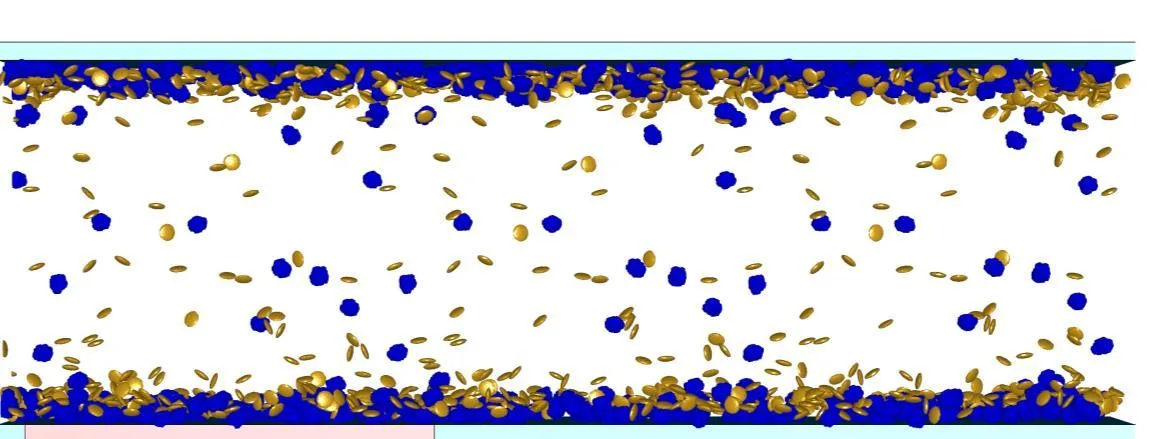
There's a leak in the garden hose. You patch the hole with duct tape, but the water presses harder and harder, and sooner or later the patch gives way. A growing clot in a blood vessel behaves much the same way.
When the vessel wall is damaged, tiny blood platelets rush to the scene. In a fast flow, they have nothing to grab onto, and that's where a helper protein comes in — von Willebrand factor. Under the pressure, it unfurls from a coil into a long sticky thread, and platelets cling to it like climbers to a safety rope. The authors of the study traced this process in a computer for the first time, accounting for the motion of every red blood cell, every platelet, and the protein threads themselves in a narrow channel — a model of a vessel.
The computer experiment showed: a clot doesn't grow indefinitely. At first it gains mass, but once it gets too big, the flow tears pieces off it: this is embolization. These fragments are carried away and can block narrower vessels downstream. The most surprising part: the final size of the clot is determined purely by hydrodynamics — the balance between adhesive and detaching forces. No chemical "command" to stop growing is needed.
Viewing blood clotting as a mechanical equilibrium helps explain why in areas with especially fast flow, clots either don't form at all or become unstable and dangerous. Like the patch on the hose: it holds just until the pressure exceeds the strength of the glue.
Von Willebrand factor is the longest protein in the blood: if stretched out, a single molecule can reach several micrometers, comparable to the size of a cell itself.
In Isaac Asimov's novel "Fantastic Voyage," a miniaturized submarine travels through the bloodstream, where clots look like giant landslides — roughly the picture the computer model recreates.