Wound healing is the intricate biological process by which the body repairs damaged tissue, such as a cut, burn, or surgical incision. It is not a single event but a coordinated sequence of overlapping phases: hemostasis (stopping bleeding), inflammation (clearing debris and fighting infection), proliferation (building new tissue and blood vessels), and remodeling (strengthening and reorganizing the repaired area). This process is fundamental to survival, as it restores the barrier function of skin and other organs, preventing infection and fluid loss.
How it works
Immediately after injury, blood vessels constrict and platelets form a clot, releasing signaling molecules that attract immune cells. In the inflammatory phase, white blood cells clean the wound of bacteria and dead tissue. Next, fibroblasts produce collagen and new capillaries grow, forming granulation tissue that fills the defect. Finally, the collagen is remodeled and cross-linked over weeks to months, increasing tensilestrength, though the repaired tissue never fully matches the original.
In practice
Understanding wound healing guides clinical treatments such as suturing, wound dressings, growth factor therapies, and skin grafts, and is critical for managing chronic wounds like diabetic ulcers.
Fun fact
Fetal skin heals without scarring, a phenomenon that researchers study to improve adult wound repair.
Stated relations:part of →cell · part of →protein · part of →DNA · part of →gene
The skin of an older person is like an orchestra where the musicians are all in place, the instruments are tuned, but the conductor walks onstage later than he should. Infection with Staphylococcus aureus sets off an elaborate concert of immune cells in the skin, and it used to seem that with age the orchestra simply plays more quietly.
A sheet of paper tears where tension exceeds strength. Epithelium, the cell sheet lining our organs, behaves similarly, but until recently models could not show how tears appear in it. The classical vertex model describes tissue as a network of polygons tightly packed together and forbids cells from detaching.
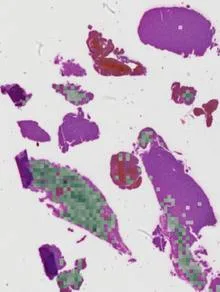
Imagine trying to figure out what happened in a room from the sound that lingers after a gunshot. The shot is gone, but the echo still bounces off the walls. That's roughly how a neuropathologist views a brain tissue section where the tumor itself is absent: the biopsy only captured healthy tissue that reacted to the disease.
The classroom goes quiet after the lesson, but the echo still rings in the child's head: faces, objects, places. It is this echo, not the lesson itself, that decides what will stay in memory. For the first time, researchers have caught it in children aged 6 to 17.
Children memorized scenes inside an MRI scanner: they were shown a room, then an object or a face in a particular spot.
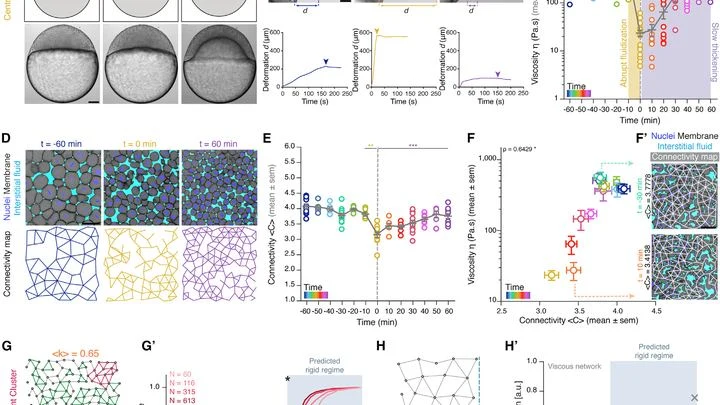
Epithelium lines our organs like tiles on a floor. At rest, cells cling to each other, and the tissue is elastic. But during embryonic development, wound healing, or tumor growth, this layer begins to flow like thick honey. What exactly triggers such softening?
Ordinary models assume that infection is like a steady flow of water that washes over everyone equally. In reality, the stream from a sick person fluctuates: right after infection it barely trickles, then turns into a raging downpour, and later subsides. The chance of catching the virus depends on the strength of this flow at the moment of contact.
Modular satellites are built from cube-shaped blocks, like a construction toy. When struck by space debris, some blocks are destroyed, leaving a puncture. Engineers took inspiration from the way living tissue heals wounds. Surviving blocks detect disorder and trigger an alarm signal that travels at the speed of light through the entire structure.
There's a leak in the garden hose. You patch the hole with duct tape, but the water presses harder and harder, and sooner or later the patch gives way. A growing clot in a blood vessel behaves much the same way.
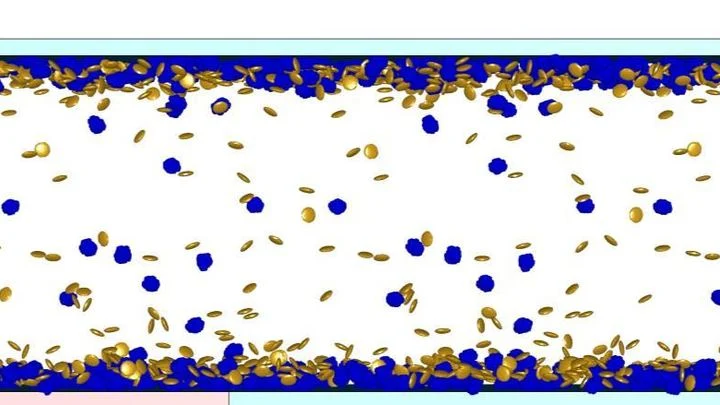
When the vessel wall is damaged, tiny blood platelets rush to the scene.
A torn telephone wire is a nuisance, but a torn DNA is a catastrophe. A double-strand break, when both strands of the helix snap at the same spot, threatens the cell with death or transformation into cancer. Fortunately, the cell has its own 'glue': special proteins that gather into a droplet right at the accident site.
A tightly stretched sheet lies on a table for days. Outwardly it's still, but the fabric fibers retain tension — loosen one edge slightly, and wrinkles will run across it, rearranging the whole pattern. That's roughly how a layer of epithelial cells behaves at rest. It doesn't just freeze; it accumulates mechanical stress — a kind of cellular memory of past movements.
A lump of plasticine, when kneaded, behaves like an amorphous solid — not a crystal, but not a liquid either. Inside such a material, avalanches can occur: one tiny rearrangement triggers neighboring ones, and a wave sweeps through the entire sample.
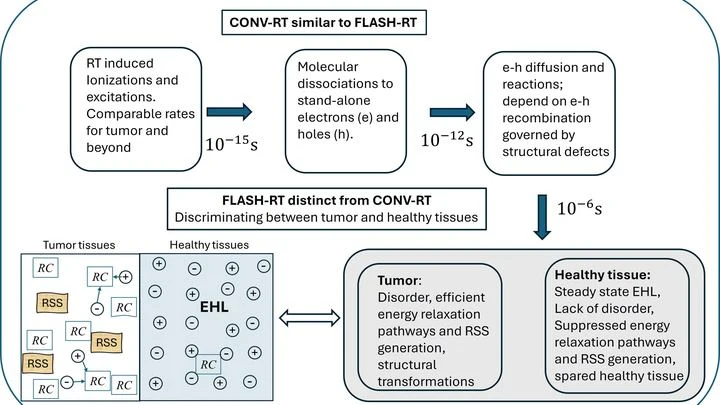
Two cities: one with neat, straight streets, the other with a tangle of alleys. If you send a powerful flood of water through both, in the first the water quickly drains away through channels, while in the second it swamps everything. That's roughly how tissues behave under ultrafast radiation therapy, known as FLASH.
A piece of dough, when pulled from the sides, doesn't stretch evenly: in one spot it thins and tears. Living tissue behaves similarly, but instead of a tear, shear bands appear — narrow zones where cells begin to slide past each other, like cards in a deck when cut.
The layer of cells lining internal organs is like a crowd in a packed subway: everyone stands shoulder to shoulder, but sometimes the crowd starts to flow, and people slip past each other. Biologists call this behavior a transition from a jammed, solid state to a fluid one.
When you cut your finger, skin cells start working in concert: some divide, others crawl toward the wound, and still others pause. But exactly how a cell decides what to do next depends on its internal "schedule"—the cell cycle.
A tumor doesn't stay put. Individual cells or whole groups break off and set off on a journey through the body. Some crawl solo, like scouts; others stick together, like a flock. Scientists built a computer model to understand how these cells pick a direction.
In the model, cells respond to two signals.
As an embryo grows, its cells don't just divide: they constantly touch their neighbors, like people in a crowded bus. The strength of these contacts determines where a cell moves and what shape the tissue takes. Scientists studied how cell 'stickiness' changes during the earliest stages of development.
A drop of oil in water behaves like a tiny ball: it seeks the spot with the least energy. If a wall is nearby, the drop often sticks to it, just as a raindrop spreads on glass. In a mixture of two immiscible liquids, such as polyethylene glycol and dextran, tiny droplets of one liquid form inside the other.