Equilibrium is a state in which a system's macroscopic properties—such as temperature, pressure, or concentration—remain constant over time because all net flows (of heat, particles, or momentum) are balanced. In thermodynamics, equilibrium implies no net exchange with the surroundings, while in mechanics it means zero net force and torque. The concept extends to ecosystems, economics, and quantum systems, where it describes stable configurations that resist perturbation.
History
The concept of equilibrium has roots in ancient mechanics, but its modern thermodynamic formulation emerged in the 19th century with Rudolf Clausius and Willard Gibbs, who formalized conditions for equilibrium in terms of free energy. John von Neumann later applied equilibrium ideas to game theory and economics.
How it works
Equilibrium arises when opposing processes occur at equal rates. For example, in thermal equilibrium, heat flows between two bodies at the same rate in both directions, so temperatures stay equal. In chemical equilibrium, forward and reverse reaction rates match. Systems tend toward equilibrium due to the second law of thermodynamics, which drives entropy to a maximum. Perturbations can shift equilibrium, but the system often returns via restoring forces, as described by Le Chatelier's principle in chemistry or by Lyapunov stability in dynamics.
In practice
Equilibrium principles are used in chemical process design, climate modeling, and materials science to predict stable phases; in quantum physics, they underpin the study of thermalization and many-body localization.
Fun fact
A system can be in equilibrium yet still be dynamic—for example, a saturated salt solution has constant concentration, but individual ions constantly dissolve and recrystallize at equal rates.
Inside an ultracold chamber, two atomic clouds collide: a few dozen cesium atoms acting as the working fluid, and thousands of rubidium atoms serving as the heat reservoir.
In a crystal, heat travels on waves. Atoms vibrate, and these vibrations, called phonons, carry energy from the hot edge to the cold one. For a long time, it was believed that if phonons hit resonance (their frequencies exactly match) and can exchange energy, heat would flow like an avalanche. It turns out that's not the case.
In the big world, there's a simple rule: energy density can't be negative, and its flow can't outrun light. In a café, that would look like this: a waiter can't deliver orders faster than he can run. Physicists call this restriction the energy dominance condition.
But in the microworld, where quanta rule and spacetime can bend, energy starts acting up.
Eight hundred participants, firms and workers, enter the market. Each holds a strict preference list in mind. The challenge: pair up so that no one wants a do-over. In mathematics, this is called a game theory with a ban on repeat alliances, and its roots trace back to the work of John von Neumann and Oskar Morgenstern.
A billiard ball strikes another, and the sum of their velocities before and after the collision obeys strict rules. The same happens in the microscopic world: energy, momentum, and charge cannot simply vanish.
A taut sheet wrinkles. If you tug a corner, a smooth wave runs across; if you sharply bunch the fabric, a sharp crease forms. Space and time in Einstein's equations behave much the same way. Gravitational waves resemble the gentle ripples of the sheet, while shock fronts are like stiff folds where matter's properties change abruptly.
A busy intersection without traffic lights. Cars drive, brake, and change lanes, and from the outside, it looks like complete chaos. But if you watch for a while, you can notice a rhythm: the flow thickens and thins. In physics, this rhythm of disorder is called entropy: it shows how far a system is from calm equilibrium, like water in a boiling kettle.
An ordinary diode in electronics works like a one-way street: current flows in only one direction. In superconductors, where electricity flows without resistance, such behavior has long been elusive — current is usually symmetric.
The authors of the new work found a way to create a perfect superconducting diode using light.
The quantum world is usually drawn with points, but real instruments only see blurry spots. Heisenberg and von Neumann long suspected: precision is unattainable.
A pot of soup forgotten on the stove cools to room temperature. It seems everything has come to rest. But if you look inside with a quantum magnifying glass, you'll find that water molecules haven't frozen: they continue their dance. It's just that now the dance is steady, not turbulent like when boiling.
A pot of water on the stove eventually settles down: the temperature evens out, the liquid stops boiling. Physicists call this thermal equilibrium — a state where energy is distributed in the most probable way.
Water can be ice, liquid, or steam. Physicists call these states phases. In theory, each phase has its own measure — a way to describe how likely it is. But not every measure you can imagine occurs in nature. Some phases are real, while others are just mathematical illusions.
Scientists have found a simple criterion that separates reality from mirage.
An ultracold cloud of atoms trapped in laser light can 'breathe': it rhythmically contracts and expands, much like lungs. Physicists have long been able to observe this breathing, but only now have they realized that its amplitude is not just a pretty picture: it is a precise measure of hidden energy jitters inside the cloud.
A neural network learning something new is like a traveler in mountainous terrain. Each piece of learned knowledge is a depression in the landscape into which the traveler rolls and gets stuck. To escape and reach a new basin, energy is needed. But as the traveler gains experience, the walls of their pit become steeper, and each subsequent climb requires more effort.
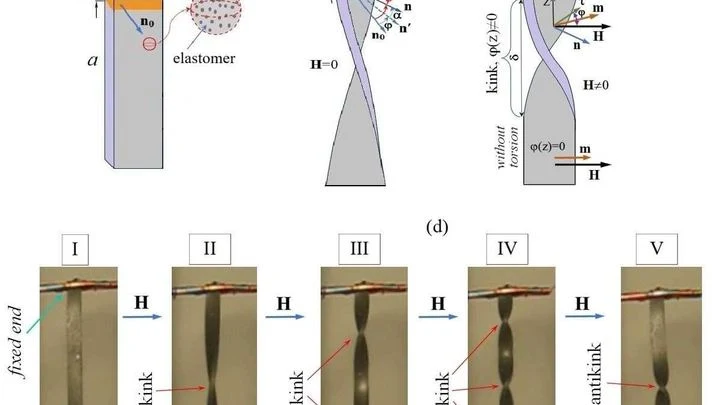
An ordinary rubber strip filled with fine iron filings doesn't just bend in a magnetic field: it ties itself into a stable knot. This effect was predicted and reproduced in experiments by physicists working with magnetoactive elastomers: a silicone base with carbonyl iron particles.
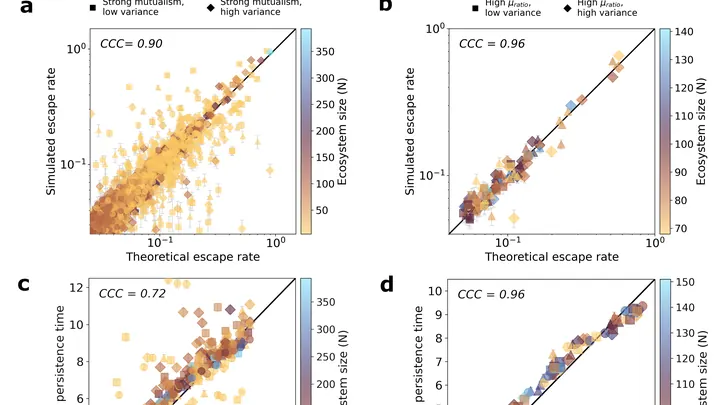
An ecosystem is like a swing that someone is subtly pushing. Previously, it was thought that the main concern was that the swing wouldn't swing too wildly. But the authors of this work showed that the greater danger is when the equilibrium point itself slides toward a place where the swing can no longer return.
A quantum computer is like an orchestra where every musician must play with precision down to a billionth of a second. If one instrument goes out of tune, the whole symphony collapses. So scientists spent a year watching 27 qubits — the simplest cells of quantum memory.
A hot coffee cools by radiating invisible light. To maintain temperature, it must receive exactly as much light back. This silent trade of photons is what we feel as steady warmth.
Every machine, whether a car engine or a tiny nanocooler, runs with a jitter. Fuel burns unevenly, electrons slip through contacts off schedule, and the power needle on your instruments vibrates slightly. These vibrations are called fluctuations. They are not just noise: they tell you how stable a device is and how much energy it wastes.
Quantum entanglement is a fragile resource. Heat a system, and thermal fluctuations will tear the delicate threads of correlations: at a sufficiently high but finite temperature, the Gibbs state of a local Hamiltonian becomes separable, that is, representable as a probabilistic mixture of products of local states.
Heat flow usually evens everything out: hot things cool down, cold things warm up, and in the end you are left with a uniform warm swamp. The same holds in the quantum world: the environment, whether a crystal lattice or a gas of photons, tends to destroy the fragile entanglement between particles.