Mini

Red Lanterns of the Cosmos: What Compact Objects from the Early Universe Conceal

Original: "The UV Side of Little Red Dots: Red, Compact, and Iron-Enhanced Rest-UV Emission with a Strong Downturn around Ly$$α$$"
arXiv:2606.03522v1 · 2026-06-02 · CC BY · ⏱ 1 min · Galaxies
The James Webb Space Telescope has spotted a population of red dots in the early Universe: their ultraviolet glow betrays the presence of growing supermassive black holes wrapped in dense gas cocoons.
Links in the knowledge graph 1

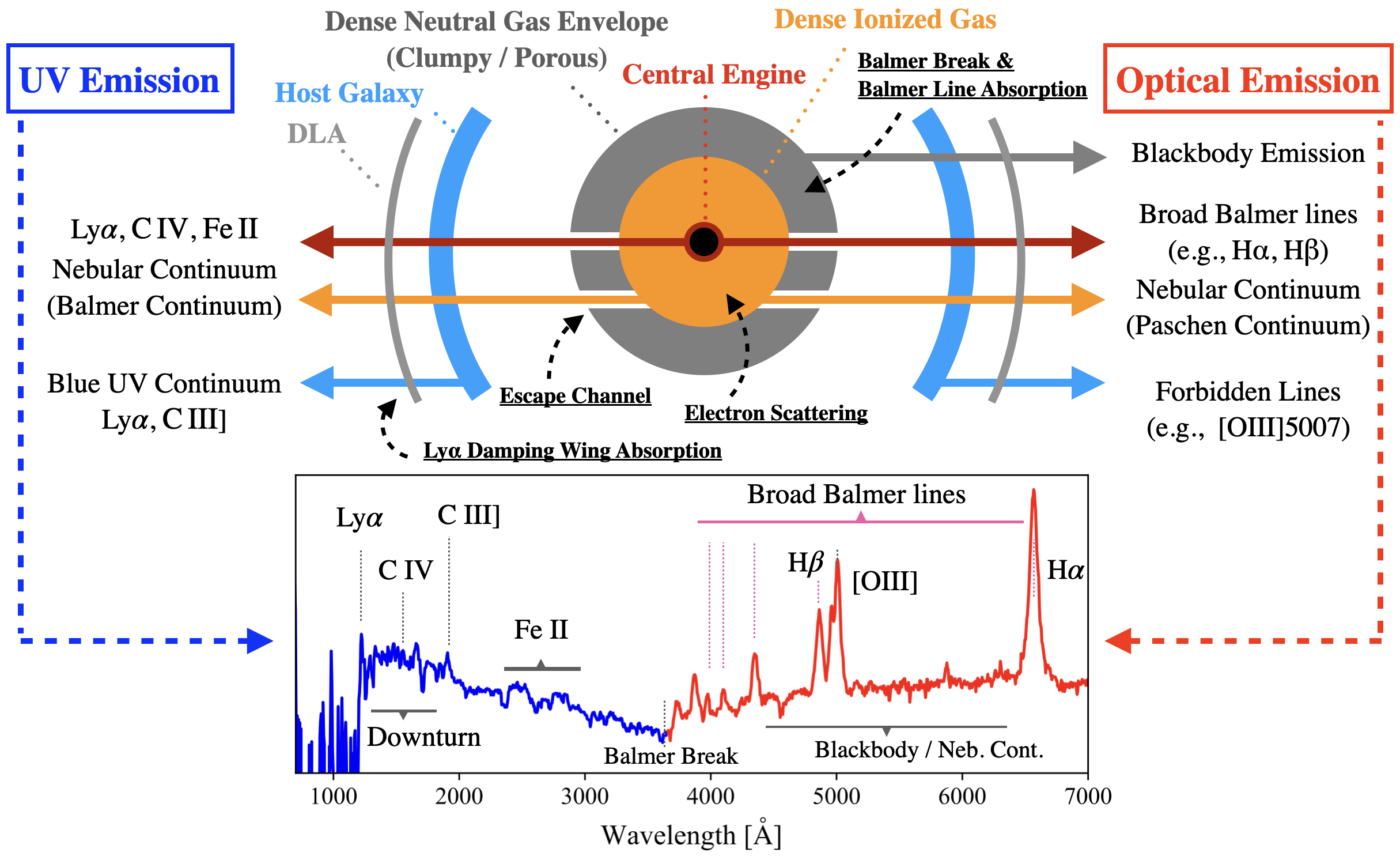
Just 600 million years after the Big Bang, red lights are already burning in the cosmic darkness. These are not ordinary stars or galaxies—they are growing supermassive black holes, shrouded in dense gas cocoons. Their ultraviolet glow, as it breaks through the thick veil of matter, takes on the hue of a setting sun. Understanding the nature of these 'red lanterns' means getting closer to solving one of the greatest mysteries: how giant black holes appeared so early in the universe.

🎯 The name 'little red dots' was born spontaneously: astronomers, seeing a scattering of very red compact objects in JWST images, compared them to ladybugs lost in cosmic grass.

🎬 These red dots are like beacons from a science fiction novel: compact, mysterious, and possibly controlling the fate of entire galaxies. They evoke something of Arthur C. Clarke's black monoliths, only here instead of cold black there is a hot red glow.

f_{\lambda,\text{rest}} = f_{\lambda,0} \left(\frac{\lambda}{1500 \text{\AA}}\right)^{\beta_{\text{UV}}}
The parameter β_UV is the spectral slope: the higher it is (closer to zero), the redder the radiation, indicating absorption of blue photons by a dense medium.
Scientists
Christian DopplerD. B. McLaughlinDidier QuelozMichel MayorR. A. RossiterStephen Hawking
Tags
black hole galaxy quasar JWST spectroscopy hydrogen carbon helium oxygen
Laws
Doppler effectHawking radiationgravitational lensingBekenstein-Hawking entropyCoulomb's lawEinstein field equations
Original: arXiv:2606.03522v1 · CC BY · bridge42worlds