Tiny Red Dots: An Ultraviolet Look at the Mysterious Compact Objects of the Young Universe ✛ ✎ ✦
Context
In recent years, the JWST has revolutionized observational cosmology, peering back to an epoch when the universe was just a few hundred million years old. Among its discoveries is a population of extremely compact and red sources, nicknamed Little Red Dots (LRDs). Their peculiar spectra with a V-shaped continuum, broad Balmer lines (discovered by Johann Balmer), and the puzzling absence of X-ray emission have left astronomers scratching their heads. Understanding LRDs is key to unraveling the formation of supermassive black holes (predicted by Karl Schwarzschild) in the early universe — one of the biggest unsolved problems in modern astrophysics, whose foundations were laid by Edwin Hubble.
Methods
To get to the bottom of the LRD mystery, a team led by Makoto Ando tapped into archival JWST data. From the Dawn JWST Archive spectroscopic database, they selected about a hundred LRDs with redshifts from 3.5 to 9.3. For each object, they measured the ultraviolet spectral slope ($β_{UV}$) and size in the UV by fitting two-dimensional brightness profiles. To bring out faint details, the spectra were combined using median stacking in several groups: by UV slope and by the strength of the Balmer jump (the flux ratio across the hydrogen ionization threshold). They also modeled the continuum shape, including contributions from dense gas, carbon, and helium lines.
Results
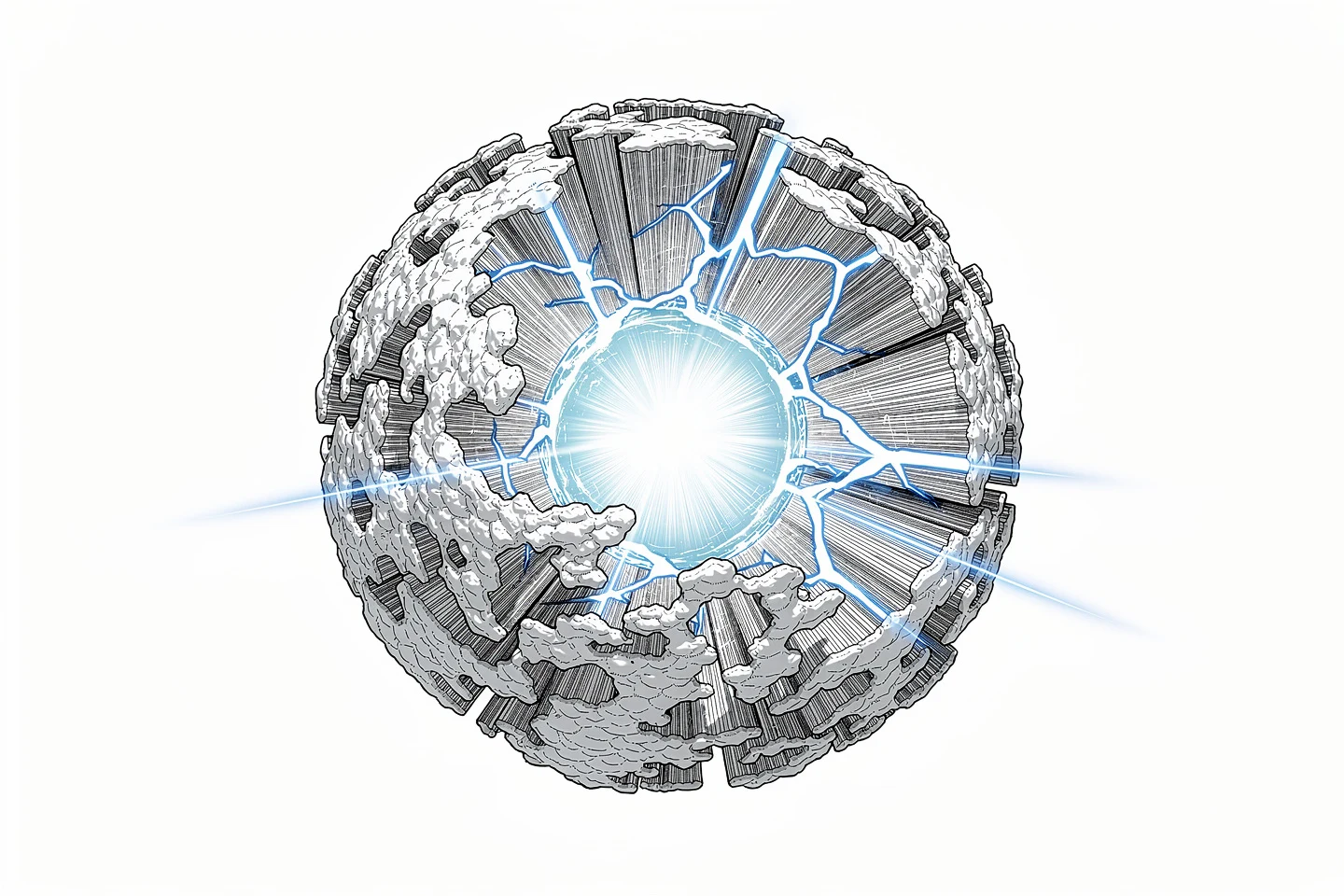
It turns out that LRDs are systematically 'redder' than typical star-forming galaxies at the same redshifts: their average UV slope $β_{UV}$ is –1.4, compared to –2.0 for normal galaxies. Their UV sizes are also tiny — on average four times smaller than those of comparison galaxies. Stacked spectra revealed a clear correlation: the stronger the Balmer jump, the redder the UV continuum, the deeper the dip around the Lyα line, and the more compact the source. Emission lines of CIII] and CIV stand out confidently, along with the HeII and OIII] complex. Particularly striking is the high FeII peak relative to MgII — the ratio reaches 8–10, which is higher than in known quasars at similar redshifts. Continuum modeling showed that starlight alone can't explain such red UV emission — an extra source is needed, like radiation from a dense ionized medium leaking through a clumpy envelope around the central black hole.
Implications
These results bolster the idea that LRDs aren't just distant galaxies, but systems dominated by accretion onto a supermassive black hole wrapped in a very dense gas cocoon. The red UV continuum and intense FeII emission point to extreme conditions near the black hole, possibly even super-Eddington accretion. The correlations between parameters suggest that the diversity of LRDs stems from varying contributions of the central engine relative to the host galaxy. This makes LRDs a unique laboratory for studying black hole growth back when the universe was young.
Future development
In the coming years, more data from JWST and future telescopes will pile up, allowing high-resolution spectral studies of individual LRDs. New X-ray observations (e.g., with Athena or Lynx) will test the idea that dense shrouds block the radiation. Theoretical models will refine the structure of the 'envelope' around the black hole and the mechanisms of ionizing radiation escape. Down the road, LRDs could become the key to understanding how the first supermassive black holes formed and how they are linked to the evolution of galaxies.
Impact
The findings will ripple across several fields: accretion theory and active galactic nuclei feedback, simulations of early galaxy evolution, and interpretation of high-redshift spectroscopy data.
Next steps
Next up: obtaining high-resolution spectra to separate narrow and broad emission-line components, along with deep UV imaging to map the emission from LRDs in fine detail.
Key open problems
The study of LRDs is directly tied to the unsolved problem of seeding supermassive black holes in the early universe. If LRDs truly are million-solar-mass black holes enshrouded in gas, their sheer numbers challenge hierarchical merger models and call for fast-track growth mechanisms, like direct gas collapse or super-Eddington accretion.
The knowledge machine's view
This section is addressed to the author of the paper and their colleagues. Neighbouring works were found by meaning-based search across our archive, not by word overlap. We do not review: we show the field around the work.
What the work does
The study uses archival JWST spectroscopic data for ~100 LRD at z=3.5–9.3. The UV slope and sizes were measured, median stacking of spectra was performed by groups, correlations with the Balmer break were identified, and emission lines CIII], CIV, HeII/OIII] and a high FeII/MgII ratio were detected. The conclusion is that an additional source of radiation is needed, presumably a dense ionized medium around the black hole.
Where its strength is
The strength is the systematic measurement of UV properties of a large sample of LRD and stacking, which allowed identifying statistically significant correlations indicating the dominance of black hole accretion in these objects.
Where it could go next
- It might be interesting to compare the obtained spectral characteristics with models where LRD are explained not by dusty quasars but by other mechanisms, as in the work on red dots not being twins of dusty quasars.based on: Red Dots Are Not Twins of Dusty Quasars arXiv:2508.21678
- There is a nearby work linking the formation of supermassive black holes to dark matter; perhaps your data on dense envelopes around black holes could help distinguish formation scenarios.based on: Cradle for a Black Hole: Dark Matter and the Mystery of Red Dots arXiv:2606.02539v1
- In the archive, there is an analysis where hydrogen fog hides black holes; your conclusions about the clumpy envelope could be developed using their approach to modeling absorption.based on: Scarlet Invisible Cores: How Hydrogen Fog Conceals Black Holes arXiv:2606.04711v1
Worth trying
- Test whether a clumpy envelope model can simultaneously explain the UV slope, the Balmer break, and the FeII/MgII ratio.
- Compare the size distribution of LRD with predictions from quasi-star models.
- Search for a correlation between black hole mass (from line widths) and UV slope to estimate the accretion rate.
Why this may matter
If LRD are indeed envelopes around actively accreting supermassive black holes, this would provide a direct observational test for scenarios of the formation of the first black holes and their early growth, which is important for understanding galaxy evolution.
Nearby works in our archive
- Red Dots Are Not Twins of Dusty Quasarssimilarity 0.76
- Cradle for a Black Hole: Dark Matter and the Mystery of Red Dotssimilarity 0.76
- Scarlet Invisible Cores: How Hydrogen Fog Conceals Black Holessimilarity 0.73
- Cosmic Pressure Cooker: Unraveling the Mystery of Little Red Dotssimilarity 0.73
- Red Dots in Space Turned Out to Be Growing Black Holessimilarity 0.72
- Quasi-stars: The Furnaces Where Supermassive Black Holes Are Bornsimilarity 0.72
- Archipelago in the Ocean of Data: Red Points Without Color Boundariessimilarity 0.72
- Tiny Black Holes Build Giantssimilarity 0.71
- Cold Water Trail in the Red Dots of Spacesimilarity 0.71
The archive is crowded around this work: 9 reviews nearby, closest at 0.76. This ground is well walked — and there is plenty to compare against.
Fun fact: astronomers unofficially named them 'little red dots' after spotting a scatter of very red, compact objects on JWST images, looking like ladybugs lost in the vastness of space.
To draw a sci-fi parallel, LRDs are reminiscent of the mysterious monoliths from 2001: A Space Odyssey — compact, energy-emitting objects that might just be steering the evolution of their galaxies.
Key numbers
- typical UV slope (β_UV): -1.4
- average effective radius in UV: ~200-300 pc
- FeII/MgII ratio: 8-10
- number of objects in sample: ~100
- redshift z: 3.5-9.3