Red Lanterns of the Cosmos: What Compact Objects from the Early Universe Conceal ✛ ✎ ✦
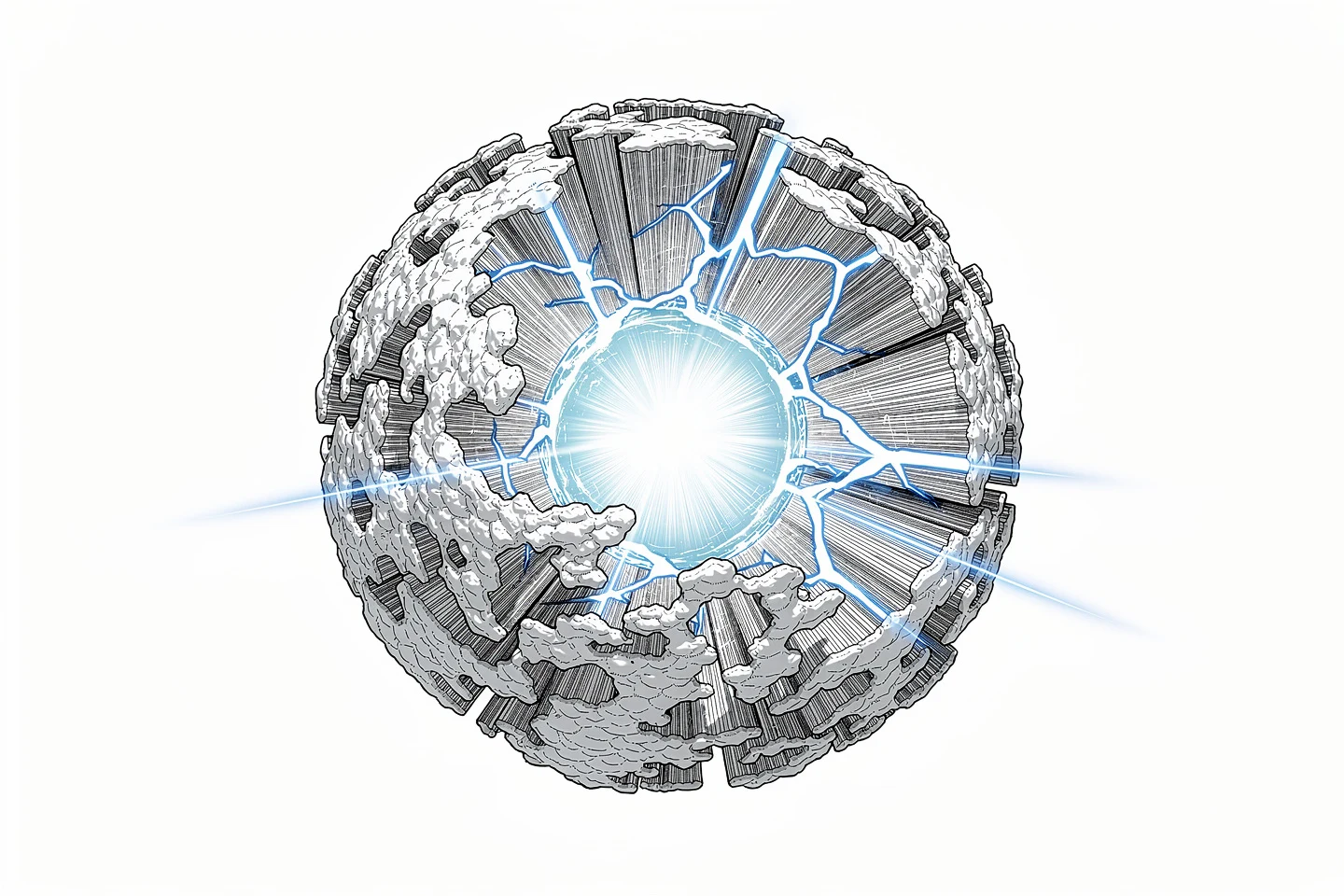
When the James Webb Space Telescope turned its gaze deep into time, astronomers expected to see familiar galaxies. Instead, the images were dotted with a scattering of bright, incredibly compact red dots. These objects, affectionately nicknamed 'little red dots' (LRDs), turned out not to be stellar cities, but something far more peculiar, like tiny celestial lanterns, with a hidden flame raging inside.
Imagine a traditional Asian lantern: thin rice paper stretched over a frame, a flame flickering inside. The paper softens the light, making it honey-colored, reddish. So it is with LRDs: at their heart is not a candle, but an accreting supermassive black hole, around which swirls a dense gas 'envelope.' Ultraviolet radiation, born from the friction of infalling matter, struggles to break through the clumpy shell, losing blue photons along the way and emerging crimson. Each photon that reaches us is like a weary messenger, having spent thousands of years wandering through a gas labyrinth. It is this reddened light that the spectrographs of JWST captured.
To peek under the 'paper,' Makoto Ando's team used a powerful statistical technique — median stacking of spectra from about a hundred LRDs. The spectra were grouped by the strength of the Balmer break — a sharp drop in radiation beyond the ionization threshold of hydrogen, discovered long ago by Johann Balmer. This break is like a sudden step that the spectrum seems to stumble upon. In the stacked spectra, other details emerged: bright emission lines of carbon (CIII] and CIV), helium (HeII), and oxygen (OIII]). It turned out that the steeper this drop, the redder the ultraviolet continuum and the more compact the source. The slope, called the UV spectral index $β_{UV}$, is about –2 for typical star-forming galaxies, but for LRDs it averages –1.4; it's as if someone threw an extra layer of gauze over each lantern.
All these signs paint a picture of a distant past, where black holes grew in a 'super-Eddington accretion' regime, devouring matter much faster than the theoretical limit predicted by Karl Schwarzschild. LRDs are the embryos of future galactic giants, the moment when the central engine has already started but the cocoon has not yet been shed. Nature seems to be playing hide-and-seek with us, veiling the violent birth of black holes with gas curtains. Further observations in high-resolution spectroscopy and X-rays will reveal exactly how light bursts through gaps in the shell, and help us understand where billion-solar-mass monsters came from in the young universe in just a few hundred million years. This is not just a niche topic in astrophysics: it brings us closer to unraveling the evolution of galaxies themselves.
Perhaps LRDs are the missing link between the first stars and modern quasars. Studying them forces us to revise models of structure formation, which began with Edwin Hubble's discovery of the expanding universe, and where not only dark matter and gas but also active feedback from growing black holes play a key role. When future next-generation telescopes remove the paper shades from these distant lanterns, we will see something astonishing, the moment the universe's greatest energy machines ignite.
The name 'little red dots' was born spontaneously: astronomers, seeing a scattering of very red compact objects in JWST images, compared them to ladybugs lost in cosmic grass.
These red dots are like beacons from a science fiction novel: compact, mysterious, and possibly controlling the fate of entire galaxies. They evoke something of Arthur C. Clarke's black monoliths, only here instead of cold black there is a hot red glow.