Quiet Quasar: Ultraviolet Storm at a Third of Light Speed ✦
Original: "A New Member of the Fast and Furious Family: A Relativistic and Time-Variable UV Outflow in a Luminous Quasar"
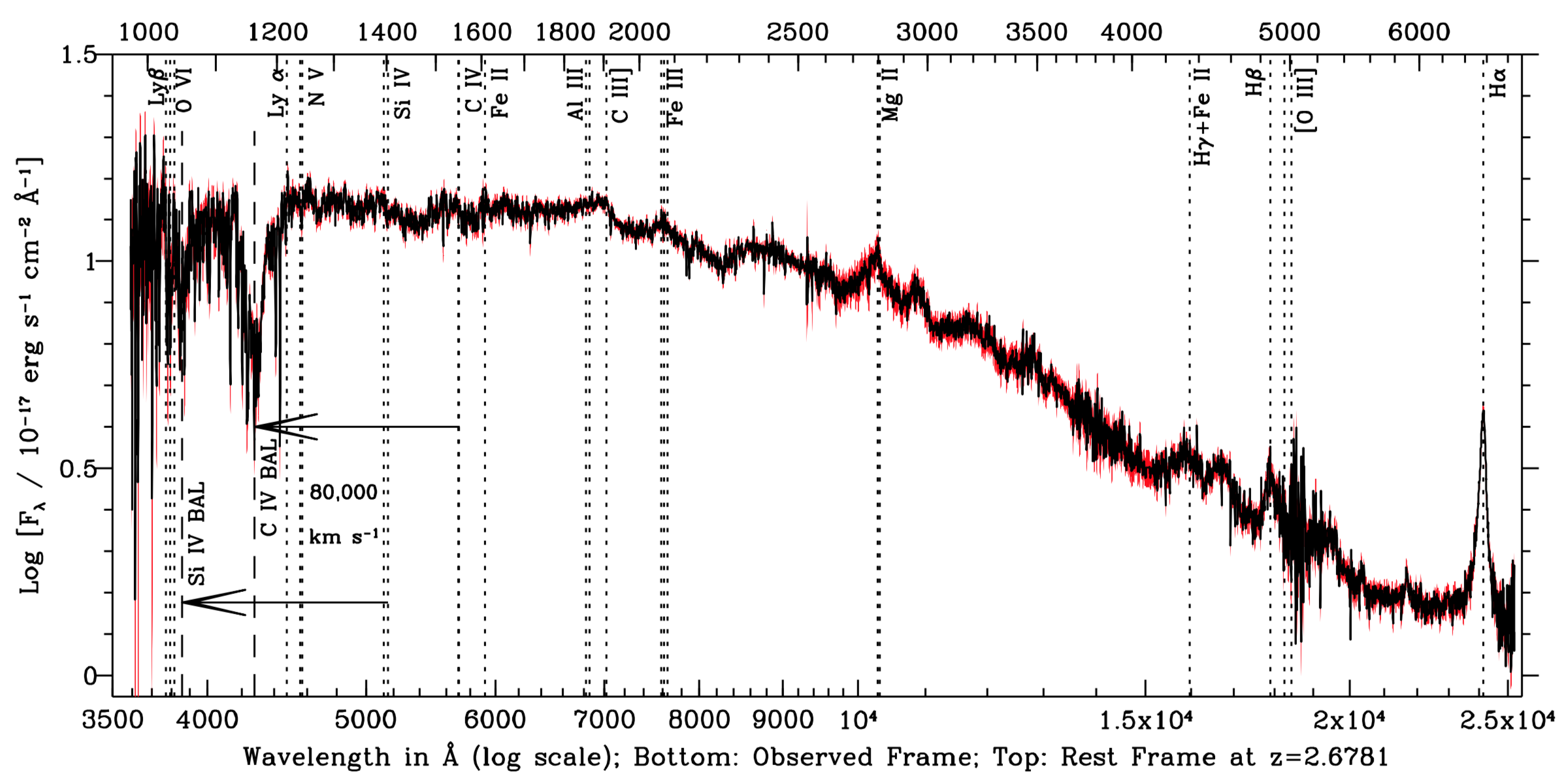
In quasar J2318, an ultraviolet wind was discovered hurtling at nearly 90,000 km/s — rewriting our understanding of galaxy evolution.
Links in the knowledge graph 1
At the center of nearly every galaxy smolders an ancient fire. In J2318, it has flared up so fiercely that it hurls gas at a third of the speed of light. This cosmic hurricane sweeps away the raw material for new stars. But how does the gas stay cold at such speeds? The answer lies hidden at the intersection of astrophysics and plasma physics. We are just beginning to listen to the howl of these winds—and perhaps, from their roar, we will reconstruct the biography of galaxies.
🎯 J2318's wind covers the Earth-Moon distance in four seconds—faster than you read this sentence. The quasar itself remains an astrophysical quiet one: its weak emission lines are deceptively calm, like the surface of water above a submarine volcano.
M_{\rm BH} = A \left( \frac{L_{5100}}{10^{44}\,{\rm erg/s}} \right)^b \left( \frac{{\rm FWHM}_{\rm H\alpha}}{v_{\rm norm}} \right)^c
Empirical calibration linking black hole mass to continuum luminosity and emission line width.
L_{\rm Edd} = \frac{4\pi G M_{\rm BH} \mu m_p c}{\sigma_{\rm T}}
Maximum luminosity at which radiation pressure balances gravity for ionized gas.
Scientists
Adam RiessBrian SchmidtEdwin HubbleGeorges LemaîtreMaarten SchmidtSaul Perlmutterquasar
black hole
galaxy
spectroscopy
speed of light
expansion of the universe
cosmic dust
hydrogen
carbonLaws
Hubble's lawDoppler effectHawking radiationgravitational lensingprinciple of constancy of the speed of lightBekenstein-Hawking entropy