Swift Outflow from Quasar J2318: Relativistic Wind at 0.3c ✛ ✦
Context
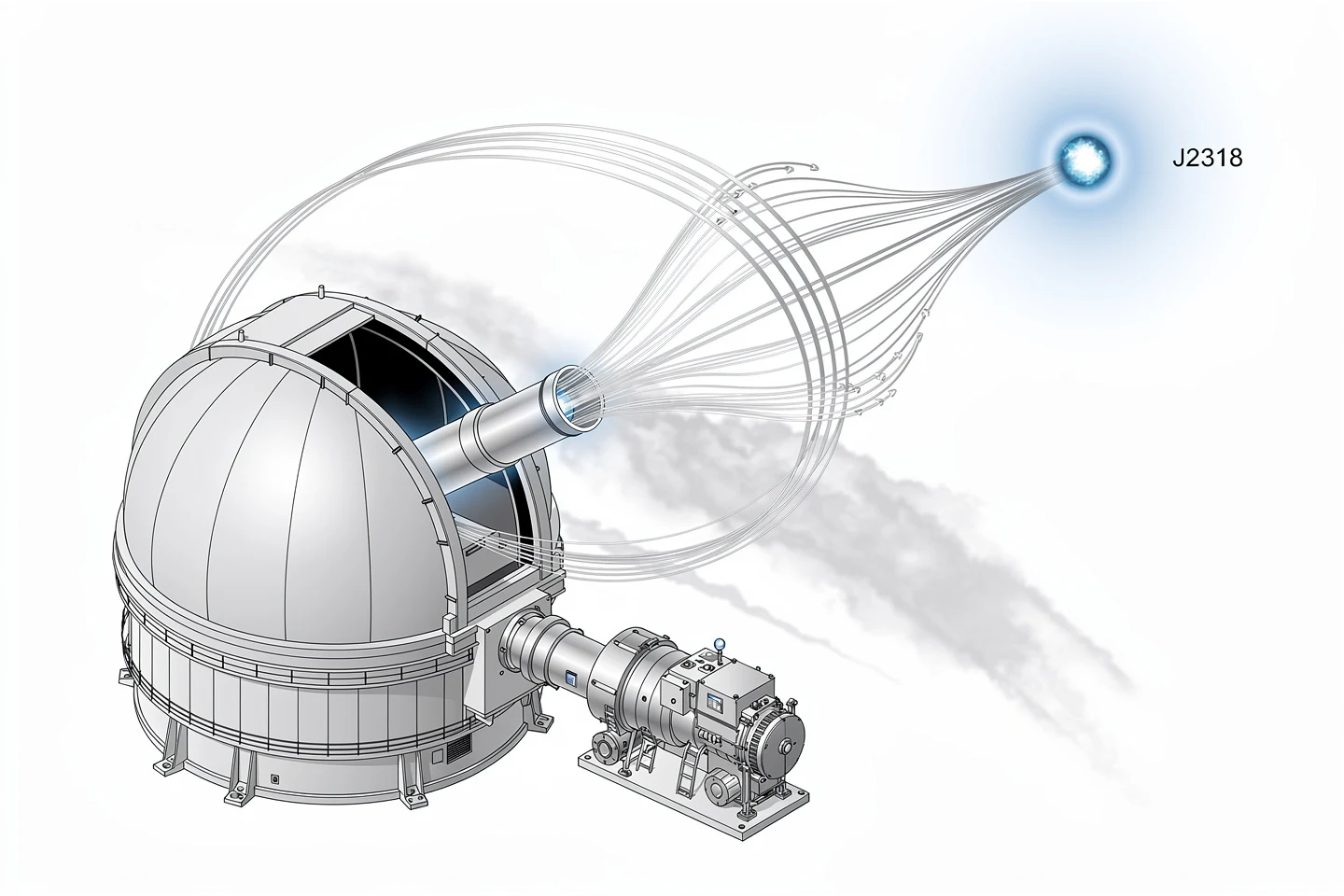
Back in the mid-20th century, Maarten Schmidt identified quasars as distant active galactic nuclei. Today we know that at the heart of every quasar lies a supermassive black hole actively devouring matter. Yet some of the gas doesn't fall into the abyss but is flung outward in powerful outflows that can affect the entire host galaxy — heating and sweeping away interstellar medium, regulating star formation. Observing these 'winds' is key to understanding the co-evolution of black holes and their galaxies.
Methods
The discovery was made possible by years of spectroscopic monitoring as part of the Sloan Digital Sky Survey (SDSS) and observations with the Gemini North telescope. Spectra of the quasar, obtained in three epochs, showed deep absorption troughs in the ultraviolet. To isolate the absorption lines, researchers built continuum models corrected for interstellar reddening and Lyman-alpha forest suppression. Both direct integration and Gaussian fitting were applied. Light curves from ground-based surveys complemented the variability picture.
Results
The absorption lines of carbon CIV and silicon SiIV ions were blueshifted by a staggering 77,000–90,000 km/s, about 0.3 of the speed of light. This is the second known quasar with such a fast ultraviolet outflow after PDS 456. Over 2.2 years (in the quasar's rest frame), the outflow monotonically increased: the equivalent width of the CIV line grew from 660 to 3,730 km/s. Virial estimates from the Hα line gave a black hole mass of 1.65×$10^9$ M⊙, and the bolometric luminosity reached 1.09×$10^{47}$ erg/s with an Eddington ratio of about 0.45. The lower limit on the mass loss rate is 0.82 M⊙ per year, corresponding to a kinetic luminosity of at least 0.75% of the Eddington luminosity.
Implications
Such powerful feedback places J2318 among objects where the outflow feedback can significantly impact the galaxy. This supports theoretical models that require 'winds' from active nuclei to explain black hole mass–bulge property relations. Moreover, the presence of low-ionization ions at such high speeds challenges acceleration theories: the gas must either accelerate without overheating, or it must form already in the flowing stream.
Future development
Further monitoring of J2318, including X-ray observations with future observatories like NewAthena, will probe hotter phases of the outflow. Instruments like James Webb can detect molecular wind components. Growing the sample of extreme outflows will help determine whether a speed of ~0.3c is a universal limit, perhaps tied to the 'trapping' mechanism of Lyman-series lines.
Impact
The results are important for understanding the evolution of massive galaxies in the early Universe, where quasars are especially active. They also spur the development of hydrodynamic simulations with feedback.
Next steps
Plans are to continue spectroscopic monitoring to track absorption variability, and to obtain deep X-ray spectra to determine the total column density and outflow energy.
Key open problems
The puzzle of gas acceleration in quasar outflows remains unsolved. How gas survives in a low-ionization state while being accelerated to 0.3c is a question that connects to the problem of shock waves and thermal conduction in astrophysical plasmas. Moreover, the link between ultraviolet and X-ray outflow components is critical for estimating the total feedback budget.
The knowledge machine's view
This section is addressed to the author of the paper and their colleagues. Neighbouring works were found by meaning-based search across our archive, not by word overlap. We do not review: we show the field around the work.
What the work does
This work presents the fastest known quasar outflow, detected through variable ultraviolet absorption of C IV and Si IV ions at velocities up to 0.3c in the radio-quiet quasar SDSS J2318. Based on Gemini GNIRS spectroscopy of the Hα line, the redshift is determined to be z=2.6781, and photometry over 20 years shows a peak variability of 0.5m in the g-band. Over ~2.2 years in the rest frame, the C IV absorption monotonically increased, indicating a growing flow.
Where its strength is
The strength of this work lies in the detection of an extreme outflow with a unique combination of high velocity and the presence of low-ionization ions, challenging standard wind acceleration models. This makes the object a key test for active galactic nucleus feedback mechanisms.
Where it could go next
- It might be interesting to compare this outflow with the influence of winds on gas in galaxy clusters, as in the work on the breathing quasar, to assess how such flows could regulate cooling and star formation on larger scales.based on: Breath of a Quasar: How a Black Hole Controls a Cluster arXiv:2607.24911v1
- Nearby lies the study of the wind clearing the Galactic center; comparing with it could clarify how outflows at such speeds interact with the interstellar medium and affect gas dynamics in central regions.based on: Black Hole Wind Clears the Galactic Center arXiv:2509.10615
- Since the work emphasizes a challenge to acceleration theories, it is useful to consider models where gas is accelerated without overheating, possibly through mechanisms similar to those discussed in the context of relativistic jets in blazars.based on: Hidden Ultrarelativistic Spine in a Blazar Jet arXiv:2606.27430
Worth trying
- Test whether the ionization state of the gas is maintained when accelerated by radiation pressure on dust, using models from the work on the dusty black hole.
- Compare the absorption variability with light curves in other bands to search for correlations similar to those found in the study of black hole pulsations.
- Assess the impact of the outflow on star formation in the host galaxy, following the approach of the work on the wind quenching stars.
Why this may matter
Understanding the acceleration mechanisms of such fast outflows while preserving low-ionization ions is crucial for building a complete picture of active galactic nucleus feedback, which governs the co-evolution of black holes and galaxies.
Nearby works in our archive
- Breath of a Quasar: How a Black Hole Controls a Clustersimilarity 0.67
- Black Hole Wind Clears the Galactic Centersimilarity 0.65
- The Wind That Snuffs Out Starssimilarity 0.62
- Dark Energy That Changes Signsimilarity 0.62
- Gravitational Slingshot: How Black Holes Accelerate Dark Mattersimilarity 0.62
- Winds of Galactic Capitalssimilarity 0.62
- Hidden Ultrarelativistic Spine in a Blazar Jetsimilarity 0.62
The closest work in the archive sits at 0.67 by meaning — the usual level for our corpus.
Original abstract
as written by the authors arXiv:2606.06226v1
We report the fastest quasar outflow first detected in the ultraviolet, via variable C IV and Si IV absorption at outflow velocities $$-77,000$$ km s$$^{-1}$$ to at least $$-90,000$$ km s$$^{-1}$$, in the radio-quiet quasar SDSS J231854.31+243954.2 (J2318). J2318 is a weak-lined quasar in the rest-frame ultraviolet, but Gemini GNIRS spectroscopy reveals an H$$\alpha$$ redshift of $$z=2.6781\pm0.0004$$. A twenty-year photometric time series shows peak-to-peak variability of 0.5 mag in the $$g$$ band. The C IV outflow strengthened monotonically over three epochs spanning $$\sim$$2.2 rest-frame years. The existence of such a high-velocity outflow implies that models of quasar outflows must be able to either accelerate gas to $$0.3c$$ while still preserving C IV and Si IV ions, or enable the formation of C IV and Si IV ions in gas which has been accelerated to $$0.3c$$. Virial estimates reveal a black-hole mass of $$1.65\times10^9~M_\odot$$, which leads to an Eddington luminosity and Eddington ratio of $$2.4\times10^{47}$$ erg s$$^{-1}$$ and $$0.45$$, respectively. Using very conservative assumptions, the UV-absorbing outflow alone has an estimated mass loss of $$>0.82~M_\odot~{\rm yr}^{-1}$$ and a kinetic luminosity ratio $$L_{kin}/L_{bol}\geq0.75$$%. The lower limit is just above the threshold usually cited for significant feedback on the host galaxy. Comparison to PDS 456, the only other known quasar with a UV-absorbing outflow at $$0.3c$$, suggests that the true $$\dot{M}$$ and $$L_{kin}/L_{bol}$$ could be up to two orders of magnitude larger.
If the wind from J2318 were blowing through the Solar System, it would travel the distance from Earth to the Moon in less than 4 seconds. The quasar itself is 'weak-lined', its emission lines anomalously faint, making it resemble an astrophysical 'quiet one' with a wild temper.
Key numbers
- Outflow speed: up to 90,000 km/s (≈0.3c)
- Black hole mass: 1.65 × 10⁹ M⊙
- Mass loss rate: >0.82 M⊙/yr
- Energy feedback (L_kin/L_Edd): >0.75%
- Redshift: z = 2.6781