Quiet Quasar: Ultraviolet Storm at a Third of Light Speed ✛ ✦
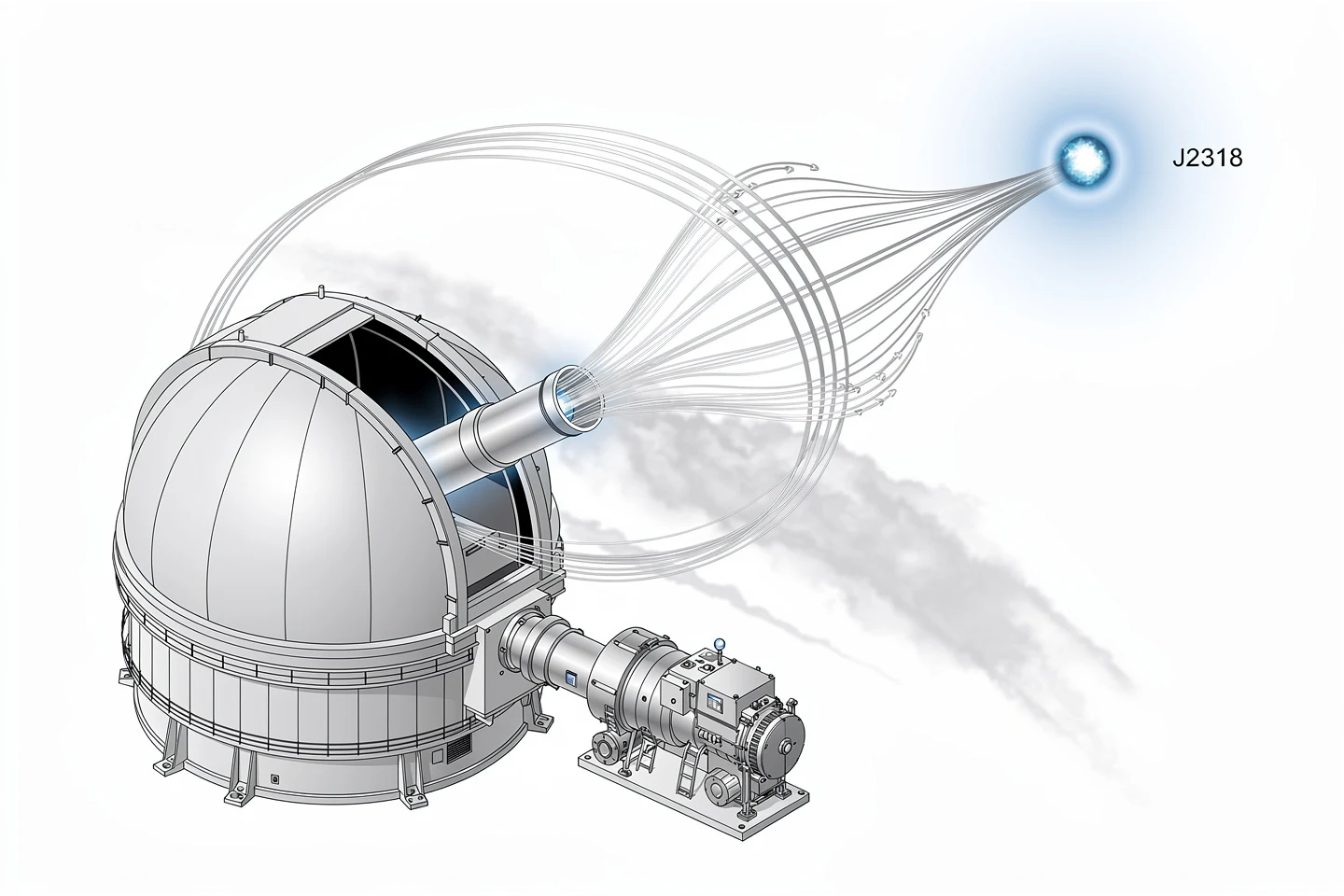
In 1963, Maarten Schmidt unraveled the nature of quasars — distant active nuclei outshining entire galaxies. Since then, we've learned that at their hearts lurk supermassive black holes, converting infalling matter into blinding light. But not everything vanishes into the abyss: some material is flung away — and in J2318, this ejection has become a monstrous wind.
An active galactic nucleus works like a cosmic blast furnace: material is drawn into an insatiable fire, and the unassimilated leftovers are expelled as exhaust. In J2318, this exhaust has gone full-throttle: spectroscopy revealed an outflow accelerated to 90,000 km/s — one-third of the speed of light. Its traces are absorption lines of carbon CIV and silicon SiIV, shifted bluewards by a monstrous amount.
The mass of the black hole in J2318 is 1.65 billion solar masses. The bolometric luminosity reaches 1.09×10⁴⁷ erg/s, meaning the core blazes at 45% of the Eddington limit. Despite such brilliance, the outflow's kinetic power is at least 0.75% of the limit, equivalent to ejecting over 0.82 solar masses per year. That's enough to sweep gas out of the galaxy and extinguish stellar nurseries.
The acceleration paradox gives no rest: how does gas, observed via absorption lines, stay cold while racing at 0.3c? Any collision would heat it to X-ray temperatures. Either the acceleration is smooth, like a slow buildup before a hurricane, or the wind is born already flying — skipping the breeze stage.
Future observations with the James Webb Space Telescope and next-generation X-ray observatories will allow us to peer into the hot phases of the outflow. Perhaps the 0.3c speed is a universal limit, dictated by the microphysics of the expanding Universe, in whose era J2318 shines at redshift 2.68. This system is not just a record-holder, but a laboratory of extreme physics accessible to direct observation. And who knows — perhaps such winds once quieted our own Milky Way, turning it into a tranquil spiral galaxy?
J2318's wind covers the Earth-Moon distance in four seconds — faster than you read this sentence. The quasar itself remains an astrophysical quiet one: its weak emission lines are deceptively calm, like the surface of water above a submarine volcano.