Cosmic wind accelerated to a third of the speed of light ✛ ✦
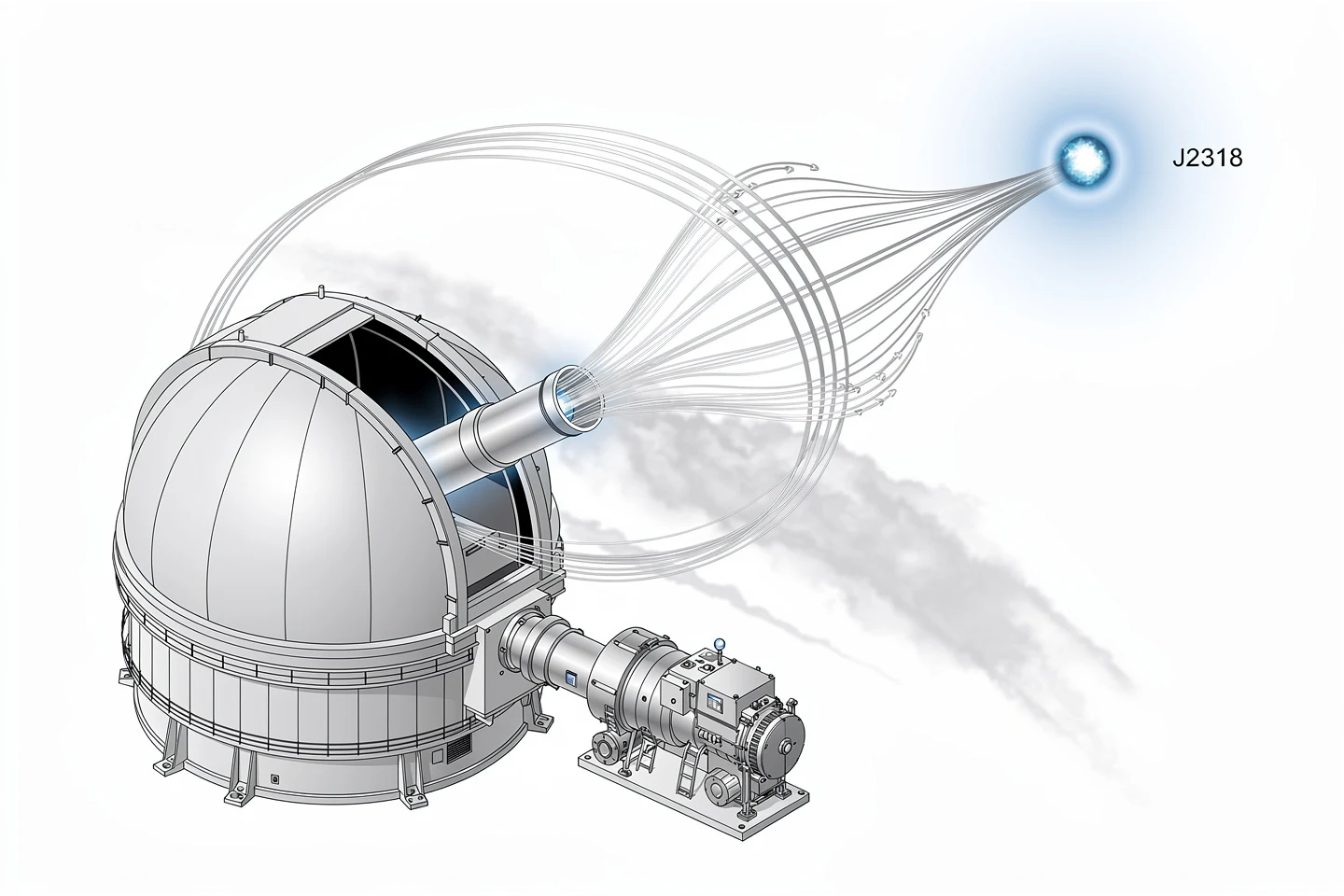
At the center of many galaxies hides a supermassive black hole — a gravitational vortex where even light vanishes. Gas falling into it spirals like water down a sink drain, but some is flung out in powerful splashes. In the quasar J2318, such a wind races at 90,000 km/s — a third of the speed of light. It would cover the Earth-Moon distance in four seconds. The quasar is billions of light-years away, and the expansion of the Universe has reddened its light. But this impression is deceptive: in ultraviolet, J2318 blazes with hidden fury.
Over 2.2 years, the wind intensified. Analysis of the light (spectroscopy) revealed carbon and hydrogen in it, after filtering out interference from cosmic dust. This wind blows gas out of the galaxy, shutting down star formation — as if splashes from the sink swept flour off the table, preventing you from kneading dough. So the black hole (a concept introduced by John Wheeler) governs its galaxy. Understanding came through the work of Edwin Hubble and the discovery by Maarten Schmidt, who proved that quasars are distant galactic cores.
If this wind blew in the Solar System, it would travel from Earth to the Moon in less than four seconds.