Quasi-stars: The Furnaces Where Supermassive Black Holes Are Born ✦
Original: "The quasi-star model for Little Red Dots: potential and challenges"
The hypothesis of a quasi-star with a dense envelope revives the idea of cosmic incubators for supermassive black holes and challenges standard growth scenarios.
Links in the knowledge graph 1
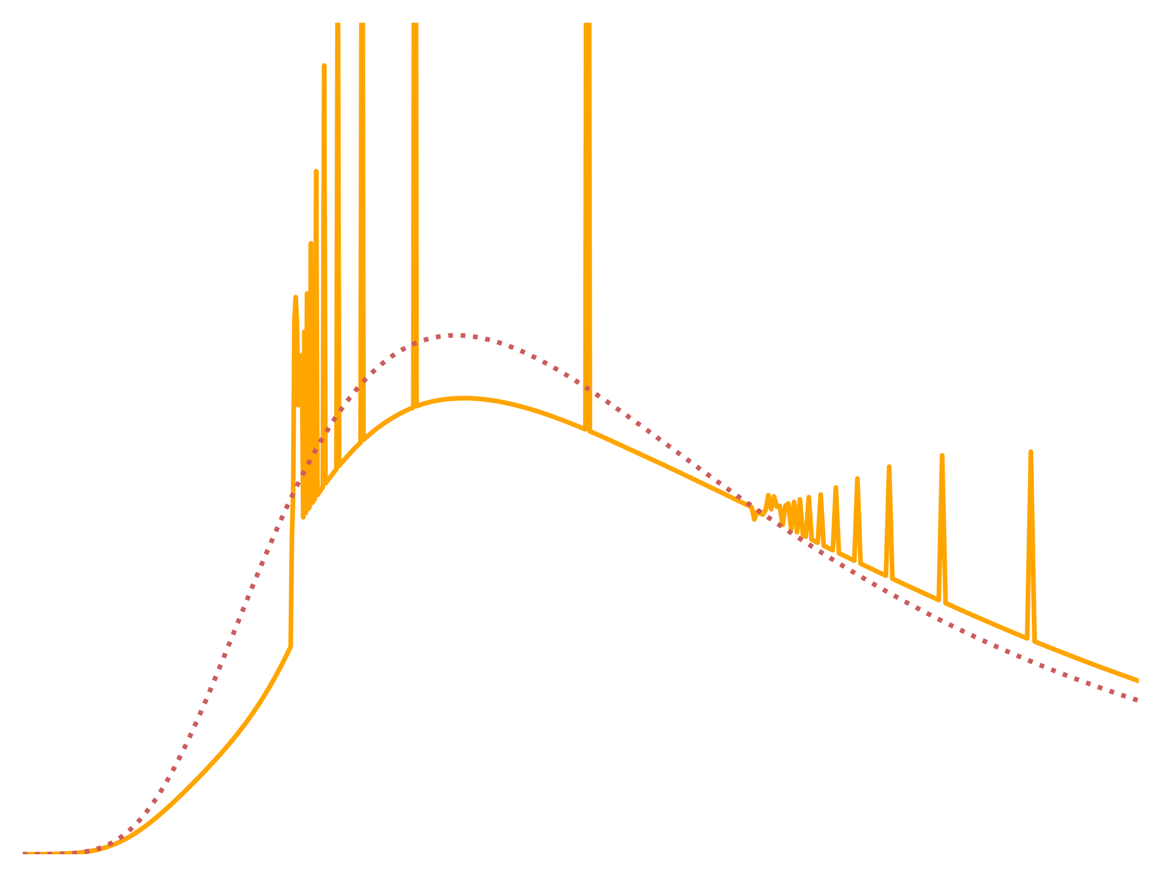
Inside a giant star lurks a black hole—the key to the "Little Red Dots." Like a cosmic furnace, the gas cocoon reforges harsh radiation into familiar spectra. If the hypothesis is correct, we are gazing into the era when the universe fired up its first gravitational engines.
🎯 A quasi-star is the size of the Solar System: its radius is about 2000 AU (50 times Neptune's orbit), and it shines a billion times brighter than the Sun.
L_{\mathrm{Edd}} = 1.2 \times 10^{38} \left(\frac{M}{M_\odot}\right) \, \mathrm{erg/s}
Relationship between Eddington luminosity and black hole mass
R = \sqrt{\frac{L}{4\pi\sigma T^4}}
Determining the convective zone radius from luminosity and temperature