Quasi-stars: The Furnaces Where Supermassive Black Holes Are Born ✛ ✦
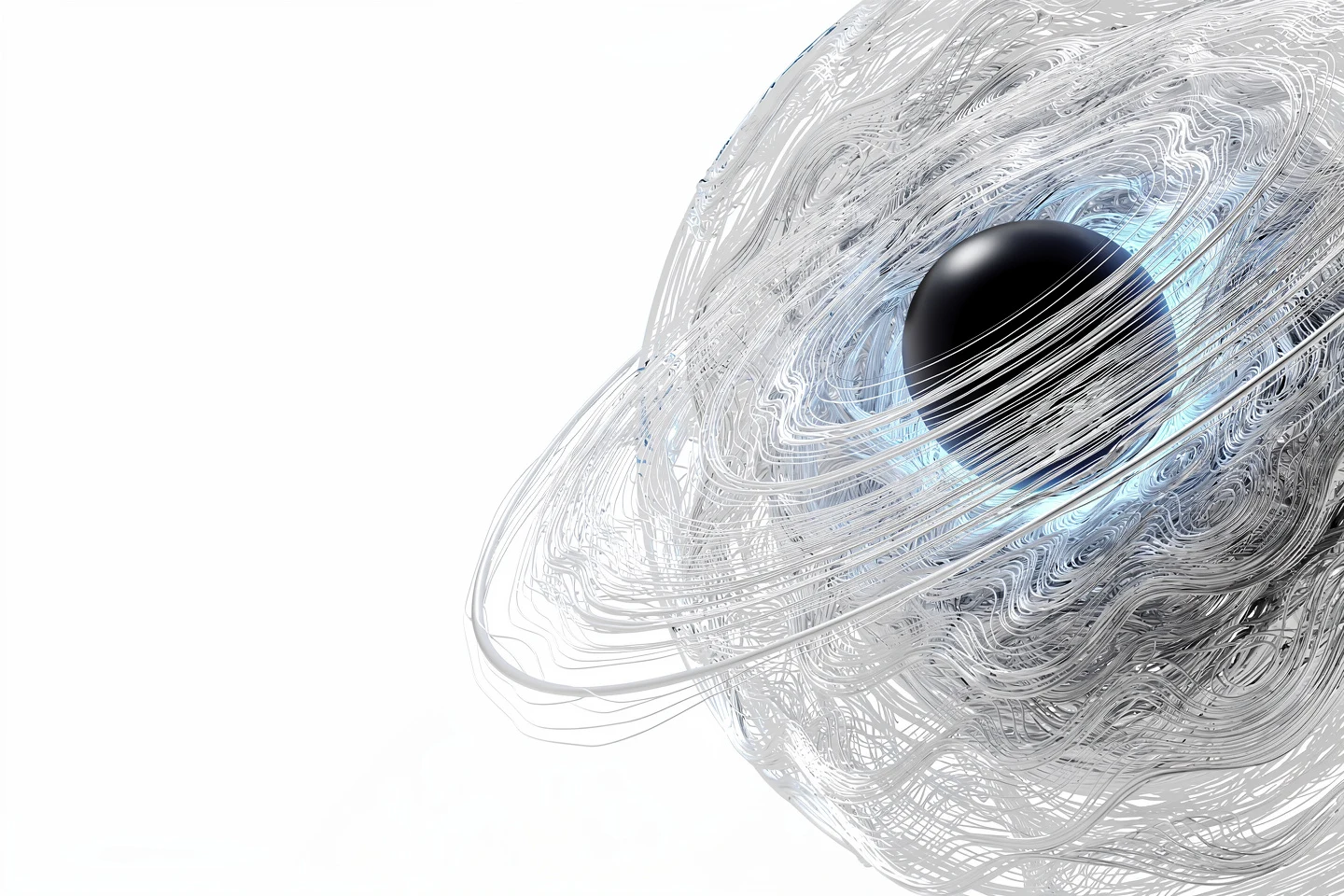
Heir to the ideas of Edwin Hubble, the James Webb Space Telescope has peered back to an era when the expansion of the universe was still picking up speed. At redshifts z>4, it spotted bizarre objects—"Little Red Dots" (LRDs). Their spectra look like an inverted checkmark: a sharp Balmer break and broad hydrogen emission lines. The dots are too bright for galaxies and not "blue" enough for quasars. The mystery: what kind of beast hides behind the spectroscopy data? An idea glimpsed in the work of Stephen Hawking and Maarten Schmidt is getting a second wind: a quasi-star — a black hole wrapped in an impenetrable gas cocoon.
Imagine a pottery kiln: the heat bakes the clay, turning it into a sturdy vessel. Similarly, in a quasi-star, a central black hole with a mass of hundreds of thousands of Suns heats infalling matter to unimaginable temperatures. But the radiation doesn't burst free: it's blocked by a thick envelope. This cocoon, a couple of thousand AU thick, acts like a transformer: the harsh accretion glow is converted into a soft continuum with a temperature around 5000 K. Inside, the gas density is 10¹¹ particles/cm³ — a veritable wall for photons. As light escapes the furnace, it carries the imprint of ionized hydrogen: the very Balmer break and emission lines that Webb sees.
Astrophysicists recreated this process using the Cloudy code, simulating the radiation's journey from an accreting black hole through a saturated convective zone and dense envelope to the tenuous proto-broad-line region. They compared synthetic spectra with data from 95 LRDs. The result was stunning: for 86 objects, the continuum shape, Balmer break depth, and hydrogen line intensities matched observations. The model also explains the correlation between break strength and reddening: it rises because the increasing column density of hydrogen shifts recombination away from standard "Case B." The central furnace operates on the Eddington principle — the more massive the black hole, the brighter: L = 1.2 × 10³⁸ (M/M☉) erg/s. And the radius of the glowing sphere is set by the Stefan–Boltzmann law: R = √(L/(4πσT⁴)). Plugging in measured luminosities and temperatures yields around 1500 AU — a typical quasi-star size.
Yet a pure quasi-star spectrum is only part of the picture. The model doesn't reproduce helium lines and the excess of hot cosmic dust in the mid-infrared. Apparently, extra components are needed: coronal gas or an inner dust shell. The degeneracy of interpretations is particularly intriguing. The same spectra could be produced by heavily dust-obscured star-forming galaxies, by "bare" accretion disks, or by exotic primordial black holes. To cut this Gordian knot, data from submillimeter and X-ray observatories are essential. Still, the quasi-star brings us back to the roots: perhaps it was the missing link between the first giant stars and the quasars of the mature universe. These objects are living witnesses to the era after the Big Bang, when gravity was just learning to build its most grandiose machines. If the model holds, then in every LRD we see the embryo of a future monster — a black hole of billions of solar masses, captured in its infancy.
A quasi-star is the size of the Solar System: its radius is about 2000 AU (50 times Neptune's orbit), and it shines a billion times brighter than the Sun.