Popular

Casey Papovich

5 articles · 30 co-authors · latest: 2026-07-02

A Galaxy That Slept for Half a Billion Years

The 'Sleepy' galaxy in the early universe furiously gave birth to stars, but after 300 million years it fell asleep. A record-breaking hydrogen dip in its glow showed that not all bright early galaxies become giants—some doze off and turn into dwarfs.
arXiv:2512.03154 · 2025-12-02

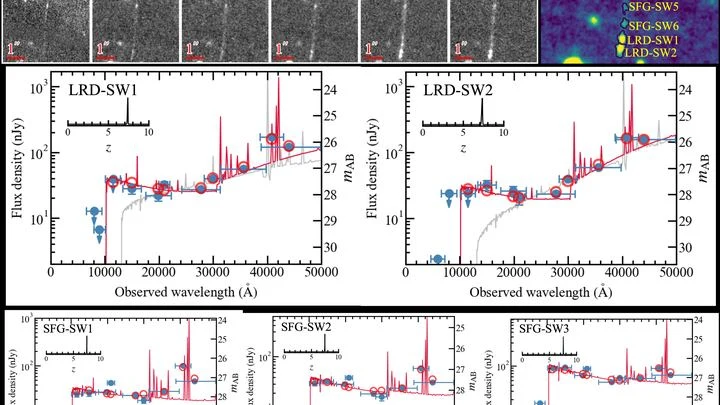
Red Eyes: Cosmic Lens Reveals a Pair of Black Holes

Using a gravitational lens — a massive cluster of galaxies bending light — the James Webb Space Telescope detected two red dots in a distant galaxy. These are intermediate-mass black holes, located not in the center but on the outskirts. The discovery suggests such invisible objects might be widespr
arXiv:2601.06015v1 · 2026-01-09

Cold Water Trail in the Red Dots of Space

The James Webb Telescope discovered that the mysterious red dots are not hot disks around black holes, but dense clouds of water vapor with temperatures around 2000–4000 °C. This reduced the mass estimates of black holes by an order of magnitude.
arXiv:2602.06024 · 2026-02-05

Quasi-stars: The Furnaces Where Supermassive Black Holes Are Born

The James Webb Space Telescope has spotted mysterious "Little Red Dots" in the early universe—compact objects that don't fit standard models. A new study suggests they may be quasi-stars: black holes shrouded in a dense gas cocoon that thermalizes radiation like a giant furnace. Calculations using t
arXiv:2606.06575v1 · 2026-06-04

Cosmic Cocoons: MEOW's Infrared Hunt Reveals the Secret Growth of Black Holes

In a new study presented in the MEOW survey, astronomers used the MIRI infrared camera on the James Webb Space Telescope to search for dust-obscured active galactic nuclei from an era when the Universe was less than a billion years old. Analyzing the emission from hot dust allowed them to identify 1
arXiv:2607.02666v1 · 2026-07-02