PeVatron's Hybrid Orchestra: A Particle Symphony at the Edge ✦
Original: "LHAASO J1849$$-$$0002: A Hybrid Lepto-Hadronic Interpretation of PeV Gamma-Ray Emission"
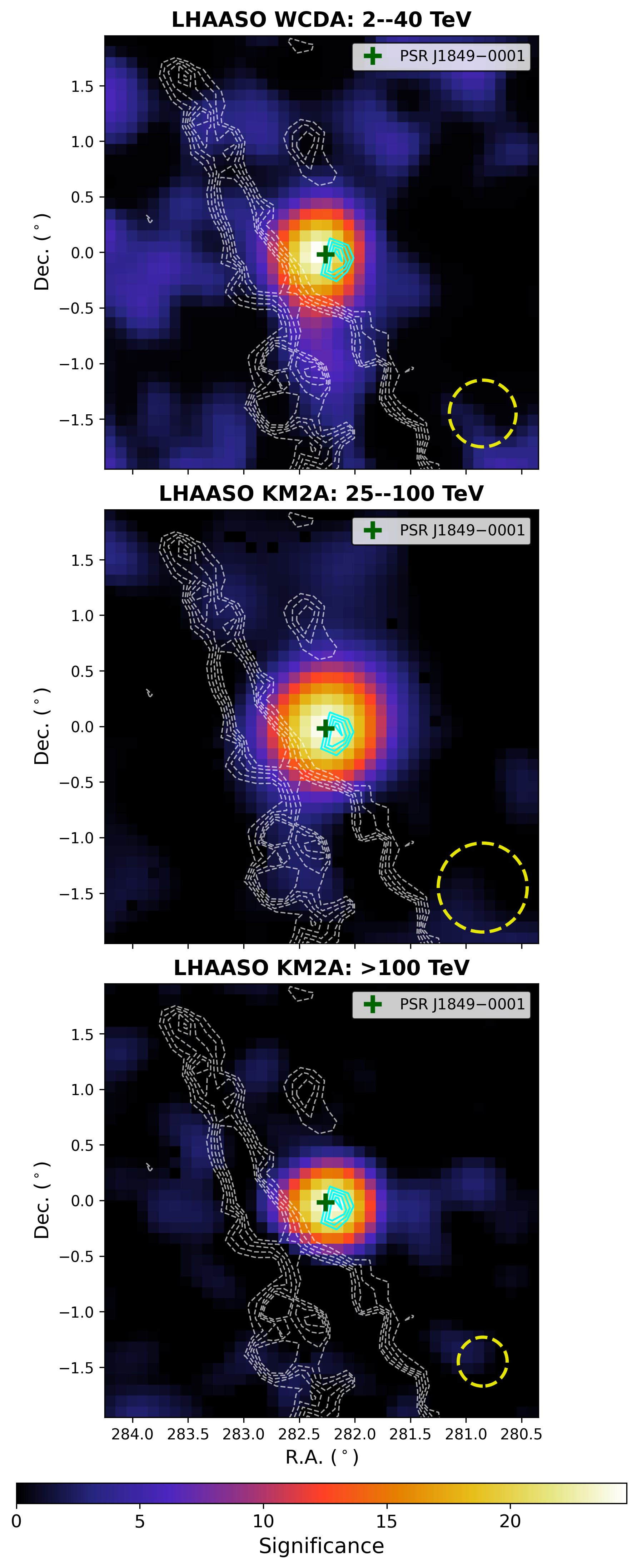
LHAASO observations reveal that pulsar J1849-0001 is a hybrid accelerator, producing gamma rays with energies of 2 PeV.
Links in the knowledge graph 1
A natural particle accelerator hidden in the Galactic plane turns out to be 200 times more powerful than the Large Hadron Collider. Pulsar PSR J1849-0001 operates as a hybrid orchestra: electrons play off the cosmic microwave background, while protons play off a molecular cloud, creating a gamma-ray symphony at 2 PeV. This finding brings us closer to solving the origin of the most energetic cosmic rays and promises the discovery of dozens of similar objects in the future.
🎯 The 2 PeV energy is 200 times the maximum proton energy of the Large Hadron Collider — such natural accelerators are still beyond the reach of laboratories.
\frac{dN}{dE} \propto E^{-\alpha} \exp(-E/E_{\mathrm{cut}})
dN/dE — differential number of particles with respect to energy, α — spectral index, E_cut — cutoff energy
D(E) = k D_{10} \left(\frac{E}{10\,\mathrm{GeV}}\right)^b
D — diffusion coefficient, k — suppression factor, b — exponent reflecting energy dependence