The Hybrid Nature of a PeVatron: How Pulsar J1849-0001 Powers Record Gamma-Ray Emission ✛ ✎ ✦
Context
The search for galactic sources capable of accelerating particles to energies around peta-electronvolts is one of the central tasks of modern astrophysics. Key candidates are neutron stars, especially pulsars, discovered by Jocelyn Bell Burnell and predicted by Fritz Zwicky. Their powerful winds create plerions—nebulae often formed after supernova explosions.
Methods
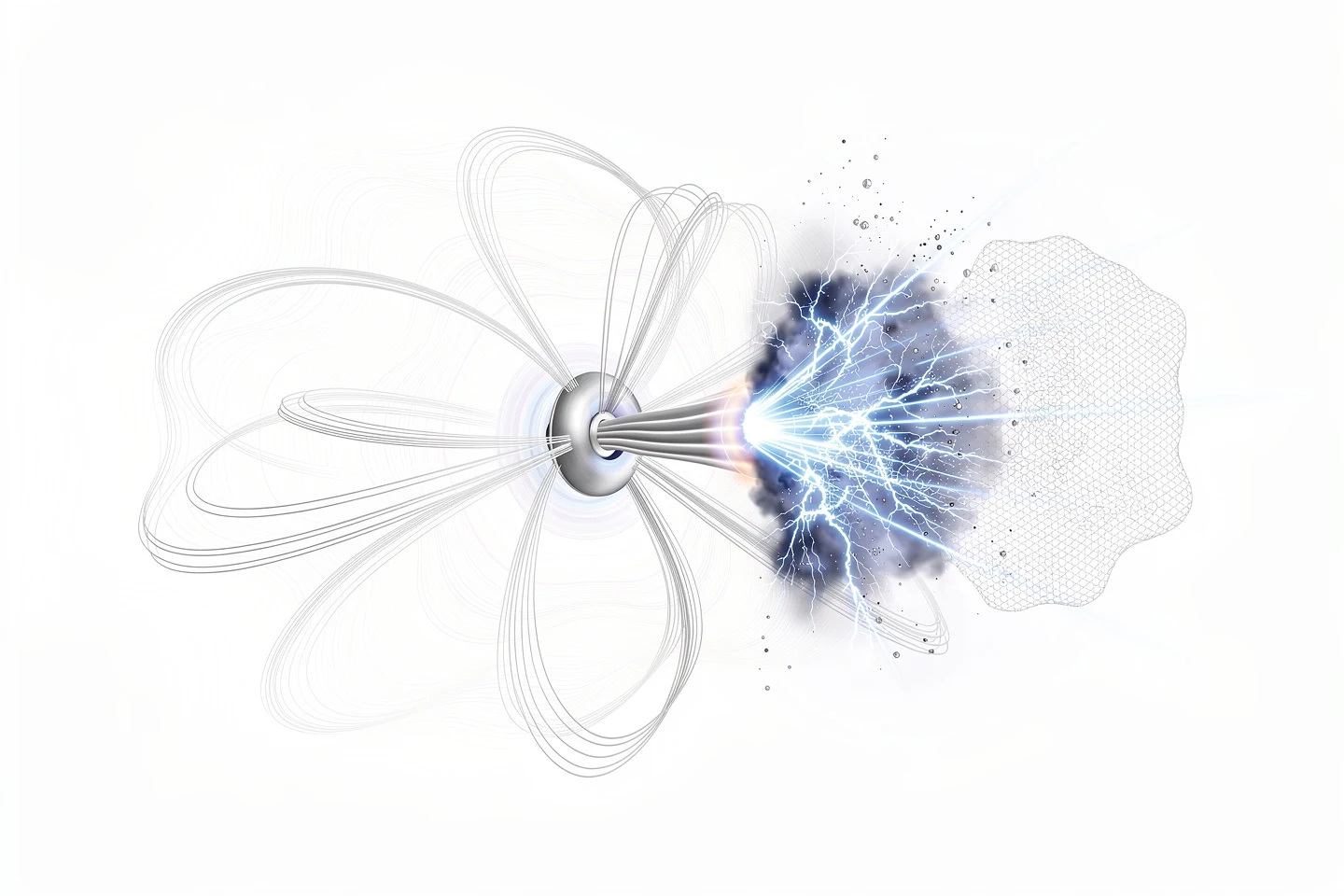
Using the GAMERA code and data from spectroscopy (measurements of radiation flux at different wavelengths) and photometry (brightness measurements), scientists built three models to explain the broadband spectrum of the source. In the hybrid model, plerion electrons scatter cosmic microwave background radiation (inverse Compton effect), while protons accelerated to PeV energies collide with hydrogen nuclei in a neighboring molecular cloud, producing neutral pions.
Results
The purely leptonic model, requiring an extreme cutoff of the electron spectrum at 600 TeV, and the hadronic model, underestimating the most energetic gamma-ray flux, proved untenable upon detailed comparison with data. The hybrid scenario, in which the cosmic-ray diffusion coefficient is suppressed to ~1% of the galactic value and the magnetic field in the nebula is 4 μG, perfectly reproduces the entire spectrum, including photons with energies of ~2 PeV. Remarkably, the most energetic emission spatially coincides with a molecular hydrogen cloud, which is natural for a hadronic origin.
Implications
The work confirms that pulsars within old supernova remnants can serve as real PeVatrons. This calls for a reassessment of the contribution of such objects to the overall budget of galactic cosmic rays and highlights the importance of hybrid models.
Future development
Future observations with spectroscopic telescopes and neutrino observatories such as NEON will finally disentangle the leptonic and hadronic channels. If a neutrino signal is detected, it will be direct evidence of hadronic processes—a kind of 'signature' of the accelerator.
Impact
The results will impact our understanding of the evolution of neutron stars and their environments, as well as strategies for searching for other galactic PeVatrons.
Next steps
Next steps include modeling the co-evolution of the pulsar and the molecular cloud, as well as calculating neutrino signals for future detectors.
Key open problems
The study is directly connected to the unsolved problem of the origin of cosmic rays in the knee region of the spectrum (energies ~1-10 PeV) and to the question of which objects dominate particle acceleration in the Galaxy.
The knowledge machine's view
This section is addressed to the author of the paper and their colleagues. Neighbouring works were found by meaning-based search across our archive, not by word overlap. We do not review: we show the field around the work.
What the work does
The study presents a self-consistent hybrid model of the LHAASO J1849-0002 source, associated with the pulsar PSR J1849-0001, explaining the observed broadband spectrum from X-rays to PeV energies. The authors used the GAMERA code to model the leptonic, hadronic, and hybrid components and showed that only a combination of inverse Compton scattering of relativistic electrons and proton-proton collisions in a molecular cloud reproduces the data. The model requires suppressed diffusion (~1% of the Galactic value) and a moderate magnetic field (4 μG), consistent with expectations for old pulsar wind nebulae.
Where its strength is
The strength of the work lies in the consistent treatment of both leptonic and hadronic processes, allowing the entire observed spectrum to be explained without extreme assumptions. Particularly valuable is that the hybrid scenario naturally links the radiation morphology to the location of the molecular cloud, supporting the hadronic origin of the most energetic photons.
Where it could go next
- It might be interesting to compare the obtained constraints on suppressed diffusion and magnetic field with modeling results of other PeVatrons, such as the microquasar Cygnus X-3, where contributions to the Cygnus bubble and particle acceleration to high energies are also discussed.based on: Microquasar Cygnus X-3: The PeVatron Powering the Cygnus Bubble arXiv:2607.07100
- A related study shows how neutron star properties (mass, not spin) can lead to the generation of strong magnetic fields; such a scenario might be worth considering when interpreting the origin of the magnetic field in the pulsar wind nebula of PSR J1849-0001.based on: Neutron Star's Sleeping Volcano: How Mass, Not Spin, Gives Birth to Magnetic Monsters arXiv:2607.17556v1
- There is a paper in the archive discussing the limits of particle acceleration in cosmic sources; comparing with it could help clarify how realistic reaching energies of ~2 PeV in this object is and what constraints acceleration physics imposes.based on: Cosmic accelerators push particles to the limit arXiv:2604.22621
Worth trying
- Test the hybrid model on other sources associated with pulsars and molecular clouds to check the universality of suppressed diffusion.
- Use high-energy neutrino data to independently verify the hadronic component, since proton-proton collisions should produce neutrinos alongside gamma rays.
- Perform detailed modeling of the pulsar wind nebula evolution, accounting for the pulsar's age and environmental dynamics, to estimate how long the source can remain a PeVatron.
Why this may matter
If such old pulsar wind nebulae are indeed efficient accelerators of protons to PeV energies, this could significantly alter the estimated contribution of pulsars to the overall budget of Galactic cosmic rays, especially in the knee region. Furthermore, hybrid models linking gamma-ray emission to neutrinos open the path to multi-messenger astronomy and tests of hadronic scenarios.
Nearby works in our archive
- Microquasar Cygnus X-3: The PeVatron Powering the Cygnus Bubblesimilarity 0.61
- Neutron Star's Sleeping Volcano: How Mass, Not Spin, Gives Birth to Magnetic Monsterssimilarity 0.60
- Cosmic accelerators push particles to the limitsimilarity 0.60
- Invisible Visitors from Space Put Physics to the Testsimilarity 0.60
- Cosmic Accelerator Flirts with the Limitsimilarity 0.60
- Black Holes: Neutrino Factoriessimilarity 0.59
The closest work in the archive sits at 0.61 by meaning — the usual level for our corpus.
The energy of 2 PeV is 200 times higher than the maximum proton energy at the Large Hadron Collider, such natural accelerators are still unattainable in laboratories.
Key numbers
- Maximum gamma-ray energy: ~2 PeV
- Distance to the pulsar: ~7 kpc
- Magnetic field in the nebula: ~4 μG
- Mass of the nearby molecular cloud: ~4×10⁴ solar masses
- Diffusion coefficient: ~1% of the average galactic value