Cosmic Mixer: How a Pulsar Whips Up Ultra-Bright Light ✛ ✎ ✦
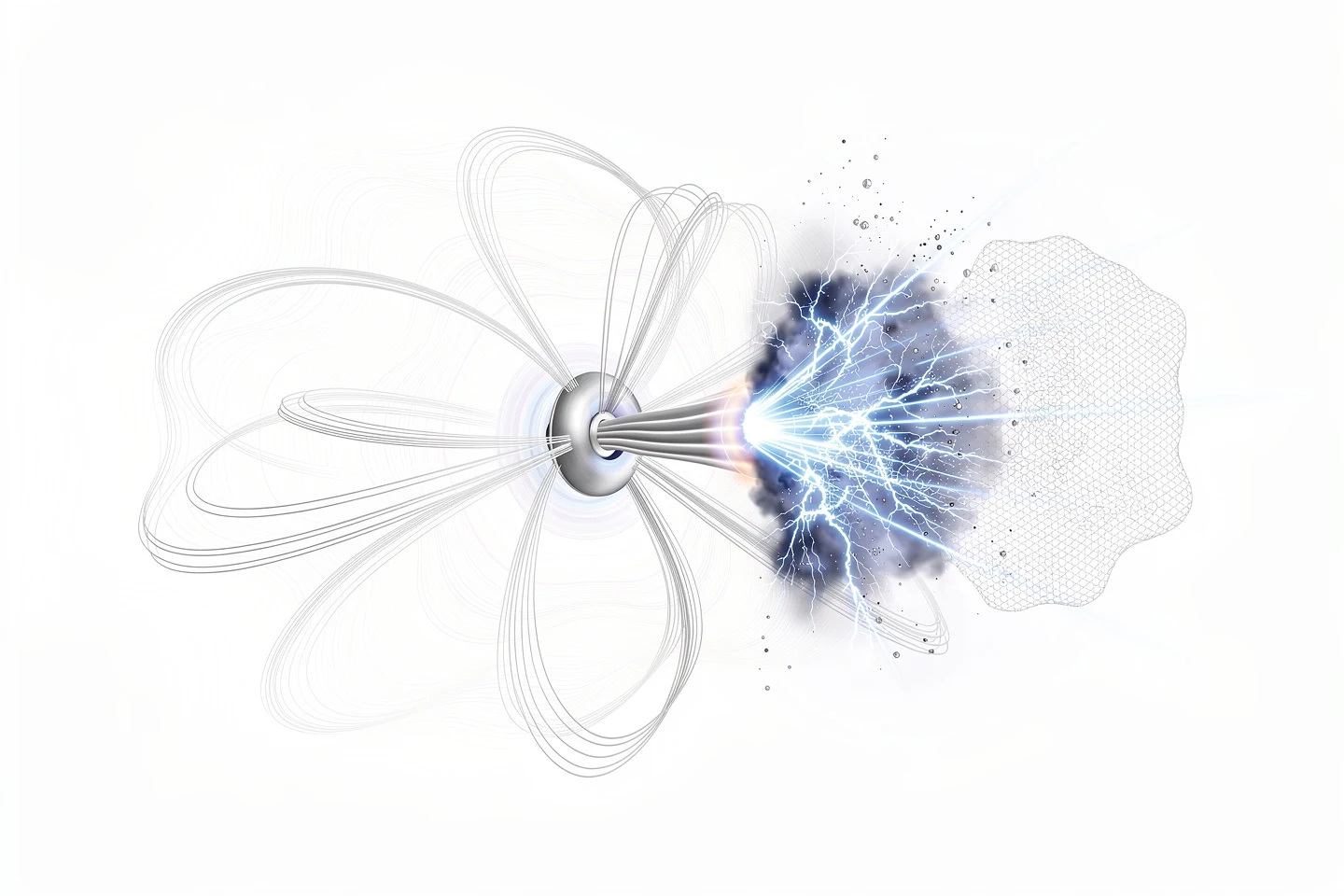
A pulsar is a dead star that spins like a kitchen mixer, making hundreds of revolutions per second. After a supernova explosion, it leaves behind a superdense ball — a neutron star. These objects were predicted by Fritz Zwicky, and Jocelyn Bell Burnell first heard their rhythmic radio signals. As it rotates, the pulsar flings out a wind of charged particles around itself, creating a glowing nebula — like splashes of batter from a whisk. When this wind crashes into a hydrogen cloud, light electrons collide with the ancient light of the Universe (cosmic microwave background), accelerating to incredible energies and emitting gamma rays. Heavier protons slam into hydrogen nuclei, producing short but powerful flares. These were detected by ground-based telescopes, although such radiation is usually blocked by the atmosphere. Analysis of brightness and spectrum (photometry and spectroscopy) confirmed this dual mechanism. Thus, the cosmic mixer generates super-bright gamma-ray bursts. Similar accelerators are likely the main source of cosmic rays bombarding Earth.
A teaspoon of pulsar material weighs more than the tallest mountain on Earth.