PeVatron's Hybrid Orchestra: A Particle Symphony at the Edge ✛ ✎ ✦
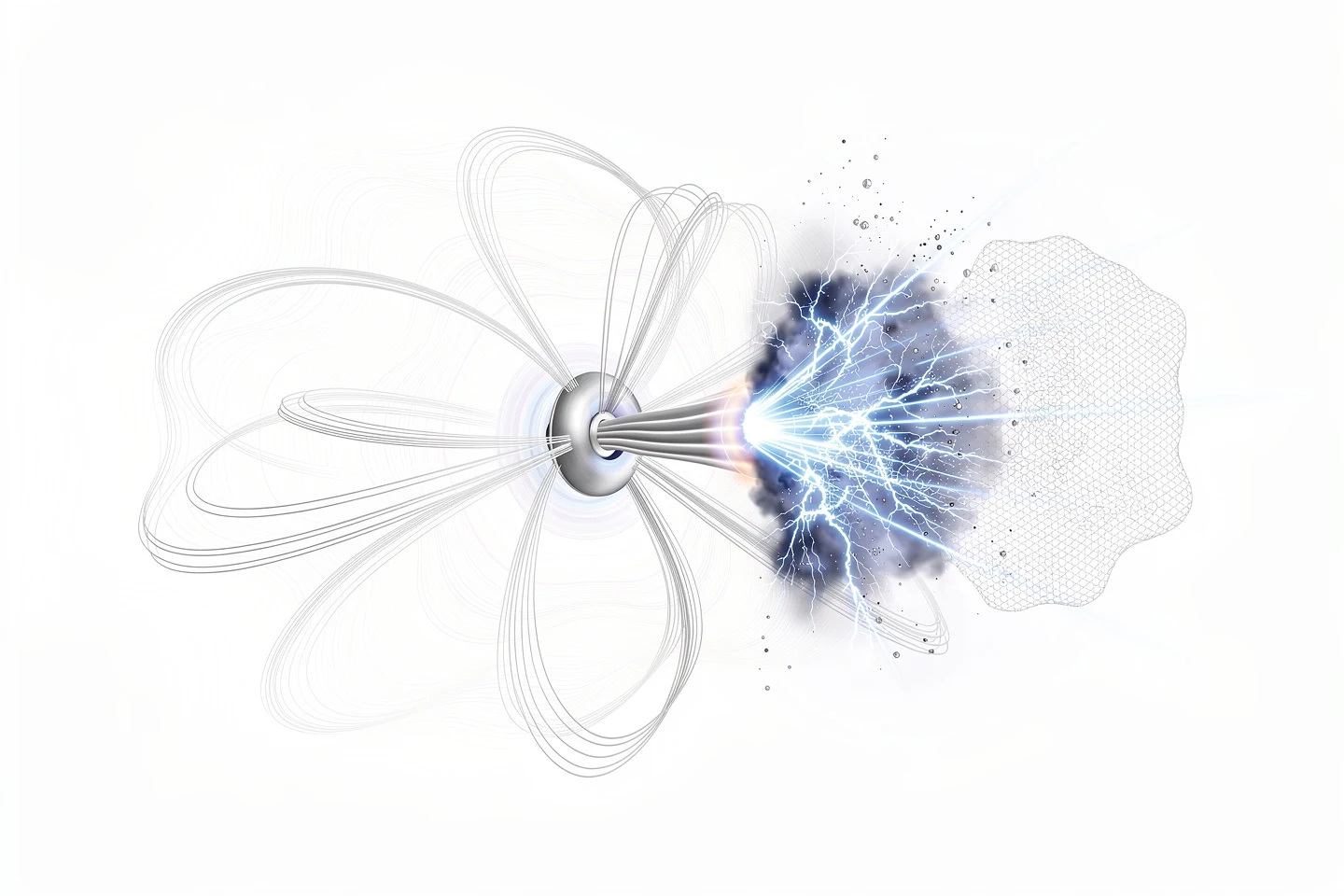
At the heart of the Galaxy, about 7 kiloparsecs away, lies a true natural particle accelerator. This is a rapidly spinning neutron star — the pulsar PSR J1849-0001, left behind by a supernova explosion. Half a century ago, they were discovered by Jocelyn Bell Burnell, and even earlier predicted by Fritz Zwicky. For a long time, pulsars were considered mere cosmic lighthouses. But this specimen proved capable of much more. Its gamma-ray emission, recorded by the LHAASO observatory, reaches 2 petaelectronvolts — an energy two hundred times greater than the capabilities of the Large Hadron Collider. Such an object is called a PeVatron, and it is directly linked to the mystery of the origin of the most energetic cosmic rays.
Imagine an orchestra where, instead of violins and brass, you have elementary particles, and the composer is the pulsar itself. Its wind inflates a surrounding plerion — a glowing nebula, a cosmic orchestra pit. Here, electrons accelerated to near light speed begin their part: they scatter photons of the cosmic microwave background — the ancient afterglow of the Big Bang. This inverse Compton scattering produces gamma-ray emission up to several TeV. But for the highest notes — those very 2 PeV — other instruments are needed. Enter protons: heavy nuclear particles accelerated in the same plerion. They leave the nebula and slam into a massive cloud of molecular hydrogen nearby, creating cascades of neutral pions that instantly decay into gamma rays. Thus, a hybrid symphony is born — electrons and protons playing in unison, filling the entire spectrum from X-rays to the very limit.
How can we be sure that this is a duet and not a solo? Evidence has been gathered via spectroscopy and photometry — measurements of fluxes at different wavelengths. A purely electronic model falls flat on the high notes, requiring an unnatural cutoff of the spectrum, while a purely protonic one lacks volume in the brightest gamma-ray burst. The hybrid scenario, on the contrary, sounds clean and hits the notes exactly: the hardest radiation spatially coincides with the hydrogen cloud. The magnetic field in the nebula is only 4 microgauss, like an orchestra pit that keeps the musicians from scattering but doesn't restrict their movements.
This discovery forces us to reconsider the role of old pulsar wind nebulae in populating the Galaxy with cosmic rays. Perhaps it is such hybrid PeVatrons, rather than young supernova remnants, that dominate the spectral break region — the mysterious "knee" at energies around 3 PeV. The next step is catching the neutrino echo. If hadronic processes are in full swing, neutrino telescopes like NEON will detect these massless messengers, confirming that the pulsar plays on two instruments at once. And perhaps the galactic cosmic-ray background is not noise, but a polyphonic symphony of such hybrid orchestras scattered across the Milky Way. Then we will have a universal key to finding other natural supercolliders.
The 2 PeV energy is 200 times the maximum proton energy of the Large Hadron Collider — such natural accelerators are still beyond the reach of laboratories.