Light Twists Current to Extract Oxygen express
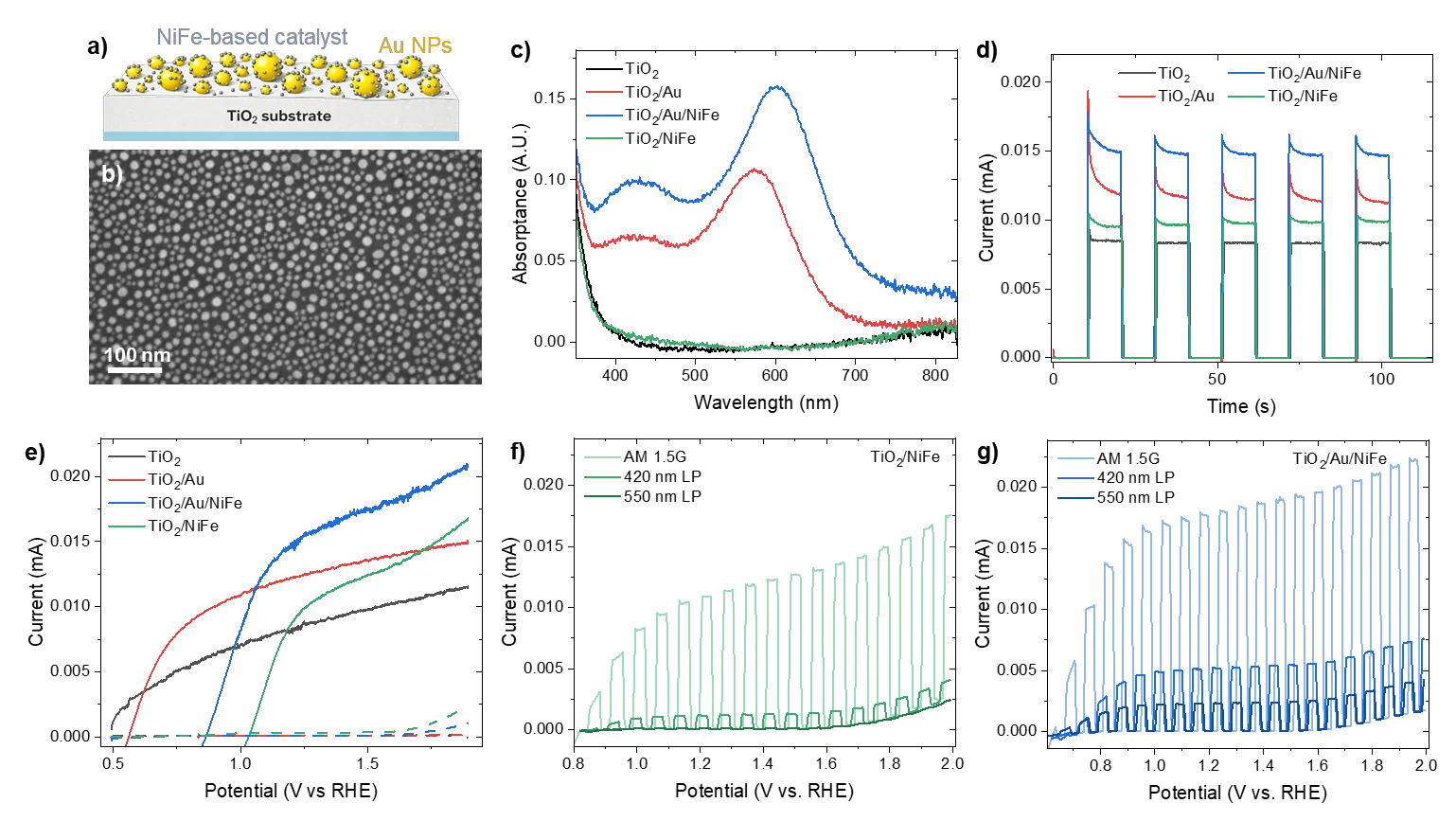
Water in a glass seems simple, but to split it into oxygen and hydrogen with sunlight, it's not enough to just transfer electrons: they also need to 'agree' on the direction of their spin. An oxygen molecule is born with two unpaired electrons spinning in the same direction. This quantum rule long hindered engineers, until a team of researchers borrowed a solution from nature.
They built a layered sandwich on glass: first a layer of titanium dioxide (the same stuff in white paint), then gold nano-islands, like a scattering of tiny mirrors. On top, this sandwich was seasoned with special cysteine molecules — the same ones found in our body's proteins. The trick is that cysteine comes in left-handed and right-handed forms, like gloves. And only the left-handed form made light work 130% more efficiently.
Why did the left-handed molecule work better? It's all about electron spin. Passing through the chiral layer, electrons are sorted by spin direction, like screws that only fit one thread. This phenomenon is called the spin selectivity effect. As a result, electrons with the correct spin reach the catalyst, and oxygen is released more readily. The researchers verified this directly: a tiny probe scanned the anode surface and measured oxygen bubbles right during illumination. The difference between left- and right-handed cysteine was visible to the naked eye — in the current and in the number of bubbles.
So nature showed how to bypass the quantum prohibition. Chiral molecules, usually used for synthesizing nanoparticles, turned out to be dispatchers for electron spins. Now we have a platform where hot electrons from plasmonic antennas are directly channeled to the oxygen catalyst. This is a step toward an artificial leaf that splits water as deftly as green plants, but with inorganic materials.
Original abstract
as written by the authors arXiv:2606.13660
Photoelectrochemical oxygen evolution is limited not only by multi-electron charge-transfer kinetics but also by the spin constraints associated with forming triplet O2. Here, we integrate plasmonic hot-carrier generation, chiral molecular spin selectivity, and oxygen-evolution catalysis within a single hybrid photoanode architecture demonstrating enhanced O2 generated via spin-polarized plasmonic hot holes. TiO2 photoanodes were modified with achiral Au nanoparticles to introduce visible-light plasmonic absorption, functionalized with cysteine as a chiral molecular interface, and coated with a NiFe-based oxygen-evolution catalyst. Wavelength-resolved photo-scanning electrochemical microscopy was used to directly detect locally evolved O2 under operando illumination while simultaneously monitoring the photoanode current. Chiral functionalization with homochiral L-cysteine enhanced both photocurrent and local O2 evolution relative to racemic DL-cysteine controls. The chirality-dependent enhancement was most pronounced under visible excitation overlapping the Au plasmon resonance, including a 130% photocurrent increase. These results provide evidence that chiral molecular layers, often used for chiral nanoparticle synthesis, can directly modulate plasmon-derived hot-carrier transfer through the chiral induced spin selectivity effect. This work establishes a chiral plasmonic photoelectrochemical platform for coupling hot-carrier generation to spin-dependent water oxidation.
Molecular chirality is like left and right hands: they are mirror images but not superimposable. In living organisms, almost all amino acids are left-handed, while sugars are right-handed. Why nature made this choice remains a mystery.
In Stanislaw Lem's novel 'Solaris', the ocean could control particle spin, creating structures impossible for earthly physics — perhaps that's how it bypassed quantum prohibitions.