Chemical evolution of stars is the gradual change in the abundance of elements within a star over its lifetime, and across generations of stars in a galaxy. Stars are nuclear furnaces: they fuse lighter elements into heavier ones in their cores, and when they die, they eject these enriched materials into space. This ejected gas then becomes the raw material for the next generation of stars and planets. Thus, each successive stellar generation is born with a higher proportion of heavy elements (metals, in astronomical parlance) than the last. Studying this process is key to understanding the history of the cosmos, from the first hydrogen-helium stars to the diverse chemical makeup we see today.
History
The concept was established in the mid-20th century through the work of Fred Hoyle, who showed how heavy elements are synthesized in stars, and later by contributions from Margaret and Geoffrey Burbidge, William Fowler, and Hoyle in their seminal 1957 paper on stellar nucleosynthesis.
How it works
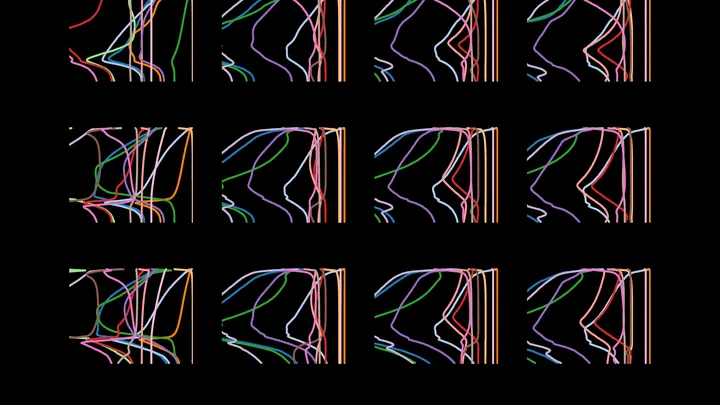
The process is driven by nuclear fusion in stellar interiors. A star's core fuses hydrogen into helium, and as it evolves, it can fuse helium into carbon, oxygen, and heavier elements up to iron. When massive stars explode as supernovae, or when lower-mass stars shed their outer layers as planetary nebulae, these newly synthesized elements are dispersed into the interstellar medium. Over time, this enriches the gas clouds from which new stars form. Astronomers trace this evolution by measuring element abundances in stars of different ages, often using globular clusters like M15, where all stars share a common origin but show variations in heavy-element content.
In practice
Understanding chemical evolution helps date stellar populations and reconstruct the star-formation history of galaxies, which is essential for models of galaxy formation and for interpreting observations of distant galaxies.
Fun fact
The iron in your blood and the calcium in your bones were forged in the cores of ancient massive stars that exploded long before the Sun existed.
Forty light-years away lives a star that went unnoticed for a long time: TRAPPIST-1 emits two thousand times less light than the Sun. But it turned out to have seven Earth-sized planets, three of which orbit in the zone where water could remain liquid. Yet little was known about the star itself, about its chemical kitchen.
Faint galaxies scattered across the Perseus cluster are like ghosts among their bright neighbors. They are so diffuse that distant objects shine through them, and they contain hundreds of times fewer stars than our Milky Way.
Two spinning tops whirl so close they nearly touch. One is scorching blue, the other dim white. Together they complete a full orbit in twenty hours. This is the pair Feige 64: a blue star with a mass of just a third of the Sun's, and a white dwarf, the cooled core of a former star, one and a half times heavier than our Sun.
The blue star seems too hot for its mass.
Two stars circle each other like dancers who come together and drift apart. Over time, one swells, and its outer layers spill onto its neighbor. The star that receives foreign matter looks no different from a single star, but its surface remembers everything.
Around young stars, flat clouds of gas and dust swirl: these are future planetary systems. Inside some of them, a void gapes: the dust and gas have been swept away, as if someone thinned out the middle of a vinyl record.
A white dwarf is the former core of a star like the Sun, squeezed down to the size of Earth. A teaspoon of its material would weigh several tons. A neutron star is an even denser remnant: a city the size of Manhattan, but with more mass than the Sun.
A star is not just a distant sun. It's a cradle for planets, and its light carries the birth story of the entire system. The chemical composition of a star is its DNA. Astronomers peer into this DNA to understand why some stars host rocky worlds like Earth, while others host gas giants.
In the furnace of star formation, the heat reaches 900 degrees Celsius, like a glowing blast furnace. It is in this hellish heat that cosmic crystals are born. Astronomers have for the first time caught the moment when crystalline dust appears right during an accretion flare (when the star gobbles up surrounding gas) at the very young star EC 53, still cocooned in dense gas.
A planet in the habitable zone is no guarantee of life. Like a conductor leading an orchestra, a star dictates the tempo and character of planetary atmosphere evolution over billions of years.
The star AB Aur is young, about 4 million years old. Around it swirls a dense disk of gas and dust. Recently, a long gas stream, a flow of material from the surrounding cloud, crashed into it.
A galactic disk is like a frozen ripple on water: every disturbance leaves a trace that can be read billions of years later. When a dwarf satellite galaxy flies past or a head-on merger occurs, stars in the disk start to oscillate, like bobbers rocked by a wave.
A heaping teaspoon, and the scale reads a billion tons. That's roughly what a teaspoon of neutron star matter would weigh if you could scoop it up and put it on a scale. Such objects are born after a supernova explosion: the star's core collapses into a sphere the size of a city, and the density exceeds that of an atomic nucleus.
Erwin Schrödinger pondered how life maintains order despite the second law of thermodynamics. He could never have imagined that part of the answer lies hidden in the instability of giant stars.
The formation of the Milky Way is a grand cosmic performance, in which mergers of satellite galaxies were woven into a single score. Each event left a trace in the dynamics and chemical composition of stars, much like notes capture the composer's intent.
In a giant cosmic cradle, the Tarantula Nebula, astronomers took a close look at 122 massive stars, each at least 30 times heavier than the Sun. They measured the nitrogen abundance in their atmospheres, and the picture turned out to be unexpected.
Deep space, galactic center. A supermassive black hole is surrounded by a scorching disk of gas and dust. And then, through this fiery veil, a star shoots by every few hours — like an arrow loosed from the bow of gravity. Each passage triggers a dazzling X-ray flare that for a moment outshines the entire galactic nucleus.
For years, the Sun teased astrophysicists. In its atmosphere, refractory elements, like spices in a basic recipe, were slightly less abundant than in nearly identical twin stars. Suspicion arose: could our star be modest, skipping the planetary "dessert" that others devour with gusto?
When two neutron stars, the ultra-dense cores of dead stars, collide, a kilonova is born: an explosion a thousand times brighter than a typical nova. This is the universe's true smelting works. In the scorching cloud racing outward at near-light speeds, a furious flux of neutrons transmutes atomic nuclei into gold, platinum, osmium.
Water in a glass seems simple, but to split it into oxygen and hydrogen with sunlight, it's not enough to just transfer electrons: they also need to 'agree' on the direction of their spin. An oxygen molecule is born with two unpaired electrons spinning in the same direction.
Putting together the Solar System is like crafting a high-end tasting menu: the recipe isn't always set in stone — sometimes the final ingredient is added while the dish is already cooking.
Images from the James Webb Space Telescope have revealed unexpectedly intense light from the first galaxies — colossal star systems that formed shortly after the Big Bang. Imagine a toaster browning a slice of bread in a minute, while an oven takes an hour to bake a loaf — the result is essentially the same.
A street where houses have just been built. Some shine with clean windows, others are covered in construction dust. That's roughly what galaxies looked like when the universe was only a few hundred million years old. The new James Webb telescope peered into that era and saw dozens of bright star islands.
A pot of boiling porridge, where instead of grains there are layers of oxygen and silicon, and the fire beneath is about to go out, and the star will collapse in on itself. Until now, astrophysicist cooks have used a simplified recipe: they assumed that bubbles and eddies in the porridge obey one and the same average temperature throughout the depth.
In a city park, trees grow faster than in a deep forest — not because the soil is better, but because branches collide and seeds are exchanged more often. Galaxies in the Spiderweb protocluster behave much the same way. This vast clump of matter will become a mature cluster billions of years from now.
Two stars circle each other like dancers in a slow waltz. This dance is not eternal: the partners gradually draw closer until they collide and merge into a single entity. At that very moment, a red nova is born — a flash that lights up the sky for a few weeks, then slowly fades, enveloped in a dense cloud of dust.
Imagine an interpreter at a crucial negotiation suddenly switching to another language, and the meaning of everything changes. That's roughly what neutrinos do in the depths of a dying star. These invisible particles are born in enormous numbers when a star's core compresses into a city-sized lump. But on their way out, neutrinos can change their type — physicists call this flavor transformation.
A supernova is the final explosion of a massive star, scattering its material over light-years. Inside the expanding shell, a neutron star remains, and the shell itself continues to plow through interstellar gas for thousands of years.
The JWST telescope has spotted a multitude of bright galaxies in the young universe. Their ultraviolet light was barely absorbed by cosmic dust — defying previous expectations.
Two black holes, orbiting each other, behave like a boat rowing with stars. Each passing star is flung away, like a stroke of an oar, and transfers momentum to the pair. For a long time, it was thought this simply brings the black holes closer. But new analysis has shown: by flinging stars unevenly, the system pushes itself sideways, spins, and tilts the orbit.
There is something wildly generous about a garden where the first flowers don't just bloom but immediately scatter their seeds far beyond the fence. Something similar was happening in the young universe.
Around small, cool, but extremely restless red dwarfs, planets the size of Earth often orbit. Such a star is like a temperamental stove that intermittently erupts flares: powerful streams of light and particles batter the planet's atmosphere, as if someone splashed fire into a simmering soup pot.
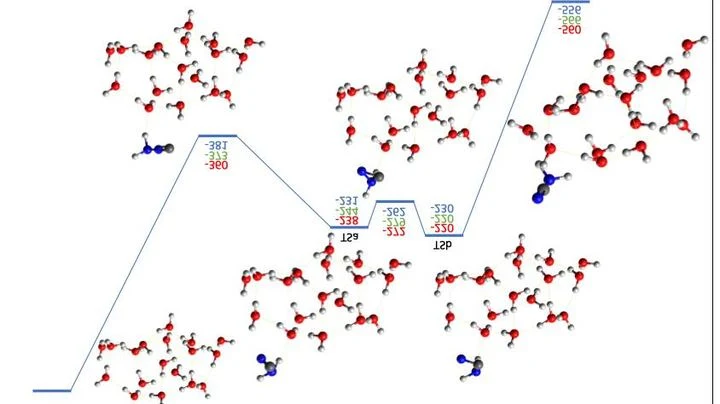
In cold clouds between the stars, dust grains are coated with ice, like windows covered with frost in winter. On this icy crust, chemical reactions take place that do not occur in gas. One such reaction is the encounter between a carbon atom and a nitrogen molecule.
A neutron star is the remnant of an exploded star, compressed to the size of a city. On its surface, a thermonuclear fire sometimes erupts: accumulated gas explodes like a giant hydrogen bomb. After the burst, ash remains — a mixture of heavy elements that rises to the surface and forms a hot atmosphere.
A baker adds more sugar to the dough, and the pie turns out different. So it is with a star: the composition of its "dough"—the cloud of gas and dust from which planets are born — determines what worlds will form around it.
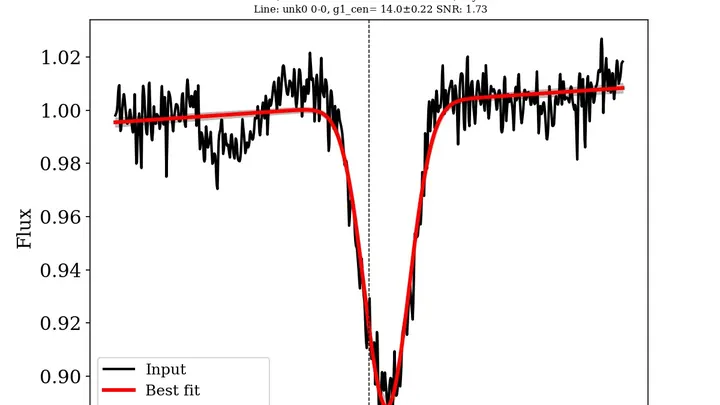
Lithium is like a thermometer dipped into a star's interior. This light element is destroyed at temperatures around 2.5 million degrees, so its abundance on the surface tells us how deeply the star's material has been mixed.
In the cold gas cloud where a star is born, chemistry sleeps. Molecules barely collide, reactions stall. But when a charged particle zips through the cloud, it knocks electrons off atoms — ionizing them. That's how active ions appear in a dormant cloud, ready to build new molecules.
Ancient stars, nearly devoid of heavy elements, are like fossilized remnants of the first cosmic flashes. For a long time, the odd ratio of carbon, hydrogen, and helium in three such stars was thought to require a hypernova — an ultra-bright supernova with hundreds of times more energy than a regular one.
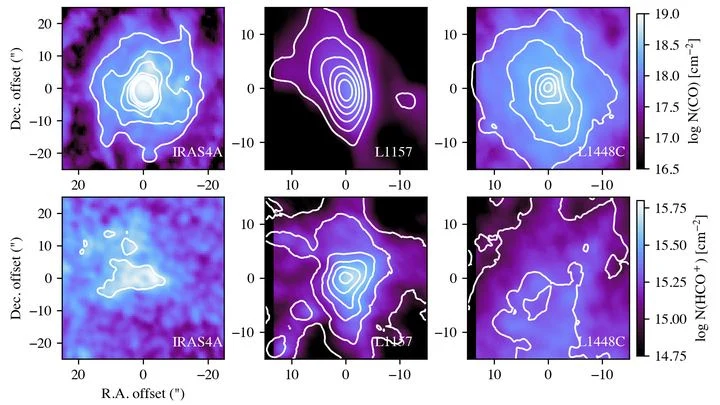
In the cold outer reaches of the Solar System, water is considered the main building material for ices. But some comets and distant icy bodies have an unusually high ratio of carbon monoxide (CO) to water, as if a scoop of ice cream suddenly had too much syrup. The authors of a new study set out to find where this imbalance comes from.
Every molecule is like a set of building blocks: the same pieces can be assembled in different ways. Two assemblies with the same atoms but different geometry are called isomers. If one can be turned into the other by a simple rotation around a bond, they are conformers, like a bent arm versus a straight one.
Neutrinos are tiny particles that barely interact with matter. They pass straight through a star like bullets through fog. When a massive star is gearing up to explode, its core contracts, temperatures soar, and neutrinos start streaming out.