An antenna is a transducer between electromagnetic waves and currents in the transmission line. The key characteristic is the radiation pattern: the directions in which the antenna radiates (or receives) most strongly. A simple dipole (two straight conductors each a quarter-wavelength long) radiates uniformly in the plane perpendicular to itself, but not along its axis. Parabolic reflector antennas (satellite dishes) concentrate energy into a narrow beam, like a searchlight. The size of any antenna is dictated by the wavelength: for transoceanic flights, vast fields of masts are built, while for cellular communication, antennas fit in the palm of your hand.
History
The theoretical foundation was laid by James Clerk Maxwell in 1864, predicting electromagnetic waves. Experimental confirmation and the first dipole antennas—Heinrich Hertz, 1887–1888. In the 1890s, Oliver Lodge invented a tuned antenna with an inductive coil. Practical radio communication was established by Popov and Marconi using vertical wires. Sergei Nadenenko derived the formula for the radiation field in 1914. In 1926, Hidetsugu Yagi and Shintaro Uda created a multi-element directive antenna (now known as a Yagi–Uda antenna). The development of microwave technology in the 1940s led to the creation of waveguides and horns. The end of the 20th century was marked by the emergence of microstrip antennas and adaptive arrays with digital beamforming.
How it works
Antenna radiation is described by Maxwell's equations. The accelerated motion of charges in a conductor creates an alternating electromagnetic field that propagates as a wave. In the far field, the electric and magnetic fields are transverse to the direction of propagation and are related as E/H = Z₀ ≈ 377 Ω. For quantitative calculation, the vector potential is used: A(r) = (μ₀/4π) ∫ J(r') e^{-j k |r-r'|} / |r-r'| dV'. From A, the fields are found. In a receiving antenna, the wave induces a current distribution, which through the reciprocity theorem is related to the antenna's characteristics in transmit mode. Phased arrays sum signals from many elements with controlled phase, enabling beamforming and steering, as well as adaptive interference suppression (spatial filtering). Impedance matching is critical: mismatch leads to reflections and a drop in efficiency.
In practice
The antenna in your phone maintains a connection with the tower, the GPS receiver picks up satellite signals from 20,000 kilometers away, and the satellite TV dish receives broadcasts from space.
Fun fact
Your credit card can be paid contactlessly thanks to a tiny antenna hidden inside the plastic—a loop of conductor that powers the chip with radio wave energy over a distance of a few centimeters.
The cosmic dawn is hidden behind a dense veil of time. To see beyond it, you need to catch the radio signal from clouds of neutral hydrogen — the so-called global 21 cm signal. But it is so faint that the receiver's own noise drowns it out.
Hit a table, and the sound quickly fades. Elastic waves in solids usually behave like ripples on water: they spread from the source and die out. But there is a way to make them freeze in place — by creating a 'flat band' in the frequency spectrum. This is a range where waves lose their speed and pile up, like cars in a traffic jam.
Radio waves, high-frequency electromagnetic oscillations, are powerless against the Earth's bulk: they attenuate, being almost completely absorbed within a couple of meters of depth. But a low-frequency magnetic field, governed by the equations of electrodynamics, behaves differently.
A mirror can direct a reflected beam onto one spot, even as it rotates. Engineers borrowed this trick for radio waves, building a smart mirror on a drone. It cancels out shakes and vibrations on the fly: it anticipates the drone's movements and instantly re-aims to keep the signal crisp.
Radio signals in a room act just like sound in a concert hall: bouncing off walls and objects, they create a unique pattern — a silent melody for every location. Your phone, like a keen ear, catches this melody amid noise and distortion. It remembers which chord matches the corner of the couch, and which one fits the doorway.
A radio transmitter with multiple antennas is like a bathtub with water pouring from several faucets. If the streams splash in different directions or at different pressures, some water goes down the drain — similarly, the signal scatters before reaching the receiver.
At the heart of the system is a rail with clip-on antennas moving along it, each emitting a radio signal. The smartphone receives these and, knowing the speed of light, calculates the distance to each antenna from the time delay.
Throw a stone into water: right at the point of impact, the waves are chaotic — that's the near field. Farther out, they spread in smooth circles — the far field. This same principle governs antennas for terahertz communications — the future of super-fast internet.
A clamp antenna system resembles a garden hose with punctures. In the waveguide cable, emission points are created where radio waves burst out, like water from a hole. Obstacles in the path block direct communication, but reflected signals can bypass the barrier.
Imagine a smart antenna panel, a phased array, that steers radio waves traveling at the speed of light. It works like an orchestra: hundreds of tiny emitters, like musical instruments, shift their phase (the moment they 'join' the overall sound) on command via a variable voltage.
A city signal bounces between walls like a ball, and your phone catches dozens of its 'reflections'—echoes. Each microsecond of delay adds 300 meters to the path.
The signal's speed is constant, like that of light (speed of light).
A base station emits radio waves. Without a special nozzle, the antenna acts like a garden hose opened full blast: water flies everywhere, but only a little reaches the flower beds. Researchers created a system with two neural networks.
When designing smartphone antennas, engineers need a reference — something like a tuning fork for adjusting musical instruments. As Maxwell showed, radio waves and light are of the same nature, and the new antenna module uses 5G millimeter waves traveling at the speed of light.
Wireless devices flood the airwaves with signals that blend into chaos — as if everyone in a room started talking at once. Scientists have proposed a solution: smart panels, reminiscent of acoustic tiles. Each cell can either reflect a radio wave on command, like a wall echo, or absorb it, as soundproofing dampens noise.
In absolute silence, you need to hear a feather drop. But someone keeps rustling a plastic bag. For the space-based LISA observatory, that 'rustling' will come from charged particles in space.
When you need to see inside the brain, you usually lie in a tight tube of an MRI scanner or get zapped with X-rays. Both methods are costly, bulky, and not always available.
Gravitational waves are ripples in space from the mergers of black holes and neutron stars. Existing detectors, built with contributions from Kip Thorne and Rainer Weiss, work like highly sensitive microphones but only hear the highest 'notes'.
Back in the 1960s, physicist Joseph Weber tried to catch gravitational waves using aluminum cylinders: they were supposed to tremble like tuning forks from the ripples of spacetime.
The ionosphere at an altitude of 70 kilometers acts like a giant mirror for radio waves. Ground antennas constantly beam signals into it and listen for the reflection. When a solar flare occurs on the Sun, a stream of X-rays reaches Earth in 8 minutes and compresses the lower layer of the ionosphere.
Each vowel sound is a distinct shape of the mouth, tongue, and throat. When you say 'ah,' 'ee,' or 'oo,' not only does the air inside your head change, but so does the way radio waves pass through it. Researchers peered into this process using MRI scans taken right during speech and built a precise computer model of the head — from bones to soft tissues.
An ordinary envelope has a rectangular shape, and the letter inside does not change the envelope's properties. With photons, particles of light, the situation is different: their 'shape' in time can vary, and this shape itself carries information.
A conventional antenna array is like a choir: many voices singing in unison, with the sound amplified in only one direction. To catch a signal from another side, you have to rearrange the whole choir. Now imagine a single voice that can change its timbre so that the sound itself focuses in the desired direction.
An ordinary antenna picks up radio waves, but there are fields it barely feels. We're talking about slow electric fields: those that change once a second or less. For them, physicists built a sensor from a beam of rubidium atoms.
A rug lies flat, but if you push it from the edge, wrinkles run across it. In a thin film of tantalum sulfide (1T-TaS2), wrinkles made of electrons, charge waves, freeze as if the rug were stuck to the floor. To move them, you need to apply force. Scientists have found a way to control this force using an electric field and a magnet.
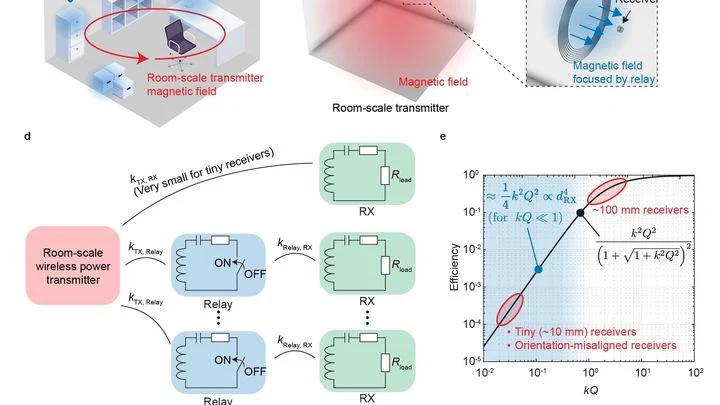
Think of wireless charging in a room as a pool where energy-water is everywhere, and tiny sensor-floats barely bob. Their induction coils are too small to efficiently scoop from this diffuse electromagnetic field. Unlike radio waves, the energy here doesn't travel at the speed of light: it lingers in the near field, waiting to be harvested.
Radio waves that oscillate less than once per second pass through the earth and water with almost no loss. Such signals are used to communicate with submarines and to search for minerals. But a conventional antenna for them would need to be hundreds of meters long, and its sensitivity leaves much to be desired.
In a small copper box, resembling a matchbox, magnetic waves reside. They arise in a tiny crystal of yttrium iron garnet when radio waves are passed through it. Two waves with different characters (one fast, the other slow) usually ignore each other. But when their frequencies match, a dance begins: the waves either merge into one strong wave or cancel each other into complete silence.
Sound on a crystal surface is like ripples on water, but traveling through a solid. This ripple is called a surface acoustic wave: it moves a hundred thousand times slower than light, so it can be compressed into very short segments and fit on a tiny chip. Usually, such waves are launched by metallic combs made of aluminum or gold.
Two lanterns on a distant shore at night merge into a single blob of light. Likewise, a conventional flat antenna cannot tell apart two radio transmitters placed too close together: their signals mix, and the receiver sees only a jumbled mess. Engineers found a way out: they made the antenna not flat but like a stack of transparent plates.
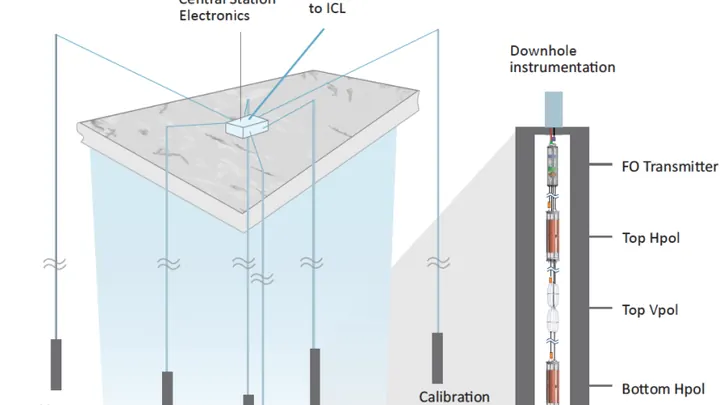
Deep within the Antarctic ice, at depths where sunlight never reaches, antennas hang suspended. They listen not for sounds but for radio waves, waiting for a signal from a particle that is nearly impossible to catch. A neutrino passes through the Earth like a bullet through fog, but occasionally, very rarely, it grazes an ice atom.
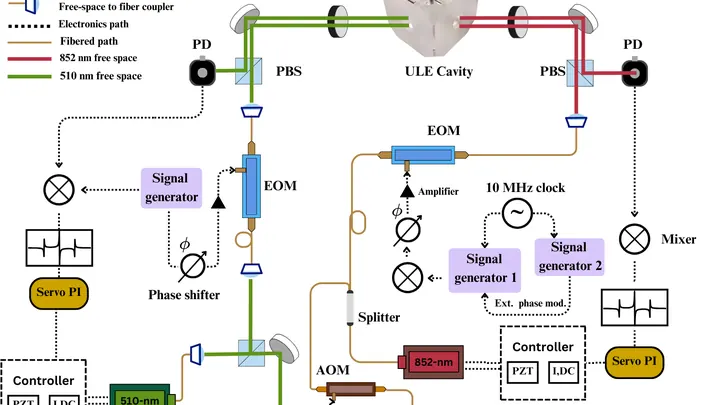
A microwave signal that doesn't jitter from interference is needed in both radar and telecommunications. Until now, a clean signal was obtained on bulky setups where lasers and resonators sat on an optical table. Now engineers have packed everything into a box the size of a cup—166 milliliters.
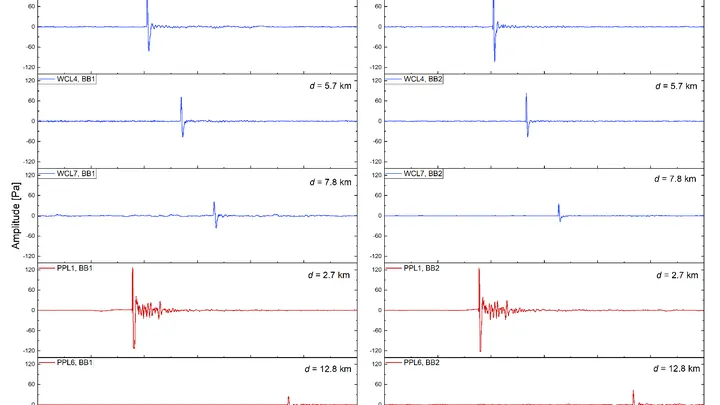
The same explosion can sound different: it all depends on which way the wind is blowing. In 2024, researchers set off charges equivalent to ten tons of TNT twice and recorded the sound with a network of 31 microphones spread over a radius of 23 kilometers. The source was identical, but the acoustic pictures turned out to be quite different.
A regular radio receiver picks up waves with a metal antenna. Here, the antenna is a single atom with an electron boosted to a distant orbit, like a satellite in a high orbit around Earth. Such atoms are called Rydberg atoms.
A graphene ribbon nine atoms wide is like a track where electrons race, as water rushes down a narrow trough. Gamma radiation is a stream of particles with enormous energy, capable of punching through metal and plastic.
Gravitational waves are ripples in spacetime curvature that imperceptibly stretch and squeeze everything around. But the Moon, like a bell, catches these waves: as a gravitational wave passes through it, it makes our satellite vibrate.
A microwave oven heats food, but this circuit harvests energy from radio waves. Engineers have built a rectifier that converts 5.8 GHz microwaves into direct current. The big news: inside, there isn't a single capacitor: those little charge reservoirs that usually sit in every rectifier.
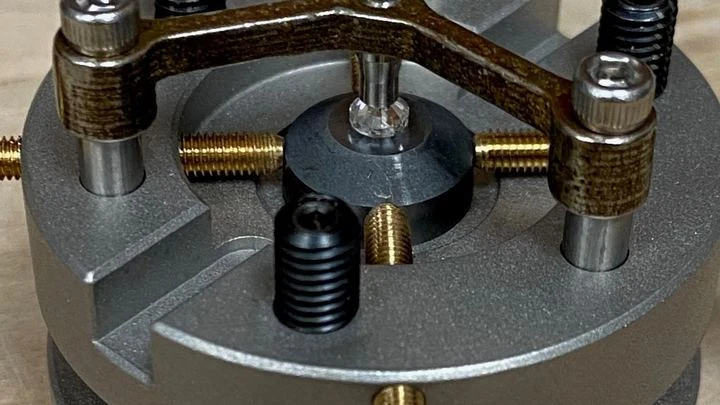
In a diamond anvil cell, pressure squeezes a material as if it were buried hundreds of kilometers deep inside the Earth. Inside this chamber, tiny diamond sensors, color centers, respond to microwaves and report on the magnetic fields and temperatures around them.
The Moon is not just a rocky sphere, but a giant bell. Passing through it, gravitational waves cause it to vibrate almost imperceptibly. This tremor was predicted by Einstein, and Weber was the first to try to hear it with Earth-based detectors.
The Moon is not just a satellite; it is a potential gravitational bell. When massive bodies collide, spacetime shudders, and that shudder, gravitational waves, makes everything in their path vibrate.
At a distance of 8.58 megaparsecs, the spiral galaxy M51 spins its arms, while the VLA radio telescope in its most extended configuration observes it with a resolution of 0.16×0.14 arcseconds. That is like spotting a coin on the surface of the Moon from Earth.