Mini

Dark Blizzard on the Edge of the Abyss: How Invisible Particles Ignite Stars
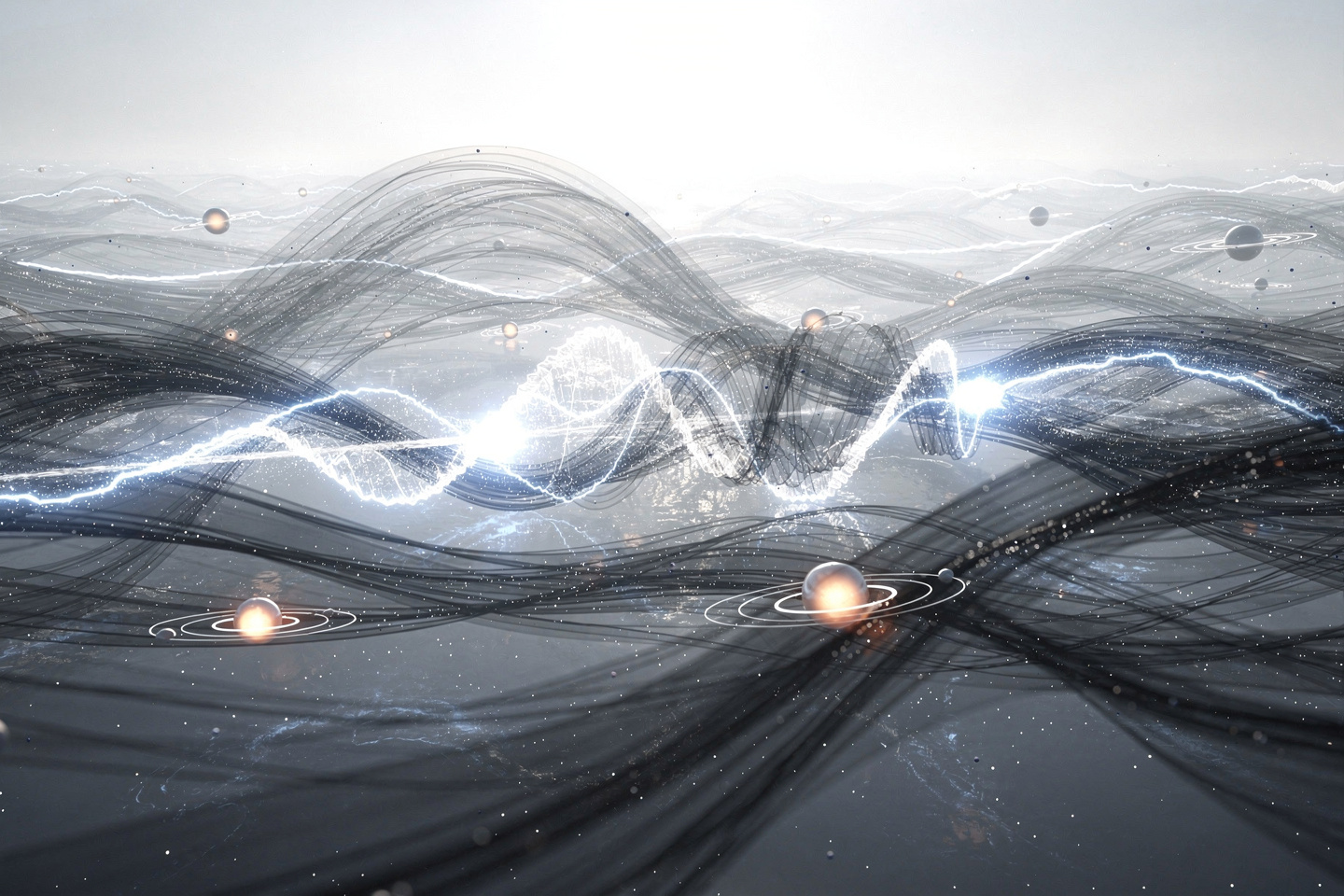
Original: "Dark matter energy exchange in stars orbiting supermassive black holes"
arXiv:2607.00840v2 · 2026-07-01 · CC BY · ⏱ 1 min · HEP Phenomenology High Energy
At the heart of the Milky Way, a star races through a swarm of dark 'snowflakes,' and their elastic impacts can rival its own fire.
Links in the knowledge graph 1

At the center of the Milky Way, star S4714 every 12 years dives into the black hole's vicinity, accelerating to 8% of light speed. There, an invisible squall awaits: dark matter particles, compressed by gravity into an incredibly dense 'snowdrift,' bombard the searing plasma. If the snowflake particles are heavy, they stoke the stellar fire; if light, they cool it. This dance of energies could give birth to dark stars, whose light is fed not by fusion but by the blows of an unseen swarm.

🎯 Star S4714 flies through periastron at 24,000 km/s—nearly 8% of light speed. If an airplane flew that fast, the trip from Earth to the Moon would take 16 seconds.

🎬 Such 'dark stars' have long stirred science fiction writers—from the sentient ocean in Stanisław Lem's 'Solaris,' whose properties defied ordinary physics, to episodes of 'Star Trek' where dark matter served as a power source for propulsion.

m_{\rm crit} \approx \frac{3 k_B T}{v_{\star}^2}
When the incoming particle's kinetic energy is greater than the thermal energy of the star's protons, the collisions heat the plasma; otherwise, the energy is carried away.
L_{\rm sat} = \frac{\pi}{2} f_{\rm peri} \frac{R_{\star}^2}{c^2} \rho_{\chi} v_{\rm peri}^3
Geometric limit above which even an infinite scattering cross section won't increase energy transfer.
Scientists
Christian DopplerD. B. McLaughlinDidier QuelozMichel MayorR. A. RossiterStephen Hawking
Tags
dark matter black hole galaxy speed of light hydrogen Standard Model Sun entropy
Laws
second law of thermodynamicsDoppler effectHawking radiationgravitational lensingprinciple of constancy of the speed of lightNoether's theorem
Original: arXiv:2607.00840v2 · CC BY · bridge42worlds