Dark Matter Heats Stars Near Black Holes: A New Path to Dark Stars ✛ ✎
Context
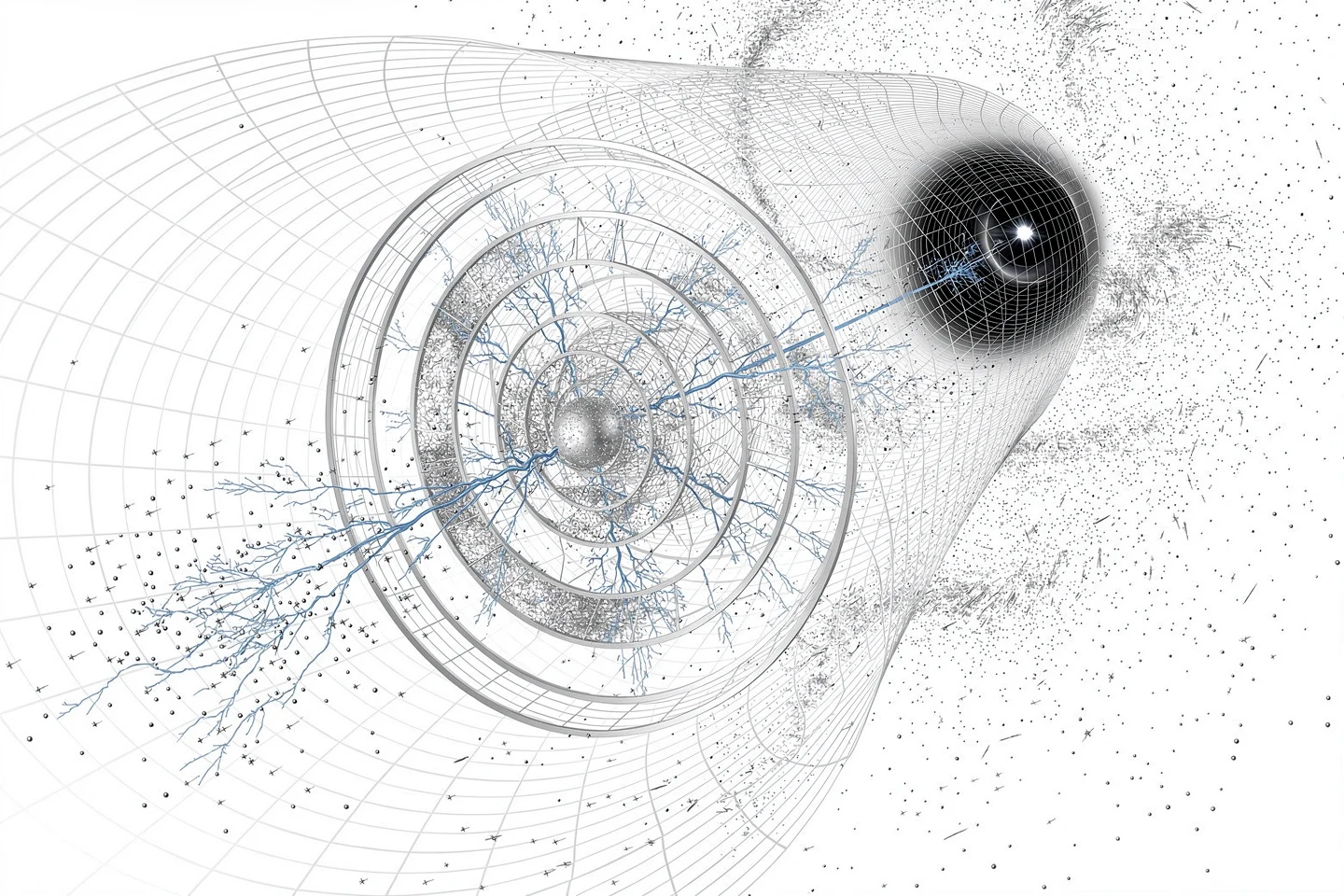
The supermassive black hole at the center of our Milky Way is an ideal laboratory for testing theories of gravity and particle physics. The discovery of stars on tight orbits, such as S4714, whose speed at pericenter reaches eight percent of the speed of light, allows probing the distribution of dark matter under extreme conditions. As early as Vera Rubin showed, galaxies are shrouded in invisible mass, but its concentration around supermassive black holes remains a mystery. The adiabatic growth of a black hole can create density 'spikes' of dark matter, increasing its concentration by hundreds of millions of times — and it's precisely through these that S4714 flies.
Methods
The authors used two approaches: analytical and Monte Carlo. In the analytical model, the orbit-averaged energy exchange rate from elastic scattering of dark matter particles on protons (hydrogen nuclei) and electrons inside the star was computed. Dark matter density profiles were used: the standard Navarro–Frenk–White profile and one with an adiabatic spike predicted by Schwarzschild (whose metric describes black holes). The Monte Carlo simulation tracked individual particle tracks through the star, accounting for realistic temperature and density profiles from the stellar evolution code MESA, including capture and evaporation of light particles. This allowed precise determination of the transition between heating and cooling.
Results
For a density spike with index γ=1, the energy exchange reaches solar luminosity (L☉≈3.8×$10^{26}$ W) at a scattering cross-section σ~$10^{-36}$ cm² for dark matter masses of $10^{-2}$–10 GeV in the case of proton scattering, and σ~5×$10^{-38}$ cm² for masses ≲0.05 MeV in the electron case. These cross-sections lie in the region predicted by freeze-in scenarios and do not contradict current direct detection limits (LZ, XENON1T). Notably, the mechanism yields both heating and cooling: for particles lighter than ~0.4 MeV, the star loses energy, cooling down. The Monte Carlo confirmed the analytics but revealed a smoother transition around the critical mass. Without a density spike, the effect is four orders of magnitude weaker.
Implications
This discovery offers a fundamentally new path to creating 'dark stars'—objects whose evolution is governed by heating from dark matter rather than nuclear reactions. Unlike predictions of the Standard Model, where dark matter does not interact with ordinary matter, here we see a direct energetic influence. The mechanism works for any dark matter model, including asymmetric dark matter where particles and antiparticles do not annihilate, a point noted in the works of Chandrasekhar on stellar dynamics. The results turn S4714 into a unique particle detector, sensitive to parameters inaccessible to Earth-based laboratories.
Future development
Observational tests will require high-precision astrometry and multi-epoch photometry of S-stars to isolate the contribution of dark matter against the star's intrinsic variability. If spikes survive stellar relaxation, similar effects can be sought in other galaxies, such as NGC 1068, where accretion onto the black hole could be enhanced by dark matter heating. It is also promising to incorporate the energy exchange rate into stellar evolution codes to obtain robust constraints on the cross-section.
Impact
The work bridges particle physics, black hole astrophysics, and observational astronomy, opening a new window into the study of light dark matter. It directly impacts the interpretation of data on stellar populations in galactic centers and the design of future experiments to search for dark matter particles.
Next steps
Next steps include numerical simulations of stellar evolution incorporating heating from dark matter for various density profiles, as well as extended analysis of other S-stars—S2 and S4716—to break the degeneracy between dark matter parameters and astrophysical uncertainties.
Key open problems
The study directly connects two fundamental puzzles: the nature of dark matter and the role of entropy in the evolution of compact objects. If density spikes exist, they act as gravitational concentrators, turning ordinary stars into particle detectors. The question of spike survival under dynamical heating is part of the broader problem of feedback between dark and baryonic matter, which is crucial for cosmology.
The knowledge machine's view
This section is addressed to the author of the paper and their colleagues. Neighbouring works were found by meaning-based search across our archive, not by word overlap. We do not review: we show the field around the work.
What the work does
The authors calculated the energy exchange between dark matter and the star S4714, which passes close to the supermassive black hole at the center of the Galaxy. Using analytics and Monte Carlo methods, they showed that with an adiabatic dark matter density spike, the star's heating can reach solar luminosity for scattering cross-sections not excluded by direct searches. They also found a cooling regime for light particles and the possibility of the star transitioning to a "dark" state.
Where its strength is
The work combines the detailed stellar model MESA with calculations of dark matter interactions, allowing for a quantitative assessment of observable effects for the specific object S4714. This turns the star into a potential dark matter detector, sensitive to parameters inaccessible to ground-based experiments.
Where it could go next
- It might be interesting to compare the obtained constraints with results from simulations of dark matter dynamics near the black hole, including gravitational slingshot effects, to refine the density profile and, consequently, the heating rate.based on: Gravitational Slingshot: How Black Holes Accelerate Dark Matter arXiv:2606.30724
- A related approach treats neutron stars as dark matter detectors; perhaps some methods for estimating signal and background could be transferred to the case of ordinary stars near the galactic center.based on: Neutron Stars as Dark Matter Detectors arXiv:2604.21652
- It would be interesting to see how dark matter heating affects stellar evolution and the formation of dark stars in the early Universe, potentially linking your results to cosmological scenarios.based on: Dark Stars: Cradle of Giant Black Holes arXiv:2511.08578
Worth trying
- Investigate how the heating rate changes when accounting for inelastic interactions or dark matter annihilation inside the star.
- Assess whether the heating of S4714 could be detected through changes in its luminosity or spectrum in the near-infrared with future telescopes.
- Consider other stars with tight orbits (e.g., S2, S62) and compare predictions for different dark matter density profiles.
Nearby works in our archive
- The Invisible Ocean Ignites Dark Starssimilarity 0.70
- Invisible Conductors of Galactic Diskssimilarity 0.69
- A Black Hole in a Fur Hatsimilarity 0.68
- Gravitational Slingshot: How Black Holes Accelerate Dark Mattersimilarity 0.68
- Neutron Stars as Dark Matter Detectorssimilarity 0.67
- Dark Stars: Cradle of Giant Black Holessimilarity 0.67
The archive is crowded around this work: 8 reviews nearby, closest at 0.70. This ground is well walked — and there is plenty to compare against.
Interestingly, the star S4714 passes its pericenter in just a few Earth days, moving at 24,000 km/s — nearly 8% of the speed of light. If an airplane had that speed, it would fly from Earth to the Moon in 16 seconds!
The idea of stars powered by dark matter resonates with the concept of 'dark stars' in science fiction, such as in Stanislaw Lem's novel 'Solaris', where the ocean exhibited properties inexplicable by ordinary physics. One can also recall episodes of 'Star Trek' where dark matter energy was used to propel ships.
Key numbers
- speed of S4714 at pericenter: 24,000 km/s (~8% of the speed of light)
- distance to the black hole at pericenter: 12.6 AU (roughly the orbit of Saturn)
- star's luminosity: 17.5 solar luminosities
- critical dark matter mass: about 0.4 MeV
- characteristic scattering cross-section: 10-36 cm² (proton) and 5×10-38 cm² (electron)