Dark Blizzard on the Edge of the Abyss: How Invisible Particles Ignite Stars ✛ ✎
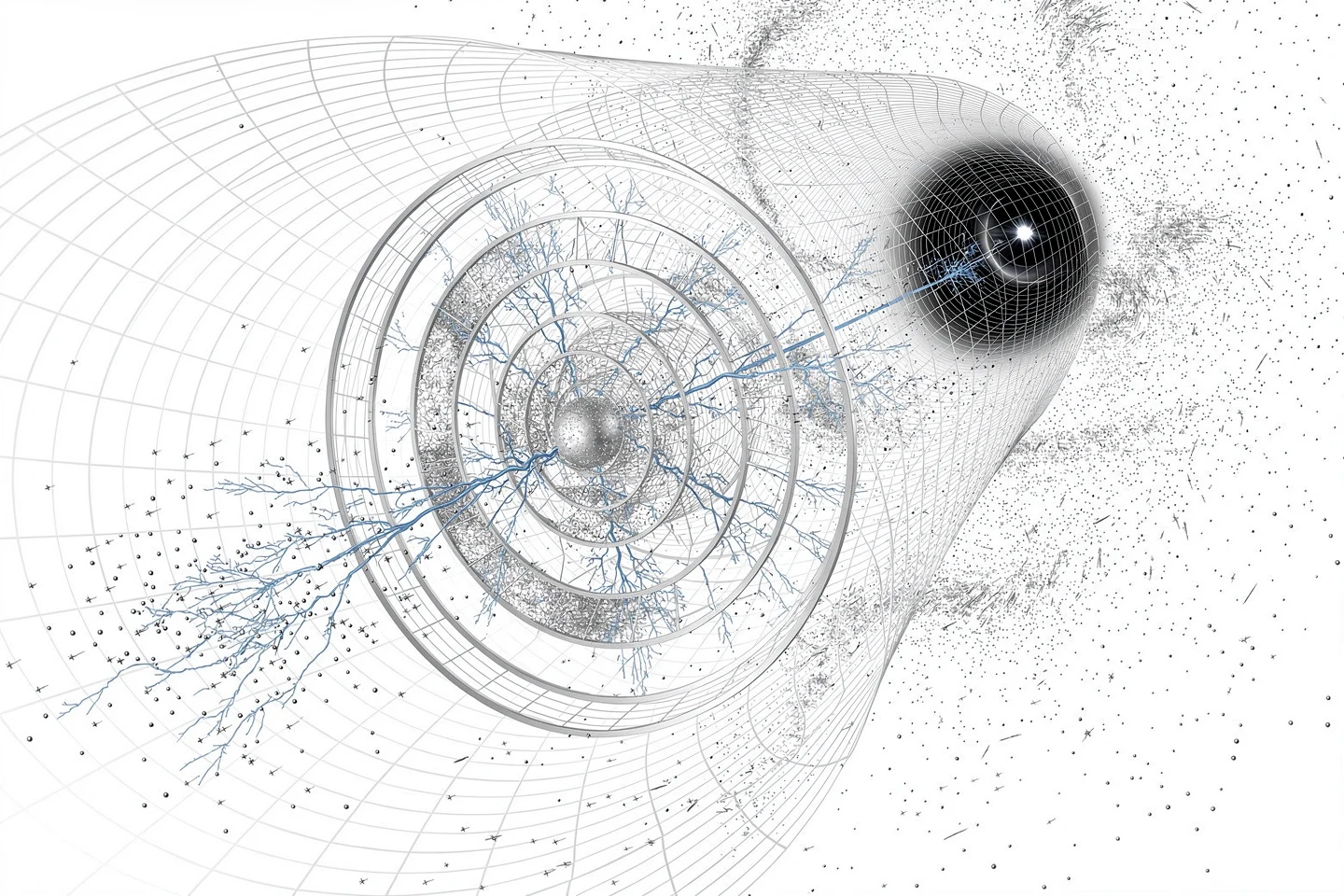
At the center of the Milky Way, where the supermassive black hole Sagittarius A* reigns supreme (its metric first derived by Karl Schwarzschild), star S4714 makes a dizzying voyage. Every twelve years it dives to the event horizon at the distance of Saturn's orbit, accelerating at the point of closest approach to eight percent of the speed of light—24,000 kilometers per second. But it's not only the hole's gravity testing its strength. According to calculations, in this abyss of space lurks an invisible storm — an adiabatic spike in the density of dark matter, amplified a hundred millionfold by the black hole's slow growth. The star tears through it like a torch through a dark blizzard, and the snowflake particles bombard every cell of its body.
These collisions themselves, elastic scattering off protons (hydrogen nuclei) and electrons, do not destroy the particles, but they transfer energy. If the snowflake is heavy (more precisely, its kinetic energy exceeds the thermal energy of the star's protons), it plunges into the plasma, heating it. If the snowflake is too light, it gets accelerated by the hot environment and carries energy away. The threshold mass separating heating from cooling is described by an elegant formula that puts the star's thermal motion on one side of the scales against the energy of the incoming visitors. For S4714, the critical boundary lies at about 0.4 MeV — hundreds of times lighter than an electron.
The researchers calculated the effect in two extreme cases: with and without the adiabatic spike. The difference was staggering. If the dark matter density smoothly declines according to the standard profile, as predicted by the work of Vera Rubin and cosmological simulations, the heating is negligible. But once the black hole gathers a clump around itself, the transferred power skyrockets to values comparable to S4714's total luminosity (17.5 solar luminosities). Moreover, the necessary scattering cross sections turn out to be within reach: ~$10^{-36}$ cm² for scattering off protons and ~5×$10^{-38}$ cm² for electrons. Earth-based detectors like LZ or XENON1T are currently silent on these quantities, but they don't exclude them either, as if leaving a loophole for the invisible.
This mechanism doesn't need dark matter annihilation — simple heat exchange is enough. That means it works even for asymmetric models, where particles and anti-particles don't destroy each other. Unlike the Standard Model, which doesn't predict elastic interactions, here a real communication channel emerges. In essence, S4714 becomes a giant bolometer, measuring the dark matter flux in regions beyond the reach of any laboratory instrument. A ghostly hope arises: perhaps the evolution of such stars will follow the path of 'dark stars,' whose burning is fueled not by thermonuclear reactions but by impacts of invisible clumps. Long ago, Subrahmanyan Chandrasekhar pondered the dynamical influence of external fields on stellar structures, but no one imagined that dark matter would play that role. The next steps are clear: high-precision photometry of S-stars to tease out the heating signal, and incorporating these processes into stellar evolution codes. Perhaps it's at the heart of our Galaxy that we will first see the invisible become visible, and then the entropy of the dark sector will speak to us in the language of ordinary light.
Star S4714 flies through periastron at 24,000 km/s — nearly 8% of light speed. If an airplane flew that fast, the trip from Earth to the Moon would take 16 seconds.
Such 'dark stars' have long stirred science fiction writers — from the sentient ocean in Stanisław Lem's 'Solaris,' whose properties defied ordinary physics, to episodes of 'Star Trek' where dark matter served as a power source for propulsion.