Invisible Heating: How Dark Matter Warms Stars ✛ ✎
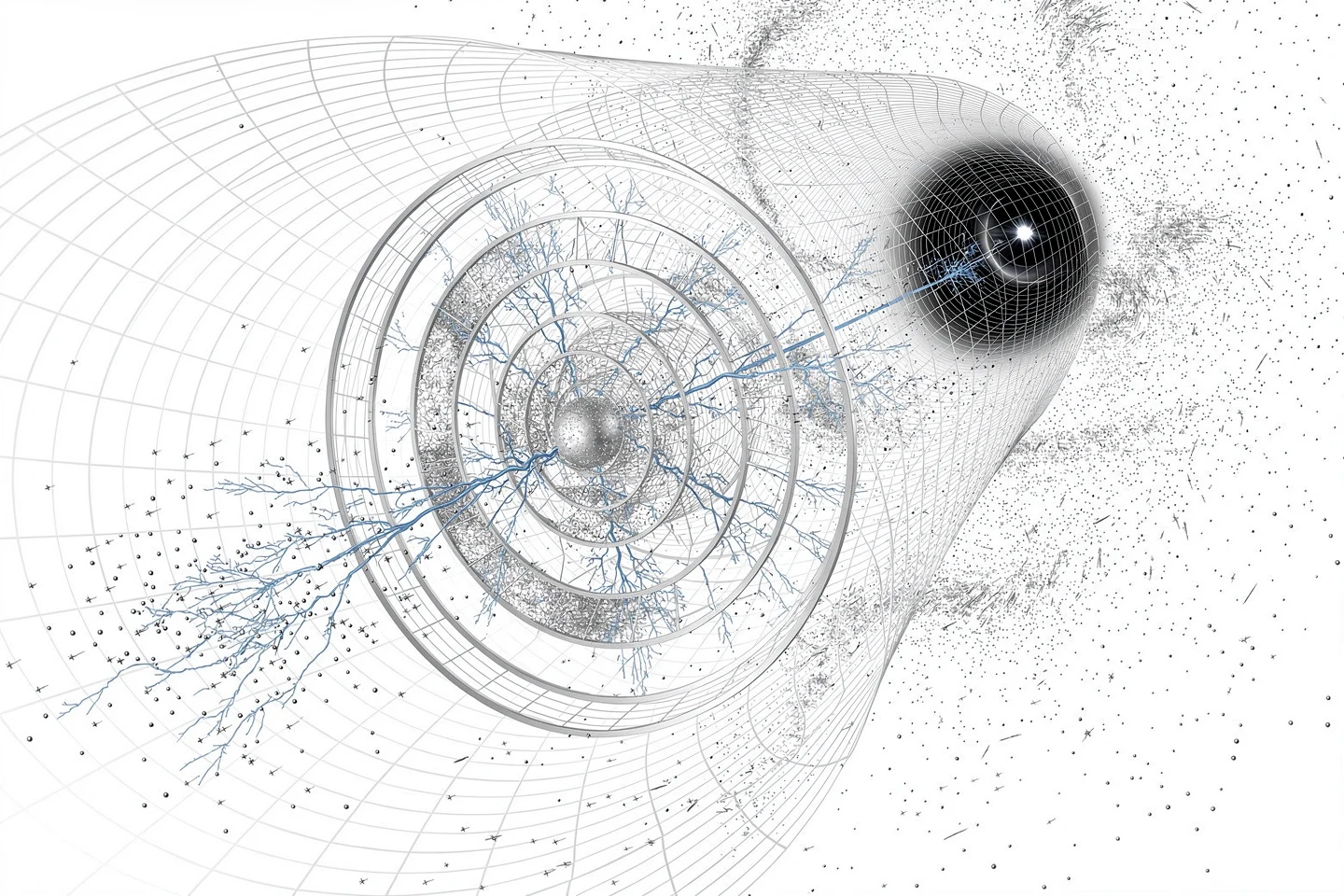
At the center of our Milky Way hides a supermassive black hole — a cosmic heavyweight millions of times more massive than the Sun. Stars whiz around it at breakneck speeds. One of them, S4714, accelerates to nearly eight percent of the speed of light — faster than any human-made spacecraft. As it flies so close, it smashes into a dense cloud of dark matter — the mysterious substance that emits no light but governs galaxies with its gravity. Back in the last century, Vera Rubin showed that without such an invisible hand, galaxies would simply fly apart.
Imagine a speedboat racing across a lake littered with billions of lightweight plastic balls. Each impact is barely noticeable, but if there are countless collisions, the hull gradually heats up. A similar process occurs in the star: dark matter particles slam into the hydrogen nuclei and electrons that make up its hot plasma. The black hole's monstrous gravity (whose behavior was described by Karl Schwarzschild) scoops dark matter into a dense cocoon — hundreds of millions of times denser than the galactic average. Calculations show that the total energy from these impacts equals the star's own luminosity. In other words, dark matter can heat the star just as effectively as its internal fusion furnace. This direct influence breaks the usual expectations of the Standard Model of physics, where dark matter was considered almost intangible.
This discovery offers a new explanation for how 'dark stars' could exist in the universe — glowing objects whose energy comes not from nuclear reactions but from a constant rain of dark matter particles. Such a mechanism doesn't require these particles to annihilate each other upon meeting, meaning it applies to an even broader class of hypothetical particles. In essence, S4714 becomes a vast cosmic trap that tells us what laboratory instruments cannot see. And the influx of heat from dark matter disrupts the star's internal thermal equilibrium and could make it shine in an entirely new way.
If an airplane flew at the speed of star S4714, it would travel from Earth to the Moon in just 16 seconds!
It's a bit reminiscent of science fiction: in Stanisław Lem's novel 'Solaris,' the planet's ocean behaves as if controlled by an incomprehensible force — much like here, dark matter acts as an invisible conductor of stellar life.