The Logical Ouroboros: When a Problem Hides from Itself ✛ ✦
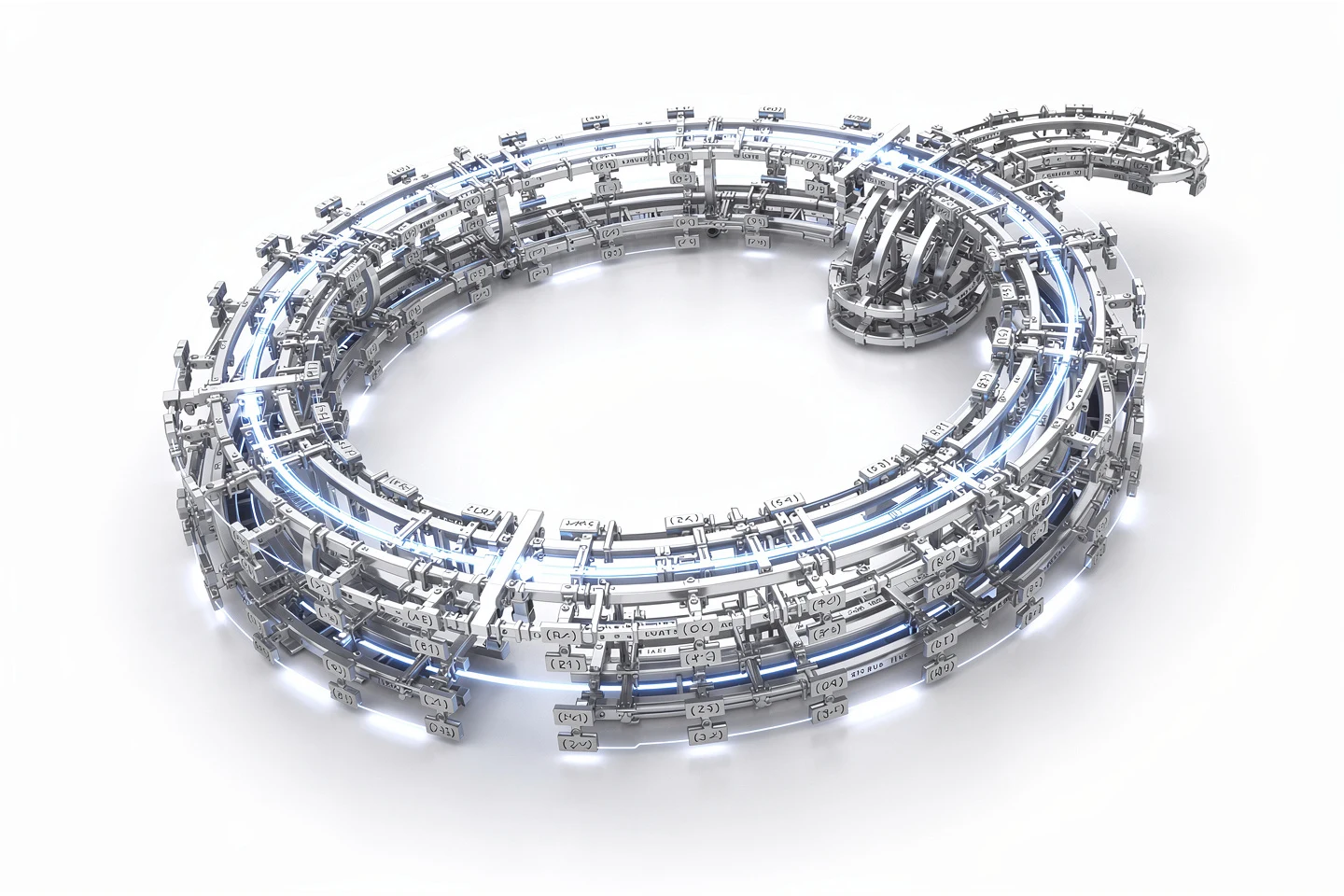
A snake biting its own tail is an ancient symbol of a closed loop. Mathematicians have crafted just such a loop: a logical formula that denies itself. A set of a million conditions has exactly one valid assignment of variables. Now add a tiny tweak: "this sole solution is forbidden." Outwardly the formula hasn't changed, but inside it is empty — the answer has vanished. And no glance at a small part will spot the trap.
To prove the contradiction, you have to try almost every combination. The number of steps explodes, like 2 to the power N. For a million variables, that's more than atoms in the visible universe.
Quantum computers and Peter Shor's algorithm speed up the search, but they don't cancel its exponential growth. Machine Learning, numerical simulation, Stochastic modeling — all hit a wall: the collective behavior of the system cannot be reduced to simple rules. Even all the quantum information is powerless.
Thus the logical ouroboros closes the circle. The information deficit, entropy, is built into the very nature of the problem. It's not a technical stumbling block but a fundamental limit, like in Gödel's incompleteness theorem. The snake swallowing its tail reminds us: you can't grasp the global truth by staring at fragments.
In 1956, Kurt Gödel asked a dying John von Neumann whether logical formulas could be checked quickly. He never got an answer. Now we know: the key lies in the very incompleteness that Gödel had discovered earlier.
The same self-reference that Douglas Hofstadter in "Gödel, Escher, Bach" called a "strange loop" and the key to consciousness now draws a boundary for artificial intelligence.