The Logical Ouroboros: When K-SAT Denies Itself ✛ ✦
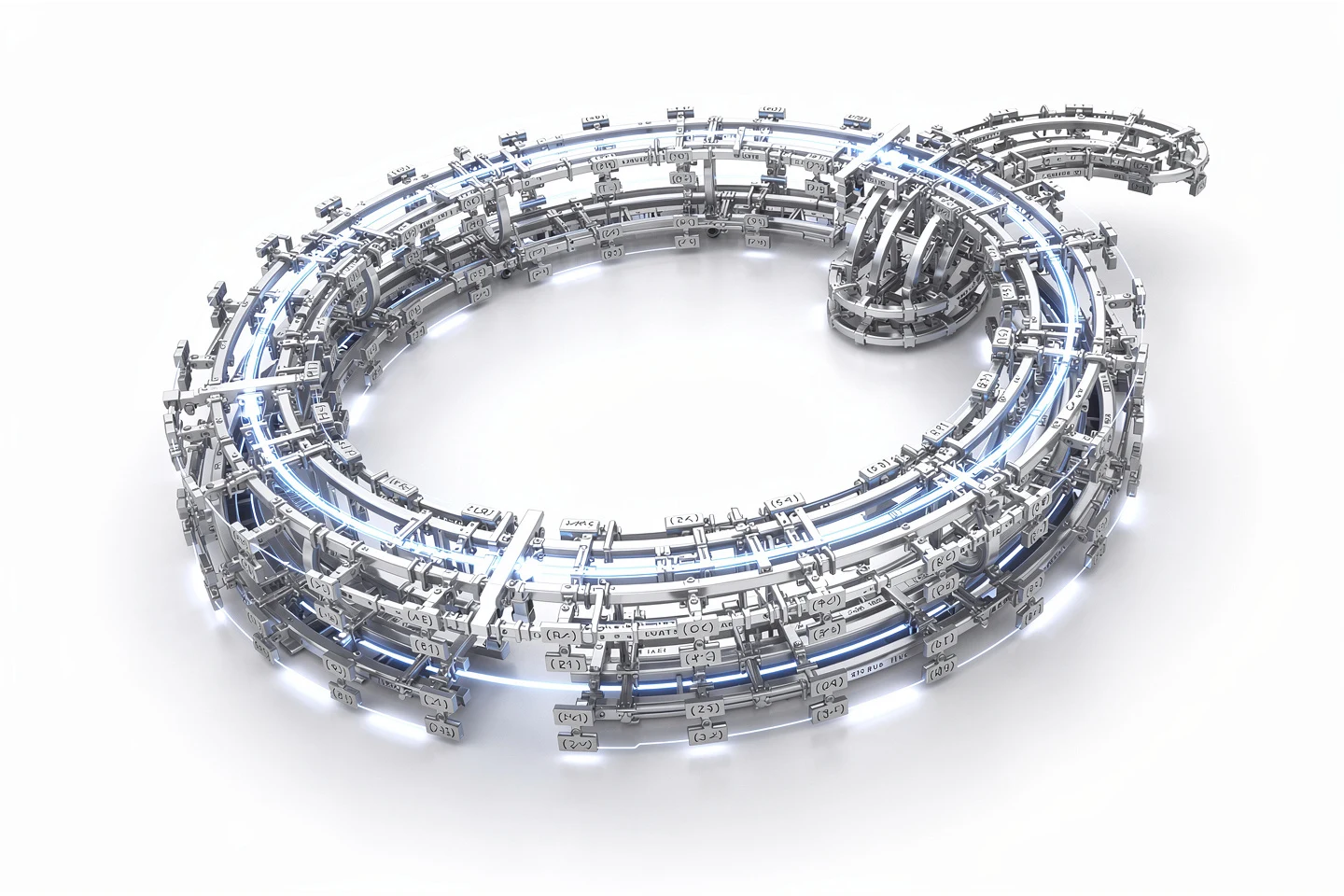
Fall 1956. Kurt Gödel puts pen to paper, drafting a question for the dying John von Neumann: Can the satisfiability of a Boolean formula be checked faster than brute-force trial and error? The answer comes 69 years later, and it turns out to be the bite of the logical ouroboros, the mythical serpent that devours its own tail.
The serpent is born from randomness. An ensemble of K-SAT formulas (the satisfiability problem for logical expressions) is built like this: each variable is a node, each clause (a logical OR of variables or their negations) a link in the chain. With clause width K ~ 20 for a million variables (N=$10^6$) and a critical density of clauses, the number of satisfying assignments follows a Poisson distribution. This is the statistics of rare events, like raindrops hitting a sidewalk. With a probability of about 37%, formulas with exactly one solution arise. And here’s the pivotal step: the authors swap one innocuous clause for a “killer” clause that forbids this single solution. The twin formula, outwardly identical, becomes unsatisfiable. The serpent swallows its tail.
A local observer, seeing only a fragment of the formula (up to $N^c$ clauses, c<1), cannot tell the satisfiable serpent from its dead twin. This blindness is by necessity. Structural irreducibility turns computational hardness into an information deficit. In the language of algorithmic information, any algorithm limited to a window of t = $N^{1-δ}$ clauses is doomed to have Kolmogorov complexity $$ K(A) \ge \Omega($N^{1-\delta}$) $$ The minimal program length in bits is exponentially large. Hence the width barrier for resolution: any proof of unsatisfiability balloons to exp(Ω($N^{1-2δ}$)) steps. As δ → 0+, this number approaches $2^N$—the barrier dictated by the Strong Exponential Time Hypothesis (SETH). The ouroboros’s tail meets its head: local blindness demands exponential insight.
This work redefines the nature of complexity. The classic P ≠ NP question, framed in terms of language classes, gives way to a more subtle distinction: the gap between truth and provability within a finite system. Complexity turns out to be not a property of the problem but a logical necessity. It explains the failure of decades of assaults: the very formulation of the question lies beyond the horizon of local syntactic deduction. For quantum computing, the limit is absolute — unlike Shor’s algorithm for factoring, which exploits hidden periodicity, SAT has no such loophole. Today’s neural network models, operating on local statistical compressions, hit the same wall of insufficient information. Exact numerical simulation of such formulas demands exponential resources. The collective behavior of clauses in the ensemble triggers a phase transition impervious to local analysis.
Sixty-nine years after Gödel’s letter, computational complexity reveals its true face — not a clock-speed race but the inescapable shadow of the logical ouroboros. The question closed in on itself, like a serpent biting its tail: the answer is rooted in the same incompleteness as the 1931 theorem. A local procedure can never certify a global truth. And that is not a weakness but a fundamental law.
In 1956, Kurt Gödel sent John von Neumann a letter asking about the complexity of the satisfiability problem — long before Cook proved its NP-completeness. Von Neumann, already terminally ill, never replied. Only now does it become clear: the answer is rooted in the very incompleteness Gödel had discovered 25 years earlier.
Douglas Hofstadter, in “Gödel, Escher, Bach,” called self-reference a “strange loop” that spawns consciousness. This work shows: the same loop, built into a Boolean formula, births an insurmountable computational hardness, and perhaps outlines the fundamental boundaries for artificial intelligence.