Entropy is a measure of disorder. Imagine a child's room: when toys are neatly arranged on shelves, entropy is low. But after a fun game, everything is scattered, and you can only restore order by making an effort. In the Universe, entropy always increases.
History
Rudolf Clausius introduced the term "entropy" in 1865, formulating the second law. Ludwig Boltzmann in the 1870s linked entropy with probability, proposing the formula S = k log W. The thought experiment of "Maxwell's demon" (1867) stimulated research into the connection between entropy and information, culminating in the works of Leo Szilard (1929) and Shannon (1948). In the 1970s, Jacob Bekenstein suggested that black holes have entropy proportional to the horizon area, and Stephen Hawking in 1974 confirmed this by discovering Hawking radiation and derived the exact formula.
How it works
According to the second law of thermodynamics, the total entropy of a closed system grows, approaching a maximum. This is due to the statistical nature of molecular motion: the system evolves from less probable states to more probable ones. Entropy is related to free energy: F = U - TS. In quantum theory, von Neumann entropy S(ρ) = -Tr(ρ ln ρ) generalizes the classical concept. For black holes, the Bekenstein-Hawking entropy S_BH = (k A)/(4 l_P²), where A is the horizon area, and l_P is the Planck length. This formula hints at the holographic principle.
Fun fact
If you shuffle a deck of cards, you will never return it to its original order just by shaking. That's entropy in action - disorder wins.
A superconductor is a material in which electricity flows without loss, like water through a perfectly smooth pipe. But if you squeeze it slightly, like a spring, its properties change. Scientists have long wanted to measure how much heat such a compressed material absorbs, but instruments couldn't fit into the cramped setup. Now they've devised a way around this obstacle.
A quantum state is like mountain weather: it changes with every glance. To estimate its uncertainty, physicists make copies and take measurements. Each copy is a thermometer that breaks after use.
A magnetic field usually acts like a strict traffic cop: for heat to turn into electricity, it must stand across the road. If the field lies along the heat flow, the effect disappears, or so it was believed for decades.
Scientists took an ultra-thin film of a magnetic oxide — a material where electron spins are aligned in a plane, like compass needles on a table.
An ordinary random network is like a road map: to connect four cities with a complex interchange, you need to lay down many highways. In the quantum world, things are different.
The universe is like dough rising in an oven. Galaxies are flying apart, and the rate of this expansion is accelerating. To explain the accelerating expansion, cosmologists came up with dark energy — a mysterious force that pushes space apart from within. The standard recipe, called Lambda-CDM, works pretty well, but it has its inconsistencies.
A magnet is slowly heated. At low temperatures, all its microscopic arrow-like spins point in the same direction: that's order. At high temperatures, they dart about chaotically. But there is a special point, the critical point, where order is just about to vanish and the system freezes in indecision.
A conventional computer computes by shuttling electric charges along wires. But can you compute with heat? A network of pipes carrying hot and cold water can perform simple logic operations if the pipes are connected in the right order.
Quantum entanglement, when particles are linked so that the state of one instantly determines the state of another, is usually a fragile thing. Any disturbance, like heat, tears the connection apart. But what if the observer's own time is limited?
Stare long enough into the night sky, and sooner or later your gaze hits a blackness beyond which nothing is visible. This is not just a distant fence: it is the edge of the universe accessible to us, the cosmic horizon. Light from more distant stars simply hasn't had time to reach us.
A black hole is not just a dark spot in space. It has a temperature, and it radiates. It has entropy — a measure of hidden information encoded on its horizon's surface, like a pattern on a soap bubble.
A quantum particle moves in a circle, passing through several stations. At each station, something happens to it — for example, its properties change slightly. After completing a full circle, the particle returns, but its state is no longer exactly what it was at the start.
In the quantum world, a fact becomes objective when its value is imprinted on many independent fragments of the environment, like a notice posted on hundreds of bulletin boards across the city. Each copy alone adds no new information, but it changes the rules of the game for anyone trying to erase that information.
A black hole has three laws, just like an ideal gas. The first: energy is conserved. The second: the horizon area never decreases. And the third, the most finicky, demands that at zero temperature the entropy (a measure of disorder) tend to zero or a universal constant.
A fussy thermometer shows different temperatures depending on who is looking at it. A black hole behaves much the same way: its thermal properties, entropy and temperature, depend on how we describe the information hidden inside.
Newton gave us a world where bodies move in a void and clocks tick the same for everyone. For three centuries, this picture worked flawlessly. But it relies on many invisible props: absolute position, the 'up-down' direction, and a single rhythm of time for the entire universe. We have never measured these directly — only through the relations between objects.
Quantum mechanics allows a particle to be in two places at once: this is called superposition. But massive objects, like a dust grain or a ball, don't behave that way: their position is always definite. Why? One idea is that it's an illusion: the particle is constantly "jittering" from random environmental kicks, and the blurred picture averages out.
Drop an ice cube into a glass of water — within a minute it melts, and the temperature evens out. That's thermal equilibrium in action: energy spreads evenly, and the system "forgets" its past.
In a crystal, heat travels on waves. Atoms vibrate, and these vibrations, called phonons, carry energy from the hot edge to the cold one. For a long time, it was believed that if phonons hit resonance (their frequencies exactly match) and can exchange energy, heat would flow like an avalanche. It turns out that's not the case.
The quantum world is a constant buzz of activity. Particles exchange energy, become entangled, and influence one another. You'd think that the more players in this game, the harder it is to predict the outcome. But sometimes, order emerges from chaos.
Physicists took a close look at the SYK model — a mathematical playground for studying quantum chaos.
A quantum computer is like a fragile snowflake resting on a warm palm. The slightest breath of heat or a gentle vibration, and it turns into a droplet. To keep the snowflake alive, you constantly adjust it, restoring its original shape. That's quantum error correction.
The wind carries pollen, and each grain moves as if on its own. But once the air swirls into a vortex, the pollen trajectories can no longer be separated: they are tangled. This is roughly how electrons behave in a strange metal: their motion is so strongly coupled to soft fluctuations of the medium that the usual particle carriers disappear.
A cup of hot coffee sometimes freezes faster than cold tap water. This paradox, known as the Mpemba effect, has long been considered a curiosity of classical physics. Now its quantum counterpart has helped test and tune quantum processors — devices that may one day power supercomputers.
A pendulum weighing a few grains of sand swings on a hair-thin glass fiber. Its motions are so faint that the thermal jostling of air molecules seems like a hurricane. Yet such a pendulum is the key to witnessing quantum wonders in the world of large objects.
Usually, light does not turn an insulator into a conductor: that requires powerful laser pulses that break the material's structure. But in twisted bilayer graphene at the magic angle, things are different.
The quantum vacuum is not empty: it is permeated by entanglement linking distant regions. But when physicists tried to compute this entanglement, it turned out to be infinite. The culprit: particles with very low energy that can smear out over arbitrarily large volumes. They are like waves with no shores to contain them.
Imagine a factory capable of producing a million parts per hour, yet it only makes a hundred. That's roughly how our Universe behaves when viewed through the lens of entropy — a measure of disorder that, according to physics, must only increase. The main "machines" of this factory are supermassive black holes.
In 1973, Jacob Bekenstein proposed that black hole possess entropy — a measure of hidden disorder. Stephen Hawking later confirmed this by adding radiation, but the microscopic origin of entropy remained obscure.
A climber on a ridge notices something strange: the horizon around them seems to freeze. No forward, no backward — only emptiness and silence. This is roughly the picture painted by new calculations for our Universe. At some point in its expansion, the invisible boundary, the future event horizon, stopped growing.
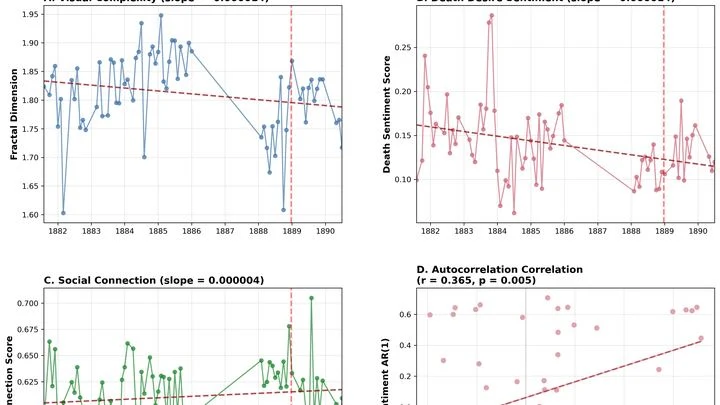
In 1888, Vincent van Gogh cut off his earlobe. Biographers and psychiatrists have been trying to explain this act ever since. But mathematicians approached the mystery differently: they measured how the artist's feelings changed in his letters and how the 'nervousness' of his brushstrokes grew, and they saw a clear signal of impending trouble.
A swing that gets pushed usually swings and quickly calms down.
Ordinary electric current heats up wires — anyone who has touched a phone charger knows that. But there's another kind of current: instead of electrons rushing in a crowd in one direction, they spin in sync, like figure skaters in a pairs routine. This coordinated rotation is called a spin current, and it produces almost no heat.
A solid under a microscope is not a monolith at all. In glass, polymer, or solidified resin, atoms are arranged randomly, and as a result, the material's properties vary from point to point. On large scales, we are used to describing them with smooth fields, like temperature or pressure in a room. But when you zoom down to a few atomic layers, that smoothness disappears.
The quantum world is full of strange connections. Two particles can become “entangled”: the state of one instantly affects the other, even if they are kilometers apart. But how do you know if they are truly entangled? It's like a ball of yarn: at first glance, you can't tell whether it's a single tangled ball or just a mess of loose threads.
Empty space is not as empty as it seems. According to quantum theory, the vacuum is filled with particles that constantly pop in and out of existence. In 1976, physicist Bill Unruh showed that if an observer moves with acceleration, this 'quantum soup' turns into a genuinely warm bath for them — the Unruh effect.
In a glass of water, oil gathers into droplets: that's equilibrium separation dictated by chemistry. But there are systems where order arises not from rest but from a constant flow of energy.
A runner trails the leader but crosses the finish line first. In the quantum world, such a trick was pulled off by a system of nuclear spins — tiny magnetic arrows of carbon-13 atoms in a diamond. This is a manifestation of the Mpemba effect: a state initially farther from equilibrium settles down faster than one closer to rest.
Cut a spin chain, and particles without an energy gap appear at the edges. They are called zero modes, and they live only at the boundary. Previously, they were counted using complex topological invariants, but now there is a simpler way.
A light ray skimming along a black hole horizon doesn't just move: it carries heat and information. Physicists have long suspected that the geometry of such rays obeys strict rules, but the details remained blurry. The new work turns these rules into a sharp inequality.
Imagine a pot of boiling water. Toss in a handful of pasta, and it quickly overcooks and clumps into a sticky mess. But in a huge restaurant kettle where the pasta floats freely, each piece stays separate.
A dengue outbreak is like a wildfire in the savanna: the flames leap from person to person via mosquito bites. Authorities respond in two ways — sending the sick to hospitals and spraying chemicals that kill the insects. But in reality, a hospital has only a limited number of beds, and fogging doesn't start immediately; it begins only when the number of infected crosses a critical mark.