Information Theory math.IT

12 articles

Alias for cs.IT — theoretical and experimental aspects of information theory and coding.

articles

Information Theory2025-11-281 minarXiv:2511.23406express
Quantum Entanglement Speeds Up Secret Computations
When a computer can't handle multiplying two giant tables of numbers, they're sliced into tiny pieces and sent out to dozens of helper servers. For secret data, mathematical tricks are used so the helpers never see the original numbers. Usually, the higher the secrecy, the more servers you need. The authors proposed using a special quantum property — entanglement between the servers.

How the Brain Passes Thoughts
Imagine an office where employees exchange notes. When there are few tasks, everyone works independently. But when an urgent order arrives, some departments start actively messaging others, and the overall work becomes more coordinated. That's roughly how the brain behaves when we try to hold several things in mind at once.
Quantum Physics2026-03-312 minarXiv:2603.30023express
Atoms Catch Radio Signals Without Extra Noise
A conventional radio receiver compares the incoming wave with a reference to extract information from it. Rubidium atoms can do this differently: they themselves act as both antenna and detector. But until now, they required an additional radio signal to set a reference point. The new scheme does without it.
Quantum Physics2026-04-081 minarXiv:2604.07639express
Quantum Rainbow: How a Tiny Computer Sorts Mountains of Data
A classical computer sorts data like a person meticulously sifting through grains of sand of different colors. A quantum processor takes its cue from nature: just as a droplet of water splits sunlight into a rainbow, revealing all hues at once, this new algorithm instantly grasps the essence of vast information arrays.
Consciousness as a Thermostat Glitch
A thermostat keeps a room at 20 degrees. Open a window in winter, and it kicks on the heat to restore equilibrium. The brain does something similar: it constantly predicts what will happen a moment ahead and corrects itself when wrong. That's how it learns.
Quantum Physics2026-05-111 minarXiv:2605.10943express
Heat-Resistant Quantum Memory
A quantum bit (qubit) is a delicate thing. Even a little heat destroys it, like a random nudge topples a crystal wine glass. To protect this fragile information, physicists have built a three-dimensional quantum structure resembling a Russian doll.
Information Theory2026-05-281 minarXiv:2605.30331express
The Mystery of Disorder: Why Entropy Follows Strict Rules
Entropy is a measure of disorder. Two shuffled decks of cards, dumped into one pile, won’t become more chaotic than the sum of their individual disorders. This is the rule of subadditivity: the whole is no more chaotic than its parts.
The Logical Ouroboros: When K-SAT Denies Itself
Fall 1956. Kurt Gödel puts pen to paper, drafting a question for the dying John von Neumann: Can the satisfiability of a Boolean formula be checked faster than brute-force trial and error? The answer comes 69 years later, and it turns out to be the bite of the logical ouroboros, the mythical serpent that devours its own tail. The serpent is born from randomness.
Information Theory2026-07-141 minarXiv:2607.13119express
Dual Hints: How Smartphones Learn Without Glitches
When you type 'salad' and the keyboard suggests 'Caesar,' behind the scenes millions of phones are jointly learning to predict words. They share not your messages, but only improvements to the common algorithm, like a coach who sends athletes only the tweaks to the plan: 'add 5 push-ups to yesterday’s routine.' Information entropy helps send only unexpected, valuable updates.
Information Theory2026-07-141 minarXiv:2607.13160express
Smart Mirrors for Signals: Balancing Energy and Speed
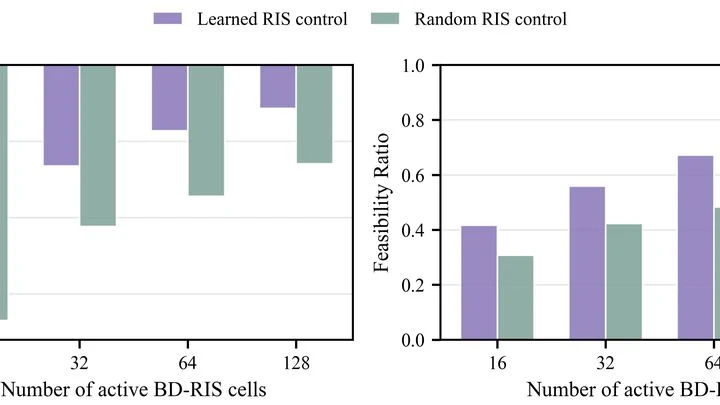
Radio waves from a smartphone, traveling at the speed of light, easily reflect off walls and corners, losing strength. Smart surfaces are programmable mirrors: they catch the scattered signal and redirect it precisely to its target, like a deft magician making a beam bypass obstacles.
Signal Processing2026-07-151 minarXiv:2607.13417express
Radio Waves Paint Portraits of Obstacles: How Diffraction and Fundamental Limits Reveal Hidden Objects
When a radio wave encounters a building in its path, it doesn't just reflect or get absorbed: it bends around it, much like ocean waves flowing around a rock, leaving calm water behind. In radiophysics, this phenomenon creates a radio shadow — a complex pattern of zones where the signal is amplified or attenuated, which scientists call a radio portrait.
Information Theory2026-07-161 minarXiv:2607.14834express
Compressing networks: when roads become points
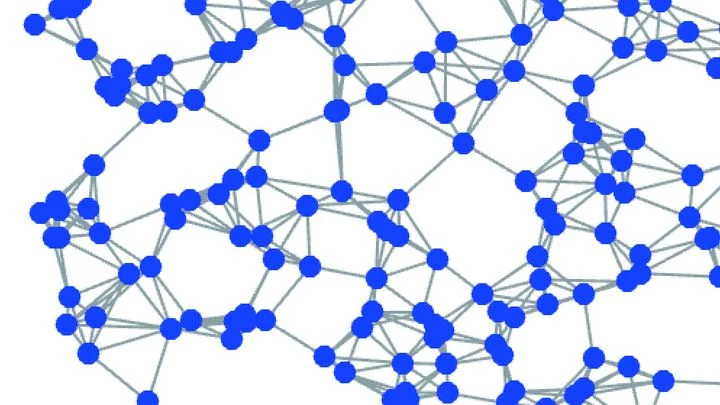
An ordinary road map with traffic is a heap of numbers. Sending them all as is takes too long. But you can reduce the volume without losing the gist. Researchers found a clever solution: first redraw the map so that streets become points, and intersections become bridges between these points.