Mini

Waltz of Invisible Moons: The First Spectroscopic Find
Original: "Planetary-Mass Exosatellite Detected Around the Substellar Companion of a Star"
arXiv:2607.05193v1 · 2026-07-06 · CC BY · ⏱ 1 min · Exoplanets Stellar
The radial velocity method has allowed us to hear the gravitational song of massive satellites around a brown dwarf, opening a new chapter in the search for exomoons.
Links in the knowledge graph 1

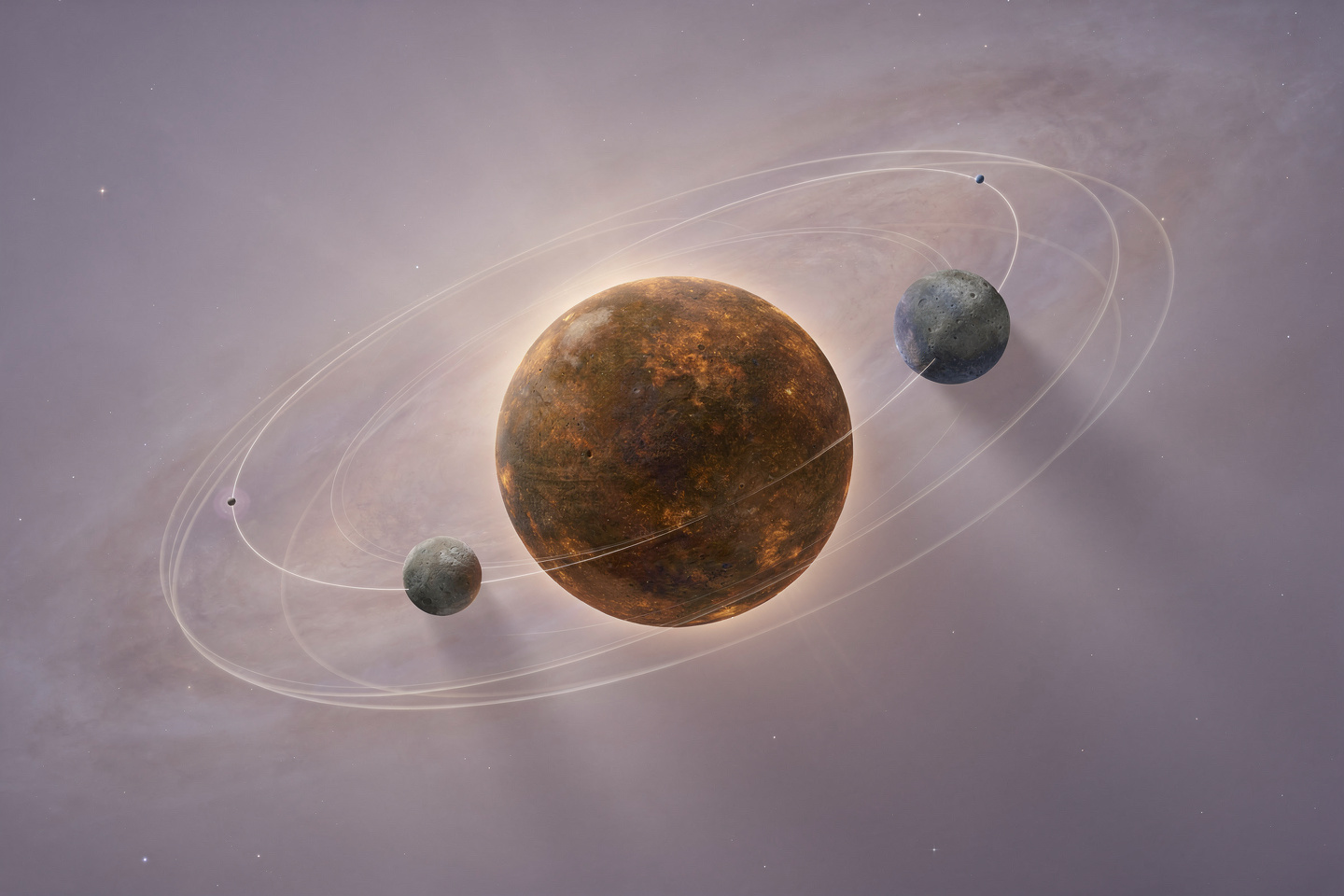
The brown dwarf CD-35 B rings like a tuning fork: its spectral lines quiver in time with the gravitational kicks of two invisible moons. The main one is nearly a whole Jupiter. These moons outweigh planets, and they dance in resonance like Galilean satellites. In the future, we might see them directly and even catch gravitational waves from their mergers. The cosmos has once again proven stranger than fiction.

🎯 The brown dwarf CD-35 B, at 37 Jupiter masses, almost qualifies as a star, and its giant moon is heavier than many known exoplanets.

🎬 Fantastical ocean moons — Pandora from 'Avatar' or Clarke's icy Europa — were long the stuff of imagination. Now we've caught real massive exomoons for the first time, making dreams of life on them a bit more tangible.

v_r = c \frac{\Delta \lambda}{\lambda}
v_r is the radial velocity, c is the speed of light, Δλ/λ is the relative shift in wavelength. From the line shift we measure the source's velocity.
P^2 = \frac{4\pi^2 a^3}{G(M+m)}
P is the orbital period, a is the semi-major axis, G is the gravitational constant, M and m are the masses of the bodies. Knowing the period and distance, we can estimate masses.
Scientists
Alan GuthAndrei LindeGeorges LemaîtreJames PeeblesAdam RiessBrian Schmidt
Tags
spectroscopy transit method speed of light hydrogen gravitational waves Hubble Space Telescope big bang
Laws
Friedmann equationsHubble's lawDoppler effectprinciple of constancy of the speed of lightKepler's third lawmass–energy equivalence
Original: arXiv:2607.05193v1 · CC BY · bridge42worlds